Medicare now pays ASCs for lumbar fusion, but coverage alonedoes not fill a spine schedule. CMS added posterior lumbar interbody fusion(CPT 22630 and 22633) to the ASC covered procedures list for 2026, as part of168 orthopedic codes added this year.¹ For 2027, CMS proposes 618 more ASCadditions as it continues to phase out the inpatient-only list.² Next year'sproposal centers on other specialties, but the direction is clear.
For ASC administrators, OR leaders, and spine implant OEMs,the open question is no longer whether outpatient spine surgery is allowed. Itis whether every case can start on time, start the same way, and run the sameway at every site. Surgeons already bring the skill. This article shows why thehours before the patient arrives, and the instruments prepared in them, decidewhether a spine program scales.
CMS policy keeps widening the outpatient path for spine.Posterior lumbar interbody fusion (PLIF) codes first joined the ASC list in2021, left it the following year, and returned for 2026.¹ Each new code givesmore surgeons a reason to move fusion cases out of the hospital.
The instruments have not followed the same path. Aconventional reusable spine system often ships in multiple containers, withheavy trays and loaner logistics that pass through the vendor, the receivingdock, and sterile processing before the first incision of the day. Eachcontainer adds one more dependency between sterile processing and the OR. Whena loaner set arrives late or a tray comes back incomplete, the case waits, andso does every case behind it.
Many ASCs did not build their sterile processing teamsaround multi-container spine systems. They staffed for arthroscopy, pain, andhand cases, where a few trays cover the procedure.
So the bottleneck forms before the patient enters the room,and the fix belongs there too. Adding staff or rooms does not remove adependency that the instrument model itself creates.
Researchers at the Rothman Institute at Thomas JeffersonUniversity reviewed 7,991 spine surgeries performed from 2005 to 2009. Theymeasured anesthesia-ready time, the period between room entry and incision.When that window ran longer than one hour, the surgical site infection ratereached 4.9 percent. When it stayed under one hour, the rate held at 2.3percent.³ In multivariate analysis, more than one hour of pre-incision roomtime stood as an independent risk factor, alongside the number of levels, ASA score,and a posterior approach.³
The authors recommended taking every possible step beforethe patient enters the room and waiting to open sterile instrumentation untilsurgery can proceed.³ Their reasoning is practical. Opened instruments sitexposed to airborne contamination, room traffic, and direct contact while theteam works through anesthesia, positioning, and neuromonitoring setup.³
The study measured in-room time, not instrument type, and itdoes not show that any kit lowers infection rates. The operational link stillmatters. Tray assembly checks, missing-instrument searches, and countdiscrepancies all compete for minutes inside that same window. A complete,sterile-packed kit that the team verifies before it reaches the room shortensthe list of tasks between room entry and incision. Staff can open it whensurgery is ready, as the authors advise, because nothing on the back table needsassembly or confirmation.
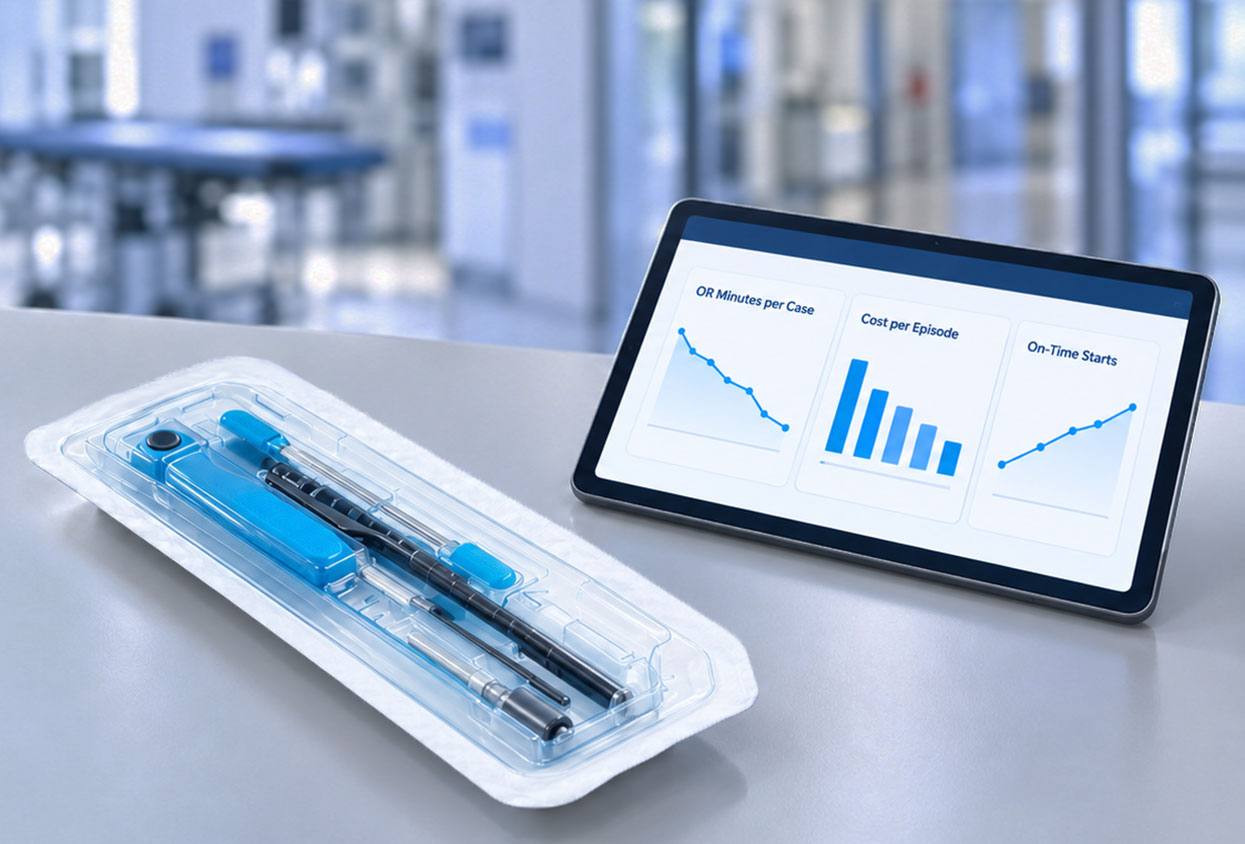
Many finance leaders assume a single-use spine kit costsmore per case. A health technology assessment of lumbar arthrodesis at anorthopedic hospital in Milan, Italy, tested that assumption with activity-basedcosting. The total process cost came to €4,242.6 per case for the disposablepedicle screw instrument kit and €4,279.1 for the reusable kit, a gap under onepercent.⁴ Sterilization alone added €25.7 per case to the reusable process.⁴
The larger differences showed up outside the ledger.Clinicians and staff involved in the assessment scored the disposable kithigher on effectiveness, 4.13 against 3.56, while safety scores showed nostatistically significant difference.⁴ Over a 36-month horizon, theorganizational analysis favored the disposable kit 0.77 to 0.00, with gains inequipment updates, internal processes, and purchasing.⁴ The authors also notethat disposable devices are easier to handle and stock and need nosterilization step.⁴
For ASC finance leaders, the lesson is simple. Unit pricealone hides reprocessing labor, tray handling, and the cost of delays. Thestudy took place in an Italian hospital, so wage rates, sterilization costs,and reimbursement will differ by site. Each ASC can run the same comparisonwith its own numbers before it decides.
Environmental questions now come up in many purchasingreviews, and spine has unusually strong data. A peer-reviewed lifecycleassessment compared a reusable and a single-use instrument and implant set forone-level lumbar fusion. The reusable set filled six boxes holding eleven traysand weighed 45.5 kg. The single-use set weighed 2.0 kg.⁵ Across every impactcategory, the single-use set showed an environmental advantage of roughly 45 to85 percent, and 75 percent on the combined single-score indicator.⁵
The main driver sat in reprocessing. Cleaning and steamsterilization of the reusable set produced up to 90 percent of its greenhousegas emissions.⁵
Two conditions shaped the result, and both belong in anyhonest summary. First, the outcome depends on the sterilization process eachfacility uses. Second, the single-use system came in modular boxes that staffopened only as needed, while the reusable set opened in full before everycase.⁵ The authors themselves warn that simple claims that either reusables ordisposables are always better can lead to wrong decisions.⁵
The proof points above describe a system, not a product.Here is how that system works for each partner.
For spine OEMs, the model is one procedure-specific kit perconstruct, developed, validated, and sterile-packed under one roof. Instrumentspend tracks case volume instead of sitting in loaner sets that circulatebetween accounts. Adding a new ASC becomes a shipping decision rather than aset-allocation negotiation. OEMs that want to explore this can start with the kitdevelopment process.
For ASCs, the model removes the sterile processingdependency for spine instruments. Each kit arrives labeled, lot-traceable, andready to open, which shortens the chain of custody and protects first-casestarts. Teams that have already worked through SPD bottlenecks in orthopedics and spine willrecognize the pattern.
The shared outcome is consistency. The same procedure kitdeploys the same way at every site, so staff learn one setup and repeat it.That repeatability turns outpatient spine surgery into a program that growswith surgeon demand, and the same approach supports efficiency gains in trauma and spine casesbeyond fusion.
Three findings point in the same direction. Pre-incisiontime carries measurable infection risk in spine surgery. Disposable andreusable kits land within one percent of each other on total process cost in aformal assessment. And lifecycle data favors single-use spine sets whensterilization and packaging match the study conditions. Coverage will keepexpanding, and the ASCs and OEMs that remove instrument dependencies now willbe ready for it. Predictable outpatient spine surgery at scale starts with Surgery-Ready™kits, before the patient even enters the room.
ECA Medical works with spine OEMs and ASCs to design,validate, and deliver sterile-packed, procedure-specific kits. See how the Surgery-Ready™procedure kit solution works for OEMs and ASCs, or contactthe ECA team to discuss your spine program.
Yes. For 2026, CMS added posterior lumbar interbody fusioncodes 22630 and 22633 to the ASC covered procedures list. Check the current CMSaddenda for the full list of covered spine codes.
Yes. In a review of 7,991 spine cases, more than one hourbetween room entry and incision carried a 4.9 percent infection rate, comparedwith 2.3 percent for cases under one hour.
Not necessarily. One health technology assessment of lumbararthrodesis found the two within one percent on total process cost, thoughresults vary by site.
A lifecycle study of one-level lumbar fusion sets found a 45to 85 percent environmental advantage for the single-use set, with resultsdependent on the sterilization process and modular packaging.
They supply standardized, procedure-specific kits thatdeploy the same way at every site, which removes loaner logistics and sterileprocessing delays.
● From SPD bottlenecks to box-ready in orthopedics and spine
● Tailored sterile instrument kits for trauma and spine surgery
1. Bosek H. The procedures that shiftedto the outpatient model in 2026. Becker's ASC Review. September 4, 2026. https://www.beckersasc.com/legal-regulatory-issues/the-procedures-that-shifted-to-the-outpatient-model-in-2026/
2. Centers for Medicare & MedicaidServices. Medicare program: hospital outpatient prospective payment andambulatory surgical center payment systems; CY 2027 proposed rule (CMS-1850-P).Fed Regist. 2026;91(128):41734-42032. July 7, 2026. https://www.federalregister.gov/d/2026-13656
3. Radcliff KE, Rasouli MR, Neusner A,Kepler CK, Albert TJ, Rihn JA, Hilibrand AS, Vaccaro AR. Preoperative delay ofmore than 1 hour increases the risk of surgical site infection. Spine.2013;38(15):1318-1323.
4. Ottardi C, Damonti A, Porazzi E,Foglia E, Ferrario L, Villa T, Aimar E, Brayda-Bruno M, Galbusera F. Acomparative analysis of a disposable and a reusable pedicle screw instrumentkit for lumbar arthrodesis: integrating HTA and MCDA. Health Econ Rev.2017;7:17.
5. Leiden A, Cerdas F, Noriega D, Beyerlein J,Herrmann C. Life cycle assessment of a disposable and a reusable surgeryinstrument set for spinal fusion surgeries. Resour Conserv Recycl.2020;156:104704.