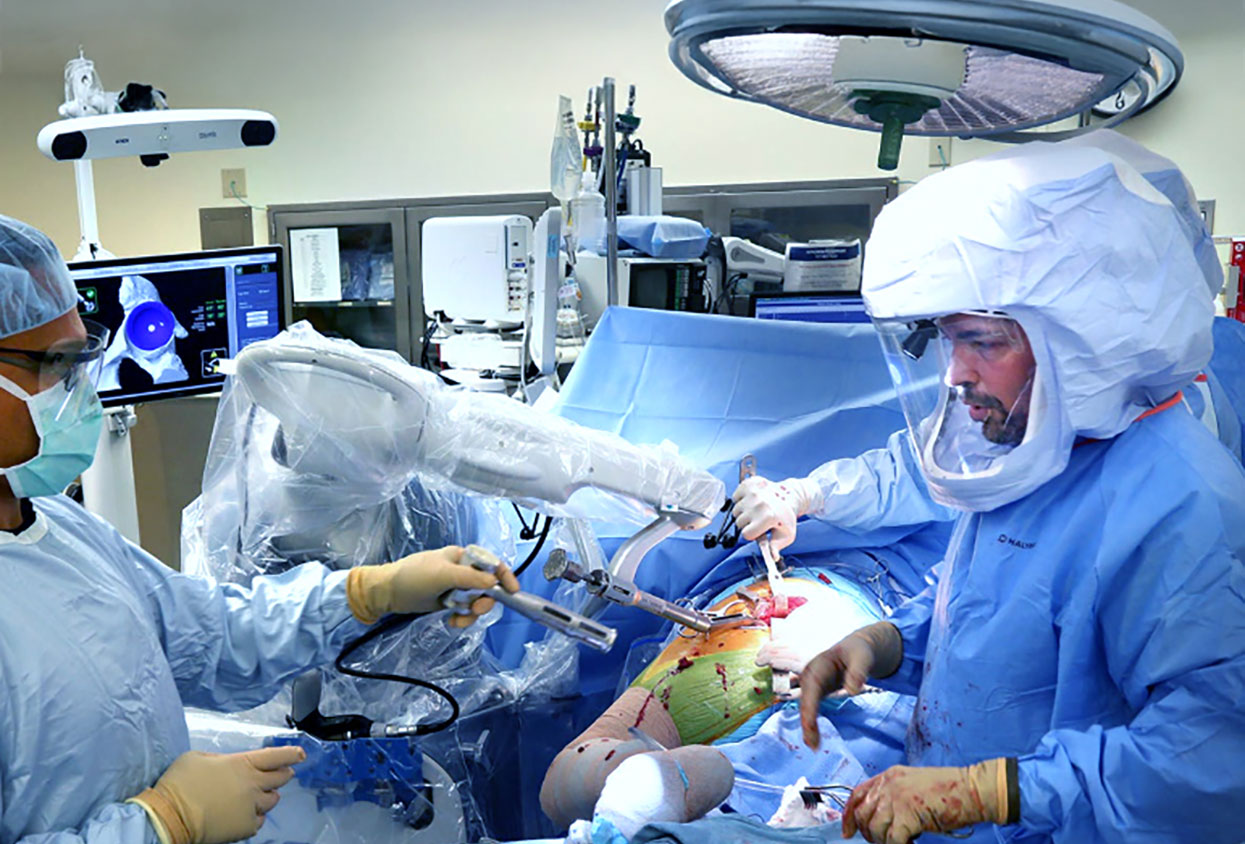
Bundled payments hold hospitals accountable for the cost and results of a whole episode of care, and that pressure now flows to implant OEMs. Hospitals judge an OEM by how its products affect the episode, including outcomes the OEM does not fully control once a device reaches the operating room. Surgery-Ready™ kits give OEMs one of the few levers they control directly: the instrument system around the implant. This article shows how that lever works inside a value-based healthcare (VBHC) contract.
Under value-based healthcare, payers reward cost and outcome performance across an episode instead of paying for each service. Medicare’s Comprehensive Care for Joint Replacement (CJR) model applied that approach to joint replacement from 2016 through 2024, holding hospitals accountable for cost and quality across the full episode.1 Its successors continue the approach. The Transforming Episode Accountability Model (TEAM), launched in January 2026, covers spinal fusion and joint replacement at selected hospitals,2 and the expanded CJR-X model becomes mandatory for most hospitals in January 2028.3 For an OEM, preferred-vendor status now depends on how its products perform inside that episode, not only on implant merit or unit price.
A hospital that is renegotiating vendor relationships under a bundled contract evaluates every component of the procedure against its contribution to episode cost and outcome. The instrument system sits inside that review, whether or not the OEM has data ready for it.
This turns the old sales conversation upside down. The buyer no longer asks only whether the implant performs. It asks whether the OEM's whole system helps the episode finish on time, on budget, and without complications.
Extra OR time, added sterilization, a delayed start, or a complication all hit the episode's finances, and they hit the standing of every vendor involved. Instrument variables once treated as the hospital's operating problem now carry financial weight for the OEM that supplies them.
That reframes the instrument tray. It now becomes a variable inside a shared financial outcome, and hospitals now ask which vendor relationships help them hit targets and which add risk.
Reprocessed instruments carry documented risks: contamination, corrosion, and deterioration that add indirect costs through delays, cancellations, and infection treatment.4 Few value-based healthcare models price those risks explicitly, so they surface later as unexplained cost overruns.
A hospital modeling expected episode cost may never assign a probability to a reprocessing-related delay. The risk sits quietly inside the model until a cost overrun exposes it. An OEM that raises the issue first, with data, shapes how the contract prices it.
An economic simulation of a single-use pedicle screw system found average combined savings of €1,415 per case, including tray sterilization, along with 21 minutes of OR time saved per case.4 A separate model for total knee replacement found a median saving of $994 per case, and with 12-hour OR days, up to 51 percent of operating days gained room for an added procedure.5
Both results map onto what a bundled contract measures: cost per episode and throughput. Neither depends on just the price of the implant or the instrument, which is why the argument lands differently with a hospital value-analysis committee than a pricing discussion does.
Note the sources of those savings. Tray sterilization, turnover time, and OR minutes drive most of them, and those are the same costs a bundled payment leaves with the hospital. An OEM that reduces them improves the hospital's margin inside the contract.
Simple arithmetic shows why OEMs care. In the knee replacement model, single-use instruments saved a median $994 per case, and 95 percent of the 200 simulated sites saved at least $500 per case.5 The model’s 500 cases per site were a simulation sample, not an annual volume, so apply those figures to a facility’s own caseload. A hypothetical site performing 300 knee replacements a year would land between roughly $150,000 at the $500 floor and $298,000 at the median. That is illustrative arithmetic on modeled results, not a promise, and each facility’s own labor and sterilization costs will move it up or down.
Still, the exercise gives an OEM a starting number for a first value-based healthcare conversation, and a reason to build the site-specific version.
Throughput matters in bundled arrangements too. Steady turnover lets a facility fit more cases into the same OR hours, and it depends on cases finishing without instrument-related delay.
Outpatient migration raises the stakes. Many bundled procedures now move to ASCs, which often run leaner sterile processing operations than hospitals, so the savings above count for more where schedules run close to capacity.
This applies directly to the value-based healthcare contracts now spreading to outpatient sites. A late or incomplete tray costs an ASC a larger share of its day than it costs a hospital with spare rooms. That is why turnover belongs in the contract model from day one.
Shared accountability works better with a solutions partner than with a vendor and a transactional instrument sale. When the instrument system becomes a joint responsibility, every party measures the same variables. At renewal, an OEM that can show its instrument system's effect on episode cost holds a stronger position than one relying on implant data alone.
OEMs can also package that data. Site-specific projections of OR time saved and reprocessing risk removed persuade a value-analysis committee more than industry averages, and a consistent dataset adapts across several health systems.
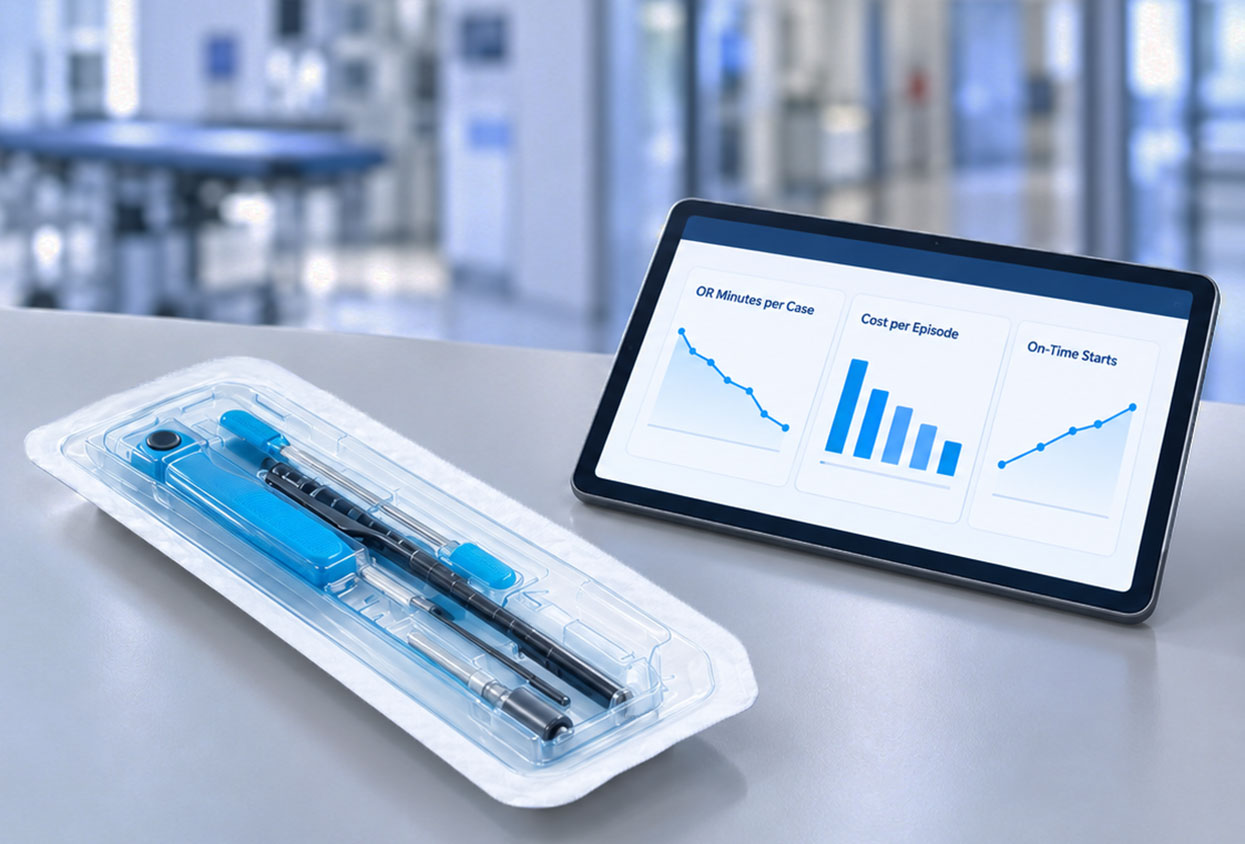
Alignment starts with a shared scorecard. Agree on the handful of measures that matter, such as OR minutes per case, delay rate, and instrument-related events, then review them together each quarter. Shared numbers turn a supplier relationship into a working partnership. Small, regular reviews prevent large surprises at renewal.
Contract terms rarely name reprocessing. Yet a contaminated tray, a corroded instrument, or a late set can add a delay, a cancellation, or an infection to the episode. Those events land in the total cost line, and an OEM's share of the result depends on how often they occur.
Sterile, single-use kits reduce those chances at the source. The OEM cannot control every hospital's sterile processing, but it can control what arrives in the single-use Surgery-Ready™ procedural kit.
Before entering a bundled contract, model reprocessing-related delay and complication rates at every participating site, per-case OR time under the current instrument system, and the reliability of that system beyond the flagship location. Start with the data on hand, use the published ranges above as conservative benchmarks, and refine the estimate as real episode results arrive. Then bring a surgery-ready system to the negotiation as a lever, not a variable you inherit.
Revisit the model at renewal. In CMS bundled models, actual episode spending is compared with a target price after each performance year, so by renewal the hospital has real results to hold your projections against.2 Share the model with your hospital partner so both sides work from one set of assumptions.
Value-based healthcare contracting keeps expanding beyond its original joint replacement pilots. TEAM already includes spinal fusion,2 so orthopedic and spine OEMs with several procedure lines should expect instrument accountability to follow. An OEM that builds surgery-ready capability now enters each new bundled relationship with a record to show instead of a promise to make.
Early movers also learn faster. Each contract produces site data that improves the next proposal, and that record becomes an asset competitors cannot copy quickly.
Surgery-Ready™ kits give implant OEMs a practical way to influence the cost and time variables that value-based healthcare contracts hold them to. The documented per-case savings and OR time reductions land on the metrics that decide whether a bundled arrangement succeeds. As more procedures move into bundles, that instrument system will matter as much as the implant design.
ECA Medical supports implant OEMs through the shift to value-based and bundled-payment contracting as a Surgery-Ready™ solutions partner, building complete, sterile-packed kits that reduce OR time and reprocessing risk at every participating site. Before your next contract negotiation, contact ECA to build the instrument system into your economic model.
What is value-based healthcare in orthopedic surgery?
It ties payment to cost and outcomes across a full episode of care instead of paying separately for each service or device.
How do bundled payments affect OEMs?
Hospitals carry the financial risk, but they judge OEMs by how their instrument systems affect episode cost and complications, not only by implant price.
Can single-use kits cut costs in a bundled case?
Two published models found per-case savings of about $994 to €1,415, driven by less OR time and less tray sterilization.
Why does turnover time matter?
It affects both cost per episode and case volume, two core metrics in bundled contracts.
How should OEMs prepare?
Model current reprocessing delays and costs at each site, then test whether a surgery-ready system reduces them.
1. Centers for Medicare & Medicaid Services. Comprehensive Care for Joint Replacement Model. https://www.cms.gov/priorities/innovation/innovation-models/cjr
2. Centers for Medicare & Medicaid Services. TEAM (Transforming Episode Accountability Model). https://www.cms.gov/priorities/innovation/innovation-models/team-model
3. Centers for Medicare & Medicaid Services. CMS announces nationwide expansion of proven joint replacement program [press release]. July 31, 2026. https://www.cms.gov/newsroom/press-releases/cms-news-cms-announces-nationwide-expansion-proven-joint-replacement-program
4. Abdalla Y. Value based healthcare: maximizing efficacy and managing risk with spinal implant technology. Interdiscip Neurosurg. 2020;22:100810. https://doi.org/10.1016/j.inat.2020.100810
5. Goldberg TD, Maltry JA, Ahuja M, Inzana JA. Logistical and economic advantages of sterile-packed, single-use instruments for total knee arthroplasty. J Arthroplasty. 2019;34(9):1876-1883.e2. https://doi.org/10.1016/j.arth.2019.03.011