Orthopedic and spine service lines continue to expand across hospitals and ambulatory surgery centers, with an increasingly aging population, growing demand for minimally invasive techniques, and a shift towards outpatient joint and spine care. As case volumes go up, the capacity within the Sterile Processing Department (SPD) remains almost the same. Some facilities have seen reductions in staffing and resources, further creating an imbalance between surgical demands and reprocessing capability.
This growing tension has become one of the most pressing operational challenges for OR leaders overseeing high-turnover orthopedic and spine programs. The instrument trays used in these specialties are large, layered, and complex. When they return to the SPD at high frequency any slowdown-whether caused by staffing shortages, equipment issues, or unexpected influxes of trays-can ripple directly into the OR. Case delays mount. Surgeons show their frustration. Patients are kept under anesthesia longer. Efficiency declines even when teams are working at full capacity.
For this reason, the rising interest in single-use surgery-ready™instrument kits is growing quickly. It is a strategic response to structural constraints that cannot be resolved with incremental SPD improvements alone: infection prevention pressures are tightening; surgeons increasingly demand predictable instrumentation; and OR administrators cannot afford recurring delays that erode utilization and financial performance.
The purpose of this blog is to help OR leaders determine exactly at what point the transition from reusable tray systems to single-use surgery-ready™ instrument kits becomes operationally, clinically, and financially advantageous in orthopedic and spine procedures. The decision point usually arrives long before leaders realize it-this guide makes those inflection moments clear.
Orthopedic and spine trays are generally considered in the top tier of difficult sets for SPD teams to process. Joint replacement trays have large, heavy, multi-tiered systems. Spine instrumentation often has many small components, cannulated tools, and high-precision instruments that require a very thorough inspection.
For the SPD, this means long decontamination cycles, deep brushing and flushing, and laborious visual inspections. One missed step introduces risk. When several orthopedic and spine rooms are running at the same time, the number of trays requiring fast reprocessing can easily surpasses typical SPD throughput. These bottlenecks are not because the SPD is failing, but because the physical constraints of reusable workflows simply do not scale.
Orthopedic teams often schedule consecutive shoulder arthroscopies, ACL reconstructions, anterior hip procedures, or lumbar decompressions in quick succession. These procedures often require multiple identical sets to be reprocessed quickly and perfectly. Turnover windows in outpatient orthopedics may be as short as 15–20 minutes, thus offering essentially no margin for reprocessing delays.
When trays arrive in the SPD, heavily soiled, or stacked in rapid waves, technicians are immediately pressed into emergency modes: rushed cleaning, fast-track sterilization, or split workflows to keep up with OR demand. These high-pressure conditions increase error risk and place both SPD and OR staff in a cycle that becomes progressively less sustainable.
The national challenge is staffing stability within the SPD. The reprocessing of orthopedic and spine trays requires increased skill levels, but turnover prohibits the continuity of experienced technicians. Newly hired SPD staff require months of training before they can safely reprocess spine and trauma instruments independently. Inconsistent skill levels introduce variation into each stage of the reprocessing cycle: soaking, brushing, assembly, inspection, packaging, and documentation.
When variability intersects with high case volumes and complex sets, errors are more possible.
Every SPD bottleneck eventually is an OR disruption. First-case delays often are directly related to unready trays. Turnover times lengthen when OR staff wait for sterilizers to finish rushed cycles. Most orthopedic and spine service lines have had days when a scheduled procedure could not start because a critical instrument failed to clear reprocessing in time.
Add to this the clinical effects of incomplete trays, missing tools, or degraded instruments, and the operational risk becomes much greater. Every delay adds anesthesia minutes, staff overtime, and decreases surgeon satisfaction. These are not one-time events but systemic consequences of a reusable system that is stretched beyond its capacity.
"Box-ready" describes the defining strength of single-use instrument kits: they come sterile, validated, sealed, and ready for the table. No decontamination. No assembly. No sterilizer cycles. No overnight holding or tracking. With one unboxing, the OR receives a complete, consistent, procedure-specific instrument set.
This eliminates the entire reprocessing chain: transport, cleaning, inspection, reassembly, wrapping, and sterilization. Instead of depending on the Sterile Processing Department SPD readiness, OR teams have direct control over instrument availability by bypassing the most unpredictable component of the surgical workflow.
Surgeons in orthopedics and spine rely on tactile precision and predictable layouts. Even small variabilities in instrumentation or tray setup disrupt the rhythm. Single-use instrument kits deliver stable consistency: identical layout, identical quality, case after case.
This uniformity reduces OR setup time, supports surgeon confidence, and helps eliminate intraoperative surprises associated with worn, missing, or misassembled tools. In specialties where technique and timing directly affect outcomes, the predictability of box-ready systems is a performance advantage.
Every time a reusable instrument is cleaned, handled, or inspected, its sterility and integrity depend upon human accuracy. Due to heavy use, orthopedic and spine instruments are particularly vulnerable to the issues of biofilm retention and damage. Single-use kits eliminate these vulnerabilities. There are no prior patients, no prior cleaning cycles, and no instrument wear that might compromise performance.
The risk of missing or mismatched instruments also falls drastically since the kits arrive sealed, counted, and pre-validated.
As orthopedic and spine trays continue to shift toward single-use systems, SPD teams realize valuable time and resource recoveries. They can redeploy staff to complex specialty sets that must remain reusable and reduce the stress associated with compressed turnover windows.
The breathing room this elimination of reprocessing provides for those selected procedures, during peak orthopedic schedules-especially within high-volume ASCs-improves overall system stability.
Case delays linked to Sterile Processing Department SPD capacity are one of the clearest warning signs. Facilities often see the same patterns:
Each of these outcomes has its hidden costs: lost OR minutes, staffing overtime, decreased throughput, and lower patient satisfaction.
Orthopedic and spine instruments are put through a remarkable amount of mechanical stress. A tool's joints loosen, its edges will dull, and parts will become increasingly hard to clean after constant use over several years. These repairs add up fast. When the costs of repair approach those of replacement, or when breakage starts to impede cases, it is likely time to reconsider whether a reusable system remains cost-effective.
Organizations already under the scrutiny of the Joint Commission or CMS for any reprocessing-related issue tend to increase their vulnerability by having variability within their Sterile Processing Department SPD workflows. In orthopedic and spine instrumentation, complexity is high, which means the margin for error is even thinner. The transition of select cases to single-use instrument kits eases the pressure on compliance by simplifying sterility assurance.
In addition, when Sterile Processing Department SPDs lack seasoned technicians who can safely reprocess orthopedic and spine sets, the error rates increase. Single-use kits minimize dependence on technical reprocessing proficiency, protecting OR teams from skill-related variability.
Uniformity is already lost if surgeons repeatedly report inconsistencies: dull drill bits, mismatched drivers, altered tray layouts. Single-use alternatives restore uniformity and help surgeons maintain consistent technique.
As ASCs introduce total joints or spine fusion programs, reusable systems are often overwhelmed. Rather than building additional sterilization capacity, many organizations adopt box-ready kits to scale safely and quickly.
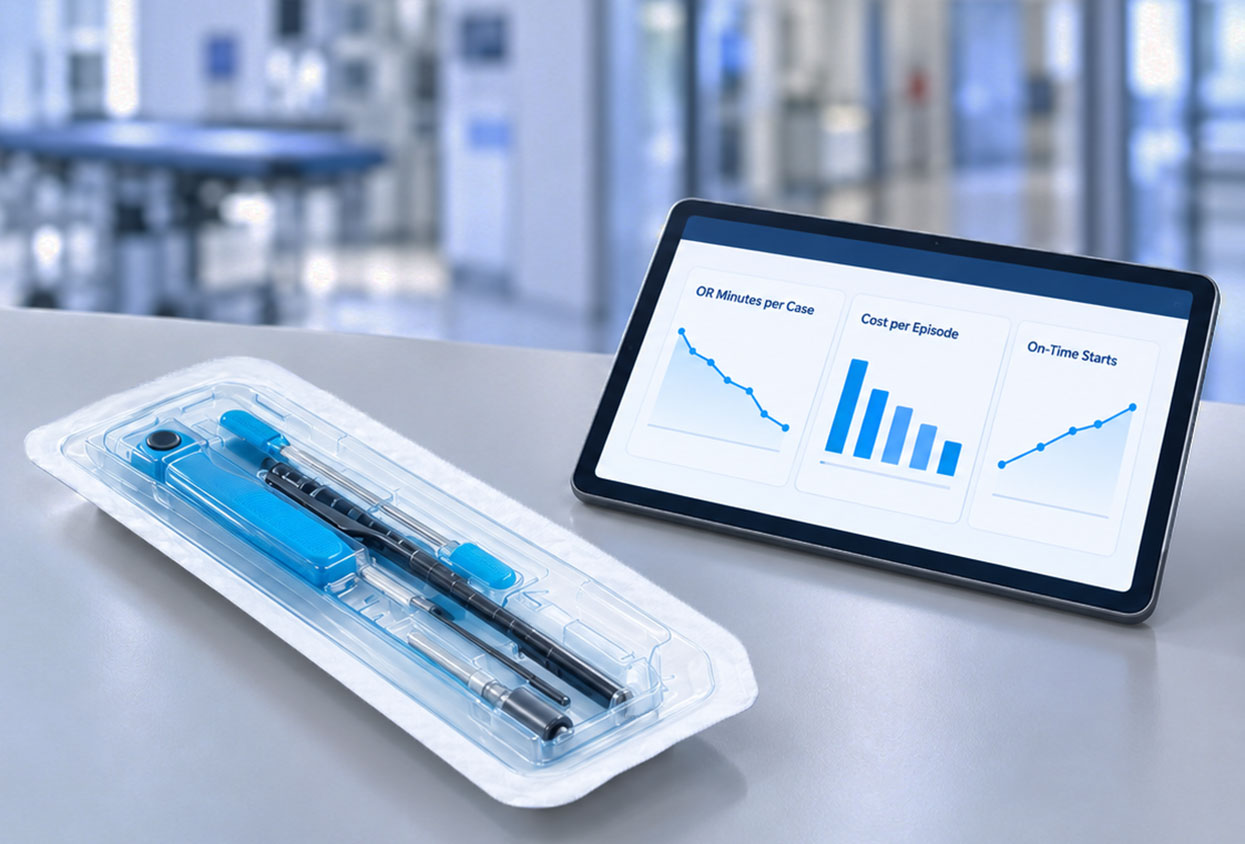
Comparatively, the upfront cost of reusable trays seems much lower than the per-case cost of a single-use kit. However, once hidden costs are factored in, the financial picture looks very different. Reprocessing for orthopedic and spine procedures requires high labor hours, significant water and energy consumption, continuous instrument repairs, and heavy reliance on equipment that requires maintenance or replacement. Single-use kits bypass these costs entirely. The direct cost becomes the total cost.
Predictable case readiness increases OR utilization of the most powerful financial levers within surgical services. The result of eliminating the Sterile Processing Department SPD delay: cases start on time, turnover becomes more predictable, and block time is utilized more wisely.
For those ASCs where profitability is dependent on tightly controlled schedules, this improvement can be decisive.
Better sterility assurance translates to lower infection risk. Predictable instrument performance minimizes the chance of surgical interruptions. Fewer errors mean fewer reportable events, better compliance standing, and lower legal exposure.
Single-use instrument kits provide predictable per-case pricing. In contrast, reusable systems involve variable repair costs, tray replacement costs, and unpredictable equipment downtime. Box-ready solutions preclude capital investments in supplemental sterilization equipment, a consideration of particular importance to space-constrained ASCs.
As reprocessing demand decreases, Sterile Processing Department SPD overtime declines, burnout lessens, and turnover stabilizes. Hospitals and ASCs avoid expanding SPD footprints as orthopedic volume grows. These cumulative operational savings outweigh any instrument price differentials. See for yourself https://www.ecamedical.com/procedure-kits
Knee arthroscopies, shoulder arthroscopies, carpal tunnel releases, and minor trauma cases are ideal early candidates. Their repetitive nature and fast turnover make them heavily dependent on the Sterile Processing Department SPD capacity. Box-ready kits solve real pain points immediately, with very fast ROI.
Spine decompression systems, trauma sets, and fusion instrumentation represent some of the heaviest burdens imposed on Sterile Processing Department SPD teams. Transitioning even some of these sets reduces error rates and stabilizes scheduling.
Procedures that require fine, continuous technique benefit immensely from consistency in instrumentation. When surgeons rely on predictable tactile feedback, single-use solutions minimize performance variation.
The immediate benefits of box-ready systems are derived by smaller ASCs, new orthopedic centers, and facilities that have very limited sterilization equipment. These systems avoid expensive infrastructure upgrades while ensuring reliable instrument availability.
Any transition starts with knowledge of the current state. The leaders go through the times of turnaround, the rates of errors, frequencies of tray repairs, overtime usage, and peak bottlenecks. Orthopedic and spine sets almost always top in contributing to workflow strain.
A focused pilot will allow the OR teams to measure the differences in setup times, surgeon satisfaction, instrument performance, and case predictability. Data from these early tests often reveals improvements many times over expectations. Train OR teams regarding the packaging, opening, and handling of instruments. Single-use systems simplify workflows but require proper training for smooth adoption. Teams get trained in kit layout familiarity, packaging integrity checks, and best practices for integration into existing setups.
Alignment across departments is key. Leaders go over case-based cost structures, delivery expectations, storage needs, and rollout phases. With clear communication, box-ready becomes a strategic initiative rather than a siloed change.
Most organizations expand in stages: starting with high-turnover procedures, then moving into complex sets based on ROI and workflow improvement.
Transitioning to single-use instrument kits in orthopedics and spine involves more than tray replacement; the idea is born from workflow pressure, clinical risk mitigation, and measurable ROI. Sterile Processing Department bottlenecks will not self-correct, and reprocessing infrastructure expansion may not be feasible for many organizations. Box-ready solutions give OR and ASC leaders greater control over case readiness, sterility assurance, and operational stability. ECA Medical helps surgical teams transition to Surgery-Ready solutions™ that simplify workflows and elevate procedural consistency.