
The procedure Kit Solution for OEMs and ASC/OR teams
OEMs get a faster, capital-light path to market. ASCs and ORs get predictable surgery at scale. Same platform.
Surgery-Ready™ is a solutions decision, not just a product decision.


Why Single-Use
The unit price is the smallest number in the equation.
Hidden reusable costs run deeper: a 2018 study at a major healthcare system and university found $866.59 in additional cost and an 8.6% instrument contamination rate.2
Instruments that arrive at factory spec, case after case.
A 2020 review in Interdisciplinary Neurosurgery cited a double-blind study in which all 23 re-sterilizable instruments sampled showed contamination in at least one region, and 56% showed severe contamination.6
Single-use instruments are factory-calibrated, used once, and never re-sterilized, so there are no reprocessing cycles to degrade performance.
Every additional processing step is another opportunity for infection. Single-use removes the steps.
In a published case-control study of "flash" sterilization, only 9.5% of uses had an acceptable clinical indication. (Zuckerman et al., American Journal of Infection Control, 2012.)
The lifecycle math favors single-use, and the published data supports it.
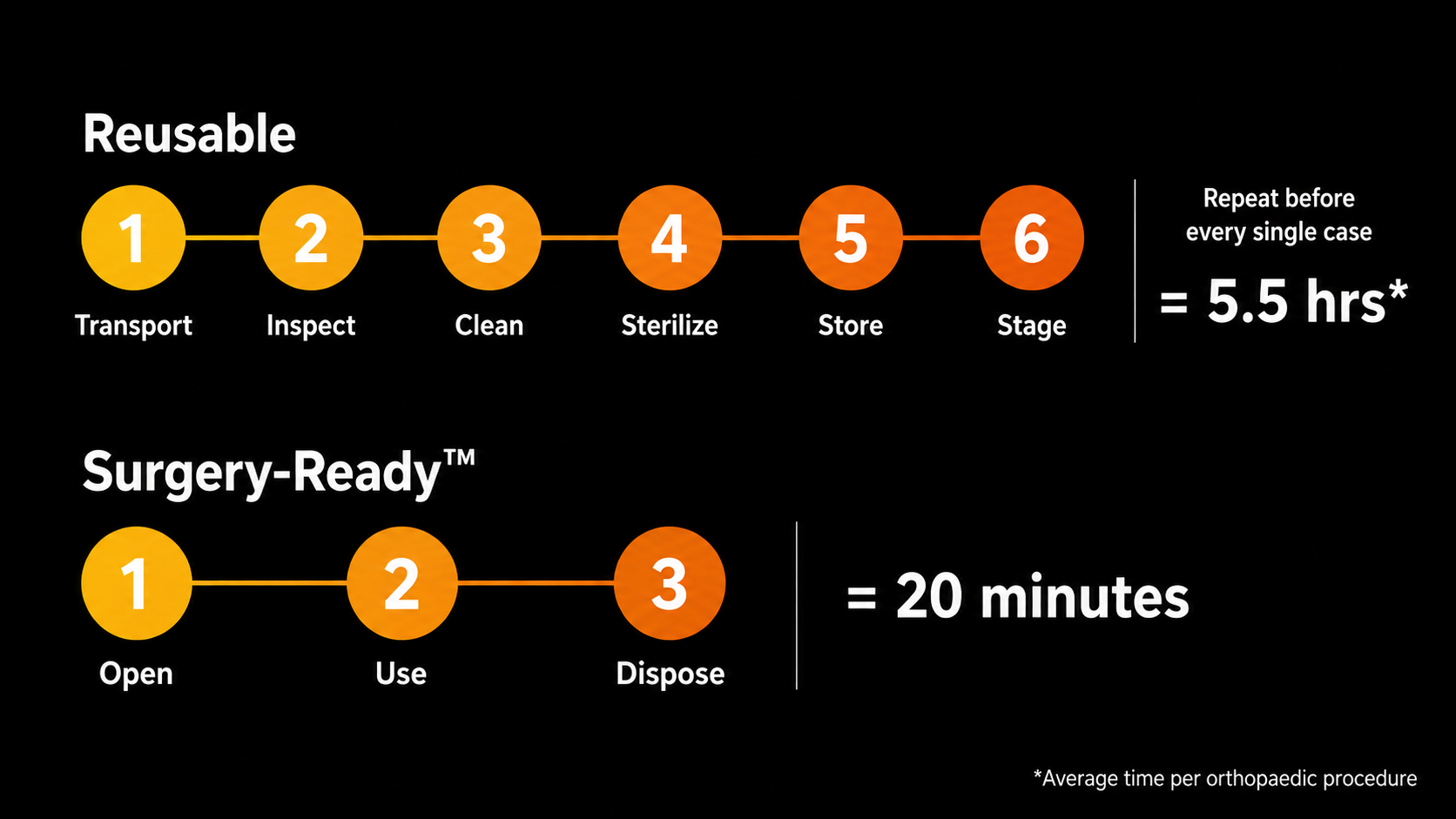
See the difference: Single-Use vs. Reusable
Every step in the reusable choice costs time, labor, and a chance for error. Single-use, Surgery-Ready™ eliminates all the possible delays.
For OEMs
Your implant is the product. The kit is how it scales.
- Faster speed to market: development, validation, and sterile packaging under one roof.
- No capital tied up in loaner sets; instrument spend tracks procedure volume.
- A standardized kit program deploys the same way at every ASC, which is what makes outpatient growth repeatable.
- The instrument is replaceable. The platform around it is the part competitors cannot easily copy.
For ASCs & Hospitals
More cases per day, with the staff you already have.
- Reprocessing eliminated, and with it the sterile-processing bottlenecks that cap case volume.
- Faster OR turnover: a published cost model found the time freed enough to fit an additional case on 51% of 12-hour operating days (29% of 10-hour days, 11% of 8-hour days), built on roughly 17.5 minutes saved per case.8
- A shorter, easier-to-verify chain of custody on every instrument.
- Surgery centers make money on flow, not on the contents of a tray.
Isn't single-use more expensive?
Per unit, sometimes. Per case, the savings can be significant: between reprocessing costs, delays, and infection risk, published analysis puts single-use at effective cost parity or better. A health technology assessment in Health Economics Review found near cost parity for lumbar arthrodesis kits: EUR 4,242.6 per case for the disposable kit against EUR 4,279.1 for the reusable, a difference under one percent, with the patient-safety and organizational advantages falling to single-use.
Won't a single-use program cost our OEM more than instruments do today?
Not where it counts. Instrument spend that used to sit in loaner sets, spares, and capital equipment now tracks case volume directly, so cost moves with revenue instead of sitting on a shelf.
Isn't reusable greener?
The lifecycle data says otherwise. See the Environmental pillar in Section 3, and the full data on ECA's Environmental page.
