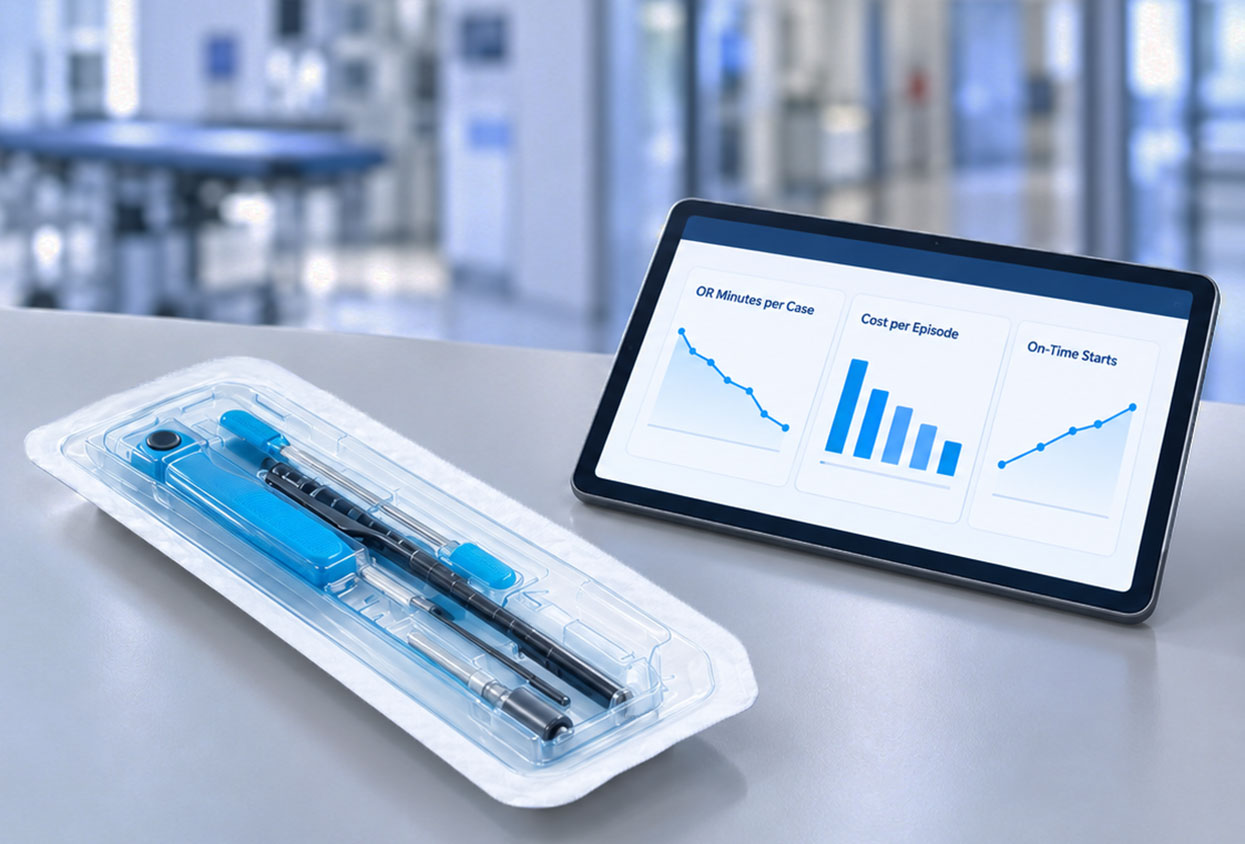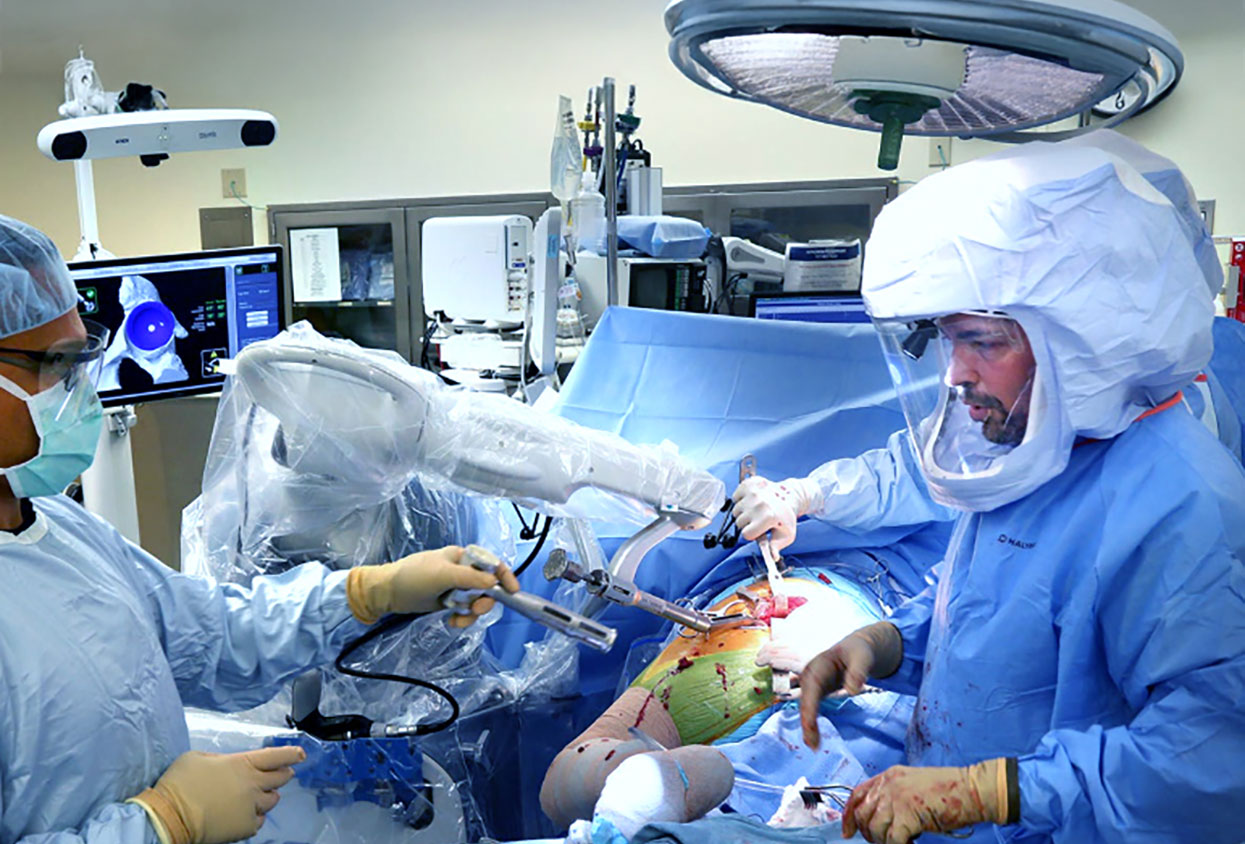
Hospitals and ASCs typically don't pay for the reusable instruments that come with an implant system. Implant OEMs loan or consign those sets, and the clinical team's job is to clean and sterilize them between cases.1 For decades, that has made instrumentation a cost center for OEMs: sets are built to print, carried as company capital, shipped from site to site, and given away to support implant sales. Single-use, sterile-packed Surgery-Ready™ procedure kits change that math. Researchers call them "a growing strategy" to control costs while improving quality and efficiency,1 and the savings they create in the OR give OEMs something they can sell. This article shows why the research points OEMs toward a Surgery-Ready™ solutions partner rather than a single-use instrument supplier.
Most implant OEMs design their implants and outsource manufacturing to a contract manufacturer (CM) that builds to print at a cost. Instruments follow the same model. The OEM sells the implant and provides the instrumentation at no charge to support implant preparation and fixation. As one orthopedic industry analysis puts it, reusable instruments "are typically not sold"; manufacturers treat them as capital and offer them "through consignment or a loan program."2
Both sides carry costs. The OEM funds the sets, the inventory to stage and replenish them, and the logistics to move them.2 A knee replacement study notes that managing the intake, processing, and transport of loaned sets "can be a substantial burden."1 The facility doesn't pay for the instruments, but it pays in OR time, sterile processing labor, and schedule risk.
Medicare's Comprehensive Care for Joint Replacement (CJR) model held hospitals accountable for the cost and quality of a full episode of care from 2016 through 2024.3 The Transforming Episode Accountability Model (TEAM), which began in January 2026, applies that logic at selected hospitals to spinal fusion, hip fracture treatment, joint replacement, and other surgical episodes.4 CMS will also require most hospitals to join an expanded joint replacement model, CJR-X, beginning in January 2028.5 Under that structure, a loaner tray that arrives at no charge still costs the episode if it adds OR time, sterilization burden, or complication risk. Value analysis committees now weigh total procedural impact, which opens the door for an OEM to offer a better solution and be paid for it.
Surgery-ready means a complete, procedure-specific kit, validated so that everything a case needs arrives together and sterile. The difference between supplier and partner sits in the design phase. A supplier, like a traditional CM, builds to the print it receives. A partner brings procedural workflow and configuration management into the design, then takes responsibility for how the kit performs in the OR. Buyers can test the claim with one question: what does the OR team still need to assemble, source, or reprocess? A partner answers with as close to nothing as possible.
A reusable set has to carry every size and option a surgeon might need, so much of it travels unused. In one total joint study, surgeons used 45.5% of the instruments in knee trays and 36.0% in hip trays. Removing unused instruments shortened setup and cut 40 to 150 minutes of sterile processing time.6
A single-use kit is optimized for the bell curve of demand: the implant types and sizes used in most cases. Outlier sizes or types, such as an odd drill bit size, a drill guide, or a driver tip, are packaged separately as stand-alone components and opened only if the case needs them. That configuration management is how ECA Medical helps OEMs optimize, tailor, and cost-reduce their instrumentation instead of recreating a loaner tray in disposable form.
A 2018 analysis notes that sterile processing departments are often targets of staff cutbacks, cannot guarantee every crevice and lumen comes back clean, and face delay pressure that pushes teams toward flash sterilization.7 Under the loaner model, the OEM owns an instrument that moves through many facilities' sterile processing departments, and it inherits risk it cannot audit at each one. When a case goes wrong, the OEM often cannot show how many cycles an instrument has seen or how staff cleaned it. A single-use kit sold sealed and discarded after one case answers those questions by design, and it gives buyers a clear answer to who prepared the instruments.
An economic simulation of a single-use pedicle screw system found OR handling savings of $1,541 per percutaneous case and $1298 per open case, with 21 minutes of OR time saved per case. Including tray sterilization, average savings reached $1,869 per case.8
A knee replacement model points the same direction. Across 200 simulated sites, single-use instruments saved a median $994 per case, and 95% of sites saved more than $500. The authors left the price of single-use instruments out of the model and noted that providers or manufacturers could use the savings to estimate breakeven pricing.1 Those savings come from OR time and sterilization overhead, they accrue to the hospital or ASC, and they leave room to price the kit.
For decades, OEMs have given instrumentation away to support implant sales. A Surgery-Ready™ system lets them sell the solution, implant and instruments together. The facility pays for a kit that removes reprocessing, tray handling, and OR delay it already pays for indirectly. The OEM replaces capital tied up in loaner sets with a product that carries its own margin. Configuration management makes the numbers work: a kit sized to the bell curve keeps per-case cost down, while stand-alone components cover outlier cases.
The pitch to buyers improves too. ASCs often run leaner sterile processing operations than hospitals, so they gain the most from less reprocessing and loaner logistics. For an OEM growing in outpatient settings, a surgery-ready system moves from nice-to-have toward requirement.
Can the partner manufacture at scale and hold quality? Does it run a collaborative kit design process informed by procedural workflow? Can it manage kit configuration, separating core kits from stand-alone components? Will its regulatory record hold up in a value-based contract?
Watch for three mistakes: renaming an unchanged catalog "surgery-ready," converting a full loaner tray into a disposable one with every rarely used instrument intact, and underestimating the engineering and clinical input a validated kit needs. Ask to see the kit design process end to end, from the first workflow conversation to the validated release.
Instrumentation moves from an operations expense to a product line with its own pricing, margin, and owner. Product development, clinical affairs, and commercial teams need a shared process for turning surgeon and OR feedback into kit design. A priced solution also needs case-level data on OR time and sterilization cost to support a customer's value analysis. OEMs that build that dataset early enter negotiations with answers ready.
Implant OEMs have spent decades giving instruments away to sell implants. A Surgery-Ready™ solutions partner lets them sell the full solution instead. The largest savings come from OR time and reduced reprocessing, those savings land with the hospitals and ASCs that value-based payment holds accountable, and they create room to price a well-configured kit. The OEM that moves first gets to define what surgery-ready means to its customers.
ECA Medical works as this kind of partner, collaborating with implant OEMs from kit design and configuration through sterile-packed delivery to build Surgery-Ready™ systems for predictable surgery at scale. Start with the evaluation questions here, then talk with ECA's team about your platform.
Don't hospitals and ASCs already get implant instruments at no cost?
Usually, yes. OEMs loan or consign reusable sets. Facilities pay instead through sterile processing, OR time, and delays, which single-use kits reduce.
How does a partner differ from a supplier?
A partner co-designs and configures the kit around procedural workflow and answers for performance in the OR. A supplier builds to print.
How can single-use kits become a profit center for OEMs?
Published models show facility savings of roughly $994 to $1,869 per case. Those savings support a price for the kit, so OEMs can sell implant and instruments as one solution.
Does a partnership reduce OEM liability?
It can, because single-use systems remove the contamination and deterioration risks that repeated reprocessing introduces.
What should OEMs look for in a partner?
Manufacturing scale, collaborative design, configuration management, procedural expertise, a proven market track record, and a strong regulatory record.
1. Goldberg TD, Maltry JA, Ahuja M, Inzana JA. Logistical and economic advantages of sterile-packed, single-use instruments for total knee arthroplasty. J Arthroplasty. 2019;34(9):1876-1883.e2. https://doi.org/10.1016/j.arth.2019.03.011
2. Tempco D. The orthopedic business model: why it's different and what to know to stay competitive. BONEZONE. March 6, 2019. https://bonezonepub.com/2019/03/06/the-orthopedic-business-model-why-it-s-different-and-what-to-know-to-stay-competitive/
3. Centers for Medicare & Medicaid Services. Comprehensive Care for Joint Replacement Model. https://www.cms.gov/priorities/innovation/innovation-models/cjr
4. Centers for Medicare & Medicaid Services. TEAM (Transforming Episode Accountability Model). https://www.cms.gov/priorities/innovation/innovation-models/team-model
5. Centers for Medicare & Medicaid Services. CMS announces nationwide expansion of proven joint replacement program [press release]. July 31, 2026. https://www.cms.gov/newsroom/press-releases/cms-news-cms-announces-nationwide-expansion-proven-joint-replacement-program
6. Lonner JH, Goh GS, Sommer K, Niggeman G, Levicoff EA, Vernace JV, Good RP. Minimizing surgical instrument burden increases operating room efficiency and reduces perioperative costs in total joint arthroplasty. J Arthroplasty. 2021;36(6):1857-1863. https://doi.org/10.1016/j.arth.2021.01.041
7. Agarwal A, MacMillan A, Goel V, Agarwal AK, Karas C. A paradigm shift toward terminally sterilized devices. Clin Spine Surg. 2018;31(7):308-311. https://doi.org/10.1097/BSD.0000000000000675
8. Abdalla Y. Value based healthcare: maximizing efficacy and managing risk with spinal implant technology. Interdiscip Neurosurg. 2020;22:100810. https://doi.org/10.1016/j.inat.2020.100810