Medicare has widened the outpatient market again, but whether the new rules turn into case volume depends on how instruments reach the room before each procedure. The Calendar Year (CY) 2026 rule brought the largest single-year expansion of outpatient-eligible surgery since at least 2018, including 168 orthopedic codes added to the ASC ortho procedures list, and more than 600 ASCs now perform total joint replacement.¹ For 2027, the Centers for Medicare & Medicaid Services (CMS) proposes 618 more ASC additions and 637 removals from the inpatient-only list, the second year of a three-year phase-out.²
For implant OEMs, ASC administrators, and OR leaders, the 2026 orthopedic additions are the ones to plan around, since next year's proposal centers on other specialties. Revision hip, revision knee, and lumbar fusion now sit on the list, and they bring some of the heaviest instrument sets in orthopedics. This article shows which procedures on the list offer OEMs the most room to grow, and why the instrument model decides how fast they get there.
The ASC covered procedures list names the procedures for which Medicare pays an ASC facility fee. CMS updates it every year in the OPPS/ASC rule, so the list grows with each cycle.
The orthopedic timeline shows how quickly the outpatient path has opened. Total knee arthroplasty joined the list for 2020, total hip for 2021, and total shoulder for 2024.³ For 2026, CMS added revision total hip, revision total knee, and posterior lumbar interbody fusion.¹
Each addition expands the addressable outpatient market for implant OEMs. The catch is that the opportunity applies only to implant systems that an ASC can run without hospital-scale sterile processing. A procedure on the list with an eight-tray instrument set can still stall in a center with a two-person SPD team. In practice, the instrument model can decide adoption as much as the reimbursement rate does.
The table below summarizes common orthopedic procedures on the list, with the instrument burden each one places on an ASC. Codes and status reflect the CY 2026 ASC payment update.⁴ Confirm current status against the latest CMS files before planning.
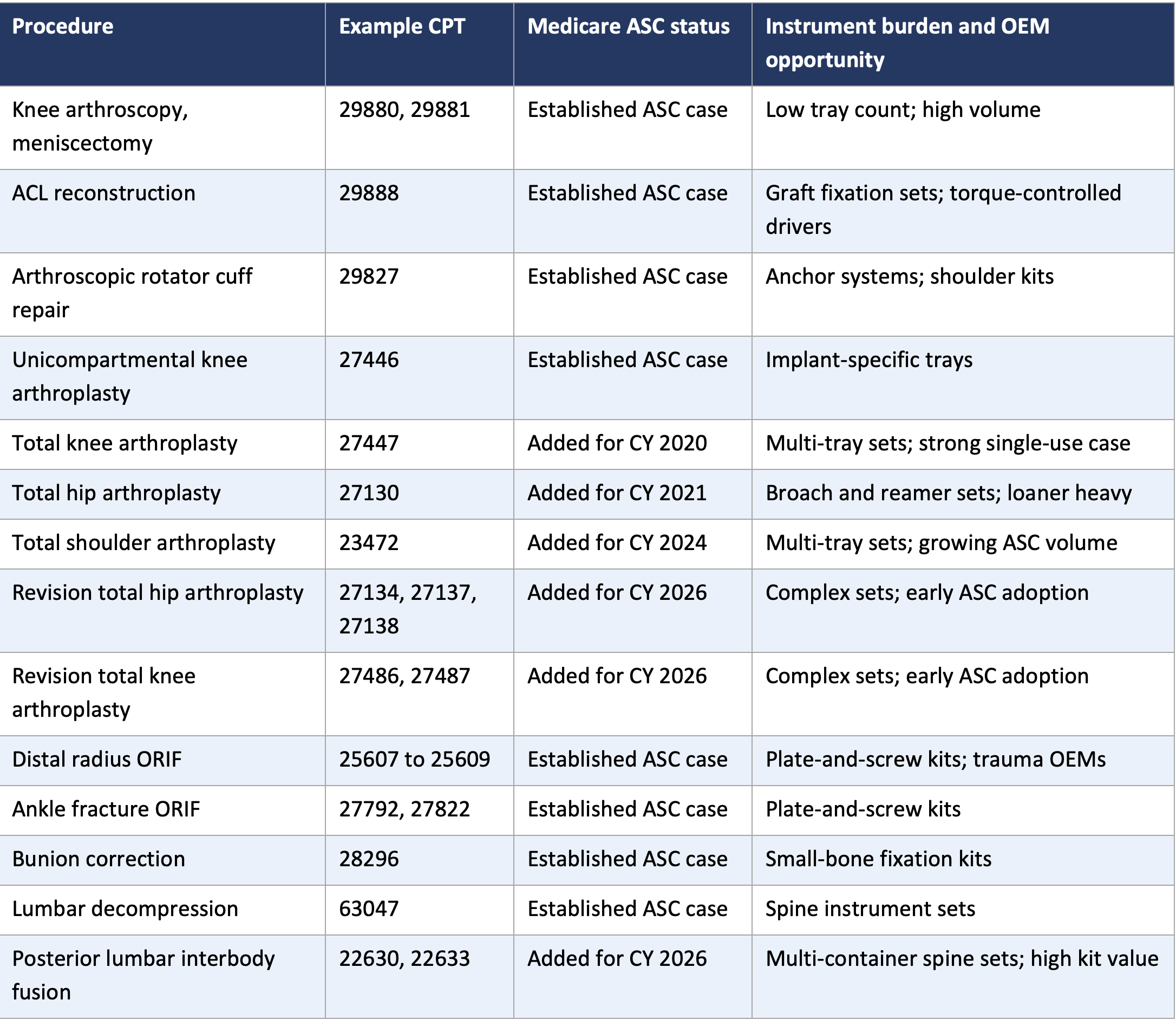
The pattern is clear. The newest additions carry the heaviest instrument sets, and those sets create the most friction in an ASC.
A simple screen helps OEMs rank the list. Score each procedure on three factors: case volume, tray count, and reprocessing dependency. Procedures that score high on all three gain the most from a procedure-specific kit, because they combine demand with the greatest operational drag.
Applied to the table, the screen splits the list into two groups. Arthroscopy, ACL, and rotator cuff cases score high on volume but low on tray count, and many ASCs already run them well. Total joints, revisions, and fusion score high on all three factors. Those are the procedures surgeons want to move but many centers cannot yet support, and they are where OEMs can open new accounts.
Total knee arthroplasty shows what that drag costs. A published cost model simulated 100,000 cases across 200 sites and compared reusable instruments with sterile-packed single-use instruments. Single-use instruments saved a median of $994 per case.⁵ On the reusable side, the largest cost drivers were tray sterilization, at a median of $480 per case, and tray management logistics, at $372.⁵ The time saved in OR turnover could have accommodated an additional case on 51 percent of 12-hour OR days in the simulation.⁵ The model did not include the price of the single-use instruments, so net savings depend on the kit price each site negotiates.⁵
Observed data points the same way. In a Rothman Orthopaedic Institute study of 35 primary joint cases, surgeons used only 45.5 percent of the instruments opened for total knee arthroplasty and 36.0 percent of those opened for total hip.⁶ Every unused instrument still went through reprocessing.
Tray count drives much of the reusable cost. Conventional knee instrument systems average about eight trays per case in published cost models, and one recent study described standard primary knee and hip sets of seven trays each.⁵,⁷ Published costs to sterilize a single tray range from $31 to $100, with a median near $58.⁵ That same joint replacement study used $79.41 per tray.⁷
The math adds up quickly. At seven trays and $79.41 per tray, an ASC spends about $556 per knee or hip case on sterile processing alone. Because surgeons use fewer than half of the instruments opened, more than half of those instruments are cleaned, inspected, and sterilized without ever touching the patient.⁶ In the seven-tray study, one surgeon's team cut its sets to three trays, and OR turnover dropped by 19 minutes. At $47.99 per OR minute, that is about $912 per turnover, plus about $318 per case in avoided tray processing.⁷
Even those figures understate what reusables cost. Per-tray estimates rarely capture SPD salaries and benefits, washer and sterilizer upkeep, water-quality testing, detergents and wraps, utilities, and the space set aside for processing and storage.⁸ Staffing adds a recurring expense. Training a new SPD technician to competency was estimated at $41,414 in 2008, and Missouri hospitals reported 30.2 percent annual turnover among sterile processing technicians in 2023.⁸,⁹ OR time compounds the total. A widely cited analysis of California hospitals put the mean cost of OR time at $36 to $37 per minute, and every minute spent waiting on trays or opening extra sets carries that cost.¹⁰ The $994 knee estimate is conservative on this point, since the model valued OR turnover at about $5 per minute in staff wages only.⁵
Taken together, a reusable tray costs an ASC far more than its sterilization line suggests. That full cost, not the per-tray fee alone, is the right baseline for comparing a single-use, surgery-ready™ procedure-specific kit.
That makes the priority set for OEMs fairly plain: total joints, revision hip and knee, and the new spine fusion codes. In each, multi-tray sets and loaner logistics limit how many ASCs can adopt the implant. OEMs that solve the instrument problem expand their reachable account base. For ASC leaders, the same screen works in reverse. Before adding a newly covered procedure, ask how many trays it needs, who will reprocess them, and how the set reaches the center. If the answers depend on loaners and overtime, the service line will struggle to grow regardless of reimbursement. The Surgery-Ready™ solution platform approach for OEMs shows how that works across many sites.
Coverage gives an ASC permission to perform a procedure. It does not give the center the staff to support it. Many ASCs run lean sterile processing teams, and a procedure on the list can still stall when trays cannot turn in time for the next case.
The tray burden is substantial. The knee cost model drew on a published estimate of 355 minutes of tray management time per case with traditional instruments. For single-use instruments, it used about 80 minutes, a figure from the manufacturer's white paper.⁵ That time covers work outside the OR and sterile processing, such as receiving, packing, and storing sets.⁵
Loaner sets add their own steps before every case. Each set ships in, gets checked in, goes through reprocessing, and ships back out. A late delivery or a missing instrument can push a start time or force a reschedule.
The economics reach the OEM too. Loaner sets tie up capital in inventory that sits in transit or on shelves between cases, and each new ASC account can require another set. A kit program ties instrument spend to procedures performed instead.
A standardized single-use Surgery-Ready™ kit program removes those steps. The same kit deploys the same way at every ASC, which makes outpatient growth repeatable for the OEM and predictable for the surgery center. It also explains why large joint kits for hip, knee, and shoulder have become a planning priority for orthopedic programs.
The ASC ortho procedures list will keep growing, and the 2027 proposal shows CMS has no plans to slow down. Coverage alone will not decide which OEMs capture outpatient volume. The winners will be the OEMs whose implants arrive surgery-ready, with instruments that fit an ASC's staffing, space, and schedule. For ASCs, the same shift means newly covered procedures become workable service lines instead of logistics problems. Predictable surgery at scale follows from that alignment.
ECA Medical partners with implant OEMs to design, validate, and deliver procedure-specific kits for outpatient orthopedic and spine programs. Explore the Surgery-Ready™ solutions or start developing your kit.
What orthopedic procedures can be done in an ASC?
Medicare-covered ASC orthopedic procedures include arthroscopy, fracture repair, foot and ankle cases, total knee, total hip, total shoulder, and, for 2026, revision hip and knee arthroplasty and posterior lumbar interbody fusion.
Is total knee replacement on the ASC covered procedures list?
Yes. CMS added total knee arthroplasty (CPT 27447) to the ASC covered procedures list for 2020.
When did total hip and total shoulder replacement move to the ASC list?
Total hip arthroplasty joined the list for 2021, and total shoulder arthroplasty followed for 2024.
How often does CMS update the ASC ortho procedures list?
Every year. CMS proposes changes each summer and finalizes them in the annual OPPS/ASC rule, effective January 1.
How can implant OEMs help ASCs add newly covered orthopedic procedures?
OEMs can supply sterile-packed, procedure-specific kits that remove loaner logistics and reprocessing, so ASCs can schedule new cases without adding sterile processing staff.
How much does it cost to sterilize a surgical instrument tray?
Published estimates range from about $31 to $100 per tray, with a median near $58. A 2024 joint replacement study used $79.41 per tray. Those figures typically exclude fixed SPD overhead, staff training and turnover, and OR time lost to tray delays.
How many instrument trays does a total knee or hip replacement use?
Conventional systems commonly use about seven or eight trays per case. Surgeons use fewer than half of the instruments opened for a primary total knee and about one-third of those opened for a primary total hip.
1. Bosek H. The procedures that shifted to the outpatient model in 2026. Becker's ASC Review. September 4, 2026. https://www.beckersasc.com/legal-regulatory-issues/the-procedures-that-shifted-to-the-outpatient-model-in-2026/
2. Centers for Medicare & Medicaid Services. Medicare program: hospital outpatient prospective payment and ambulatory surgical center payment systems; CY 2027 proposed rule (CMS-1850-P). Fed Regist. 2026;91(128):41734-42032. July 7, 2026. https://www.federalregister.gov/d/2026-13656
3. Centers for Medicare & Medicaid Services. OPPS/ASC final rule fact sheets: CY 2020 (CMS-1717-FC), https://www.cms.gov/newsroom/fact-sheets/cy-2020-medicare-hospital-outpatient-prospective-payment-system-ambulatory-surgical-center-payment; CY 2021 (CMS-1736-FC), https://www.cms.gov/newsroom/fact-sheets/cy-2021-medicare-hospital-outpatient-prospective-payment-system-ambulatory-surgical-center-payment; CY 2024 (CMS-1786-FC), https://www.cms.gov/newsroom/fact-sheets/cy-2024-medicare-hospital-outpatient-prospective-payment-system-ambulatory-surgical-center-payment
4. Centers for Medicare & Medicaid Services. January 2026 update of the Ambulatory Surgical Center [ASC] payment system. Medicare Claims Processing, Pub. 100-04, Transmittal 13578, Change Request 14359. January 28, 2026. https://www.hhs.gov/guidance/sites/default/files/hhs-guidance-documents/CMS/r13578cp.pdf
5. Goldberg TD, Maltry JA, Ahuja M, Inzana JA. Logistical and economic advantages of sterile-packed, single-use instruments for total knee arthroplasty. J Arthroplasty. 2019;34(9):1876-1883.e2. https://doi.org/10.1016/j.arth.2019.03.0116. Lonner JH, Goh GS, Sommer K, Niggeman G, Levicoff EA, Vernace JV, Good RP. Minimizing surgical instrument burden increases operating room efficiency and reduces perioperative costs in total joint arthroplasty. J Arthroplasty. 2021;36(6):1857-1863. https://doi.org/10.1016/j.arth.2021.01.041
7. Hedden K, Harrer S, Choi JH, Gentile PM, Shahi A, Brown ML. An efficiency model for decreasing operative room turnover time for total joint arthroplasties. Arch Bone Jt Surg. 2024;12(9):660-664. https://doi.org/10.22038/ABJS.2024.77381.3575
8. Agarwal A, MacMillan A, Goel V, Agarwal AK, Karas C. A paradigm shift toward terminally sterilized devices. Clin Spine Surg. 2018;31(7):308-311. https://doi.org/10.1097/BSD.0000000000000675
9. Missouri Hospital Association. 2024 Workforce Report (data as of December 31, 2023). https://www.mhanet.com/mhaimages/workforce/2024/2024_wf_report.pdf
10. Childers CP, Maggard-Gibbons M. Understanding costs of care in the operating room. JAMA Surg. 2018;153(4):e176233. https://doi.org/10.1001/jamasurg.2017.6233