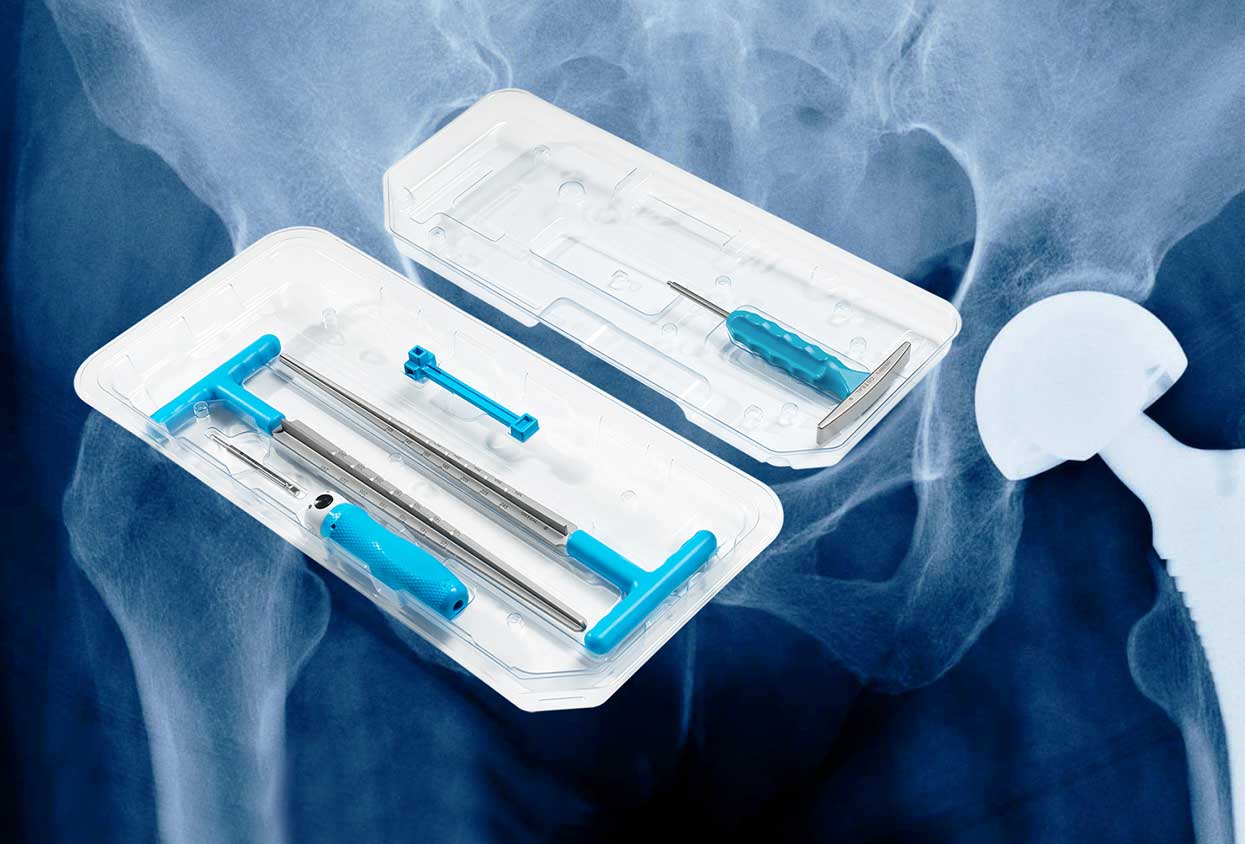
The usual way to add knee cases is a new room or a longer shift, but for many ASCs the extra time already sits between the cases they run today. One published cost model put a number on it. Sterile-packed, single-use instruments saved about 17.5 minutes of turnover per total knee case, enough to fit an additional procedure on 51 percent of 12-hour operating days.¹ So the short answer to the question in the title is yes, with limits worth understanding.
For ASC administrators, OR leaders, and knee implant OEMs, that finding matters because the coverage question is settled. Total knee arthroplasty has been on the ASC covered procedures list since 2020.² The open question is capacity. Few ASCs can add rooms or shifts quickly, so growth in ASC knee procedures has to come from the time they already staff. This article shows where the minutes come from, how they turn into cases, and what the model leaves out.
The figure comes from a peer-reviewed cost model published in the Journal of Arthroplasty. The researchers compared traditional reusable instruments with sterile-packed, single-use instruments for total knee arthroplasty. Using Monte Carlo simulation, they modeled 100,000 cases across 200 sites, with most inputs drawn from published clinical literature.¹
The model started from a mean OR turnover time of 38.4 minutes with traditional instruments. It then applied a turnover-time saving of about 17.5 minutes per case for single-use instruments, averaged from four published studies.¹ Tray count drove much of the difference. Traditional cases used about eight trays, while single-use cases needed about one.¹
The source of the time is easy to see in any OR. Fewer trays mean less to open, inspect, count, and break down. And no one has to wait on a reprocessed set to come back from sterile processing before the next patient can enter the room.
Turnover also depends on work outside the room. For traditional instruments, the model drew on a published estimate of about 355 minutes of tray management per case, covering receiving, packing, and storing sets. For single-use instruments, it used about 80 minutes, a figure from the manufacturer's white paper.¹ Those hours never show up on the OR clock, but they decide whether the next set is ready on time.
Observed data supports this. In a Rothman Orthopaedic Institute study of 35 primary joint cases, surgeons used only 45.5 percent of the instruments opened for total knee arthroplasty. After the team removed unneeded instruments and consolidated the remainder into one tray, mean setup time dropped from 20.7 to 14.2 minutes, and the sterilization process gained back 40 to 75 minutes.³
The model translated turnover savings into schedule capacity. It assumed back-to-back cases with two hours allotted for each, then tested 8-hour, 10-hour, and 12-hour OR days. With single-use instruments, an extra case fit on 51 percent of 12-hour days, 29 percent of 10-hour days, and about 11 percent of 8-hour days. With traditional instruments, the figure stayed under 1 percent on every day length.¹
Here is a concrete version. An ASC running two 12-hour knee days a week could gain about one extra case a week on average. Across 50 operating weeks, that comes to roughly 50 additional knee procedures a year from the same room and the same team.
The 8-hour day results deserve attention too. Many ASCs run standard 8-hour blocks, and an extra case on about one day in nine still adds meaningful volume over a year. Longer day blocks magnify the effect because the saved minutes accumulate across more cases.
The model also measured the opposite problem. Traditional instruments pushed 35 to 38 percent of operating days into staff overtime. Single-use instruments cut that share to less than 1 percent.¹ For a center that struggles to recruit and retain nurses and surgical technologists, fewer late finishes may matter as much as the extra cases.
Time is the primary economic driver here. The extra case carries revenue, while the room, staff, and anesthesia hours already exist. When turnover between cases shrinks, the fixed cost of the day spreads across more procedures, which lowers the cost per case and makes the schedule easier for surgeons to trust.
The same model put a dollar figure on the change. Single-use instrumentation cut the median modeled cost per case from $1,391 to $406, a median saving of $994.1 The study reports each figure as a median, so the saving does not equal the simple difference between the two costs.
Tray sterilization drove the largest share of the difference. For traditional instruments, sterilization alone carried a median cost of $480 per case, followed by tray management logistics at $372.¹ Sites with higher staff wages and sterilization costs were more likely to see larger savings, which suggests that ASCs in high-wage markets have the most to gain.¹
The model has clear limits, and any ASC finance team should know them. It covered sterilization, tray handling, OR turnover, and 90-day infection costs. It did not include the price of the single-use instruments, so net savings depend on the kit price each ASC negotiates.¹ The authors suggest using the modeled savings to estimate break-even pricing, and they note that 95 percent of simulated sites saved more than $500 per case.¹
Those costs also represent only part of a knee procedure. The authors estimate they account for about 10 to 20 percent of total procedure cost.¹ Even so, a change of that size on every case adds up quickly across a year of knee days. Leaders comparing the options can review the true cost difference between reusable trays and Surgery-Ready™ solutions for a broader view.
Saved minutes only create capacity when the system around them stays consistent. A repeatable knee program looks a little different for each partner.
For ASCs, it means one standard kit per implant system, the same setup on every case, and on-time first starts. Staff learn a single configuration and repeat it, which shortens training and reduces variation between teams. The schedule can run against known kit availability instead of tray turnaround. ASCs exploring the approach can see how Surgery-Ready™ kits help ASCs improve OR efficiency and predictability.
For knee implant OEMs, it means no loaner sets in transit and instrument spend that tracks procedure volume. Adding a new ASC account no longer requires building another reusable set. That makes outpatient expansion faster and easier to forecast. Many OEMs start with single-use surgical instruments matched to their implant systems.
Data closes the loop. When every case uses the same kit, ASCs can track turnover, start times, and case counts against a stable baseline and confirm whether the expected minutes appear on their own schedule. The data behind what a delayed OR start really costs offers a useful benchmark.
The shared outcome is ASC knee procedures that run predictably at scale. When delays shrink, both partners benefit.
Seventeen minutes looks small on one case. Across a year of knee days, it can add dozens of procedures, reduce overtime, and lower per-case instrument processing costs. The published model shows the direction clearly, and its stated limits show where each ASC needs its own data, especially on kit pricing. For ASCs and OEMs planning outpatient knee growth, turnover time deserves the same attention as reimbursement. The next step is to measure current turnover on knee days and compare it with the published baseline.
Building Predictable Surgery with ECA Medical
ECA Medical partners with knee implant OEMs and ASCs to design and deliver sterile-packed, procedure-specific Surgery-Ready™ kits. See what your schedule can look like without instrument reprocessing. Explore the Surgery-Ready™ solutions or contact the ECA team to start the conversation.
Can ASCs perform total knee replacement for Medicare patients?
Yes. CMS added total knee arthroplasty to the ASC covered procedures list for 2020.
How much OR time do single-use knee instruments save?
A published cost model applied about 17.5 minutes of turnover savings per total knee case, based on earlier clinical studies.
Do single-use knee instruments cost less per case?
The model found a median saving of $994 per case in processing-related costs, not counting the price of the single-use instruments.
Why did the cost model exclude instrument purchase price?
The authors focused on costs that instrument type affects and suggested using the savings to estimate break-even pricing.
How do knee implant OEMs support ASC growth?
They supply sterile-packed, implant-specific kits that remove loaner logistics and let ASCs schedule against kit availability.
1. Goldberg TD, Maltry JA, Ahuja M, Inzana JA. Logistical and economic advantages of sterile-packed, single-use instruments for total knee arthroplasty. J Arthroplasty. 2019;34(9):1876-1883.e2.
2. Centers for Medicare & Medicaid Services. CY 2020 Medicare hospital outpatient prospective payment system and ambulatory surgical center payment system final rule (CMS-1717-FC). Fact sheet.
3. Lonner JH, Goh GS, Sommer K, Niggeman G, Levicoff EA, Vernace JV, Good RP. Minimizing surgical instrument burden increases operating room efficiency and reduces perioperative costs in total joint arthroplasty. J Arthroplasty. 2021;36(6):1857-1863.