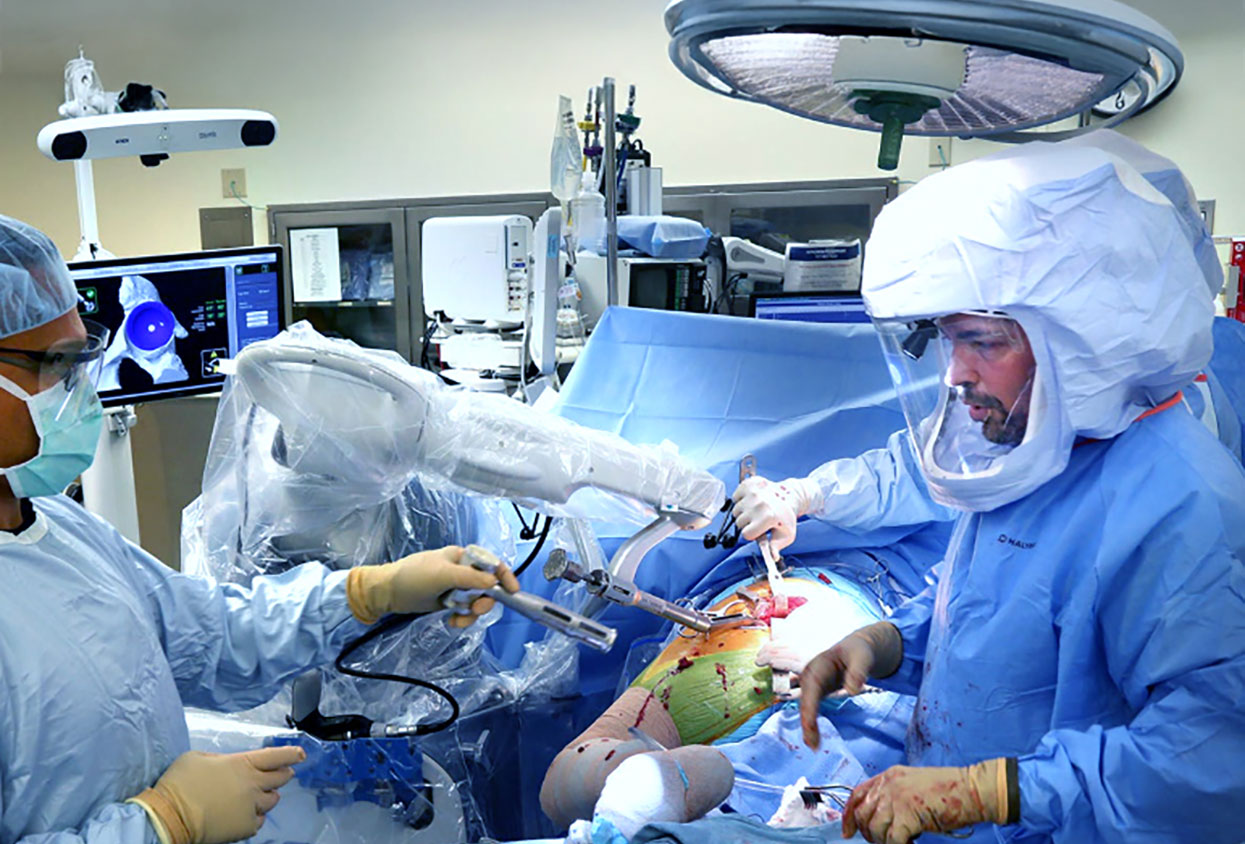
A delayed OR start looks small in the moment, ten minutes here and fifteen there. The published research tells a different story. Those minutes add up to measurable labor cost, lost case capacity, and, in one large spine surgery database, a higher rate of surgical site infection. Here is what three studies say a delayed OR start really costs, and where the delay comes from.
Researchers at Toronto Western Hospital analyzed nearly nine years of prospectively recorded errors from one neurosurgeon's practice, covering 1,531 elective cases. Delay was the most common error type, at 33.6 percent of all errors, and 51.4 percent of cases had at least one delay.1 First cases of the day had more delays than later ones, which contradicts the assumption that mornings run smoothest. A late first case was also associated with more delays in the cases behind it.
The authors offered a reason for the morning pattern. Several rooms start at once, which puts a heavy load on registration, imaging, holding-area nurses, and porters, all of whom serve the same wave of first cases.1 Staffing in those areas stays constant through the day, so the bottleneck forms early.
The study also found that cranial cases ran into more delays than spinal cases, and the authors tied that gap to extra steps such as same-day preoperative imaging.1 Delay risk varies by procedure, which means a facility can map where it concentrates. And a slow start rarely stays contained.
Equipment failure, meaning missing or malfunctioning equipment, led the list. It caused 57.9 percent of delays in cranial cases and 55.2 percent in spinal cases.1 The authors also cite earlier research finding that a single fallen instrument causes an average delay of 7.6 minutes. These numbers describe equipment and instrument reliability, not surgeon or anesthesia performance.
The study also ruled out two common suspects. Among first-case brain tumor surgeries, neither the type of anesthesia nor inpatient versus outpatient status had a significant effect on how often delays occurred. Getting the patient into the room caused most of the remaining cranial delays, and waiting for an intraoperative radiograph ranked second in spinal cases.1 Of all these causes, equipment availability sits most squarely in the part of the process a facility can redesign. Start there before you add staff or buffer time.
The hospital priced each ten-minute delay at about $18 in nursing and OR attendant pay. At roughly 135 delays a year in one surgeon's practice, that came to about $2,430 annually. Extended across the hospital's department of surgery, the researchers put the figure near $138,857 a year.1
The authors called that a gross underestimate. It leaves out cases cancelled at the end of a day that ran long, overtime for nurses when cases stretch past regular hours, and the stress on patients, families, and surgical teams.1 A delayed case pushes the next one back, and the losses compound from there.
A separate cost model looked at total knee replacement. Researchers simulated 200 sites with 500 cases each and compared sterile-packed, single-use instruments with traditional reusable trays. Single-use instrumentation saved a median $994 per case, and tray sterilization was the largest driver of those savings.2
Time mattered as much as dollars. Because turnover ran faster, up to 51 percent of operating days with single-use instruments could have fit an additional procedure, depending on the length of the operating day.2 The model also found that sites with higher staff wages and sterilization costs had a greater chance of above-average savings. That matters for ASCs and hospitals in high-cost labor markets, where every lost minute costs more. The opportunity to reduce case flow friction and streamline OR operations and ultimately to serve more patients by conducting more cases per day, becomes unachievable.
None of these savings come from the price of an implant. They come mainly from fewer trays to reprocess, less tray handling, and shorter turnover.2
A third study looked at a different kind of delay: the time a patient spends in the operating room before incision. A review of 7,991 spine surgeries at a single academic center found 276 surgical site infections. Patients who developed an infection spent longer in the room before incision, 68.0 minutes on average versus 60.5 minutes.3 When that time exceeded one hour, the infection rate reached 4.9 percent, compared with 2.3 percent at one hour or less.
In multivariate analysis, in-room delay beyond one hour remained an independent risk factor, along with the number of levels operated, the patient's ASA class, and a posterior approach.3 Delay stands out on that list because, unlike the other three, a facility can change it.
The authors' explanation is straightforward. During extended setup, the sterile field and opened instruments may be exposed to contamination from air, room traffic, or direct contact. They recommend completing as much preparation as possible before the patient enters the room and waiting to open sterile instrumentation until surgery is ready to proceed.3 They also found that the share of cases with more than an hour of in-room delay ran highest in August and September, a reason to watch the schedule more closely in late summer.
Equipment-related delay often reflects capacity more than effort. Sterile processing teams are asked to turn more trays with the same headcount, and a shared tray set can run short when several rooms start at once. More training cannot close a capacity gap. Reliable, ready inventory can.
The problem is not the people. It is a system that depends on every reusable tray being cleaned, assembled, sterilized, and delivered on time, for every case, every day.
ASC owners feel these numbers most. A surgery center earns revenue per case, so a reclaimed slot converts directly into income, while every delay pushes cases later and can trigger overtime. The knee replacement model showed room for an additional procedure on up to 51 percent of operating days.2 At a facility running near its limit, that is roughly one more case every other day, without new rooms, new hires, or longer hours.
Owners also carry the liability that comes with infection. In the spine surgery review, the infection rate rose from 2.3 percent to 4.9 percent once in-room time before incision passed an hour.3 That gives administrators a concrete reason to treat start-time discipline as a patient safety measure, not just a scheduling goal.
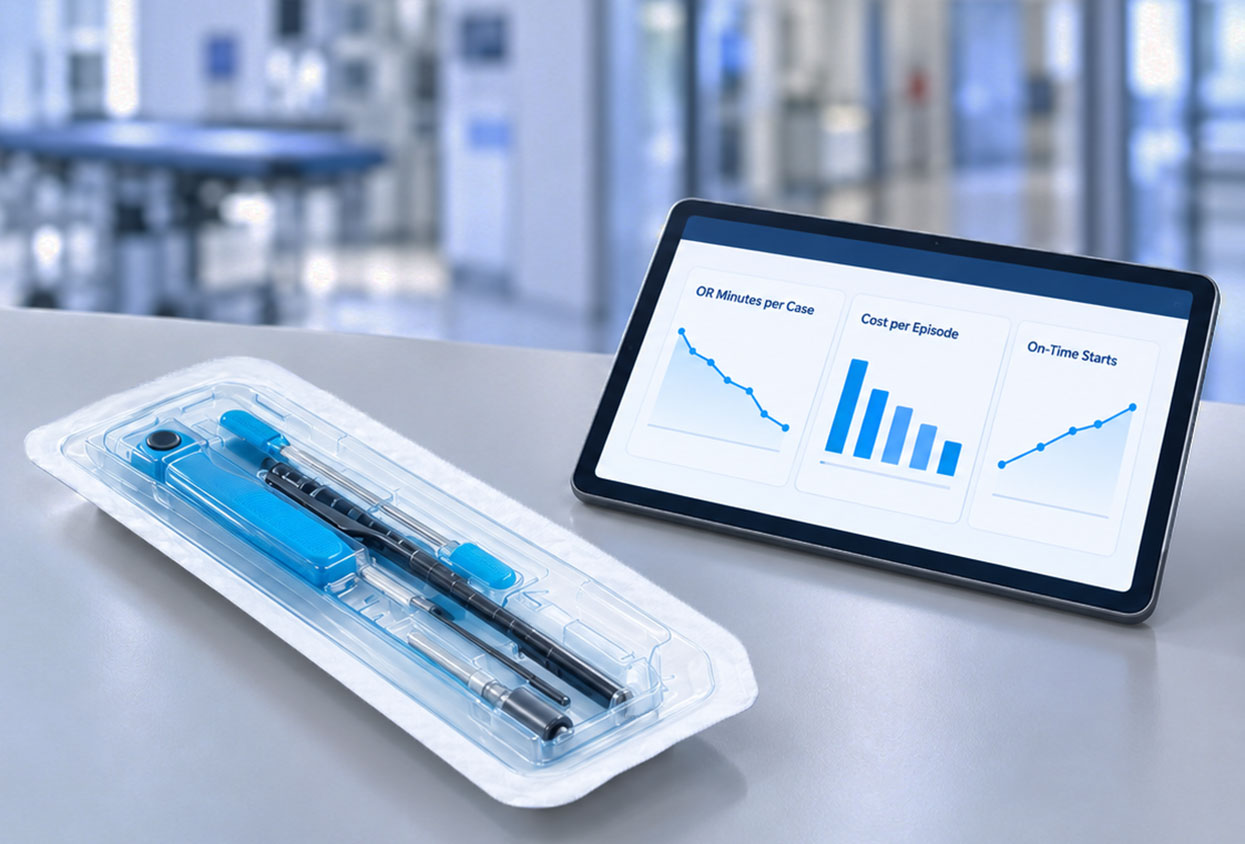
The most common documented cause of delay is a missing, late, or malfunctioning piece of equipment. A complete, sterile-packed, single-use kit arrives with the instruments the case needs, so there is no shared tray to fail or run late. Turnover becomes more predictable, which frees capacity. That beats managing around the problem with buffer time in the schedule, which protects the day but leaves the cause in place.
You can measure your own exposure this month. Track the share of cases with any delay, the share of those delays tied to equipment or instruments, and the average length of each delay. Then compare your numbers with the Toronto Western benchmarks: about half of cases delayed, and equipment behind more than half of those delays.1
After a switch, keep tracking the same three numbers for a full quarter. If delay rates and instrument-related interruptions fall, you have local proof that supports the published research. If they do not, you have located a different bottleneck, and you found it with data instead of guesswork.
The real cost of a delayed OR start does not show up in minutes. It shows up in labor, in lost case capacity, and in infection risk, and the research now puts numbers on all three. Asking staff to move faster will not fix that. Removing the instrument gaps behind the delay will.
ECA Medical's Surgery-Ready™ kits arrive complete, optimized and tailored for the specific implant and surgery type and sterile-packed for each procedure, so rooms never wait on a shared tray or a missing component. For ASC owners, administrators, and hospital OR directors building predictable turnover at scale, that addresses the instrument side of the most common documented cause of delay. Contact ECA Medical to model turnover savings for your case mix. sales@ecamedical.com
What counts as a delayed OR start?
Definitions vary by study. The Toronto Western study counted a first case as delayed if the patient entered the OR after 8:10 a.m., and a later case as delayed if it started more than an hour after the previous one.
Does delay increase infection risk?
One spine surgery review found an infection rate of 4.9 percent when in-room time before incision exceeded one hour, compared with 2.3 percent at one hour or less.
What causes most OR delays?
In the Toronto Western study, equipment failure, meaning missing or malfunctioning equipment, caused more than half of documented delays.
How much does OR delay cost a hospital?
One hospital study estimated about $138,857 a year in nursing and attendant labor alone, and its authors called that a gross underestimate.
Can single-use kits shorten turnover?
A total knee replacement cost model found a median saving of $994 per case with single-use instruments and room for an additional procedure on up to 51 percent of operating days.
1. Wong J, Khu KJ, Kaderali Z, Bernstein M. Delays in the operating room: signs of an imperfect system. Can J Surg. 2010;53(3):189-195. https://pubmed.ncbi.nlm.nih.gov/20507792/
2. Goldberg TD, Maltry JA, Ahuja M, Inzana JA. Logistical and economic advantages of sterile-packed, single-use instruments for total knee arthroplasty. J Arthroplasty. 2019;34(9):1876-1883. https://doi.org/10.1016/j.arth.2019.03.011
3. Radcliff KE, Rasouli MR, Neusner A, Kepler CK, Albert TJ, Rihn JA, Hilibrand AS, Vaccaro AR. Preoperative delay of more than 1 hour increases the risk of surgical site infection. Spine. 2013;38(15):1318-1323. https://doi.org/10.1097/BRS.0b013e31828f1f0b