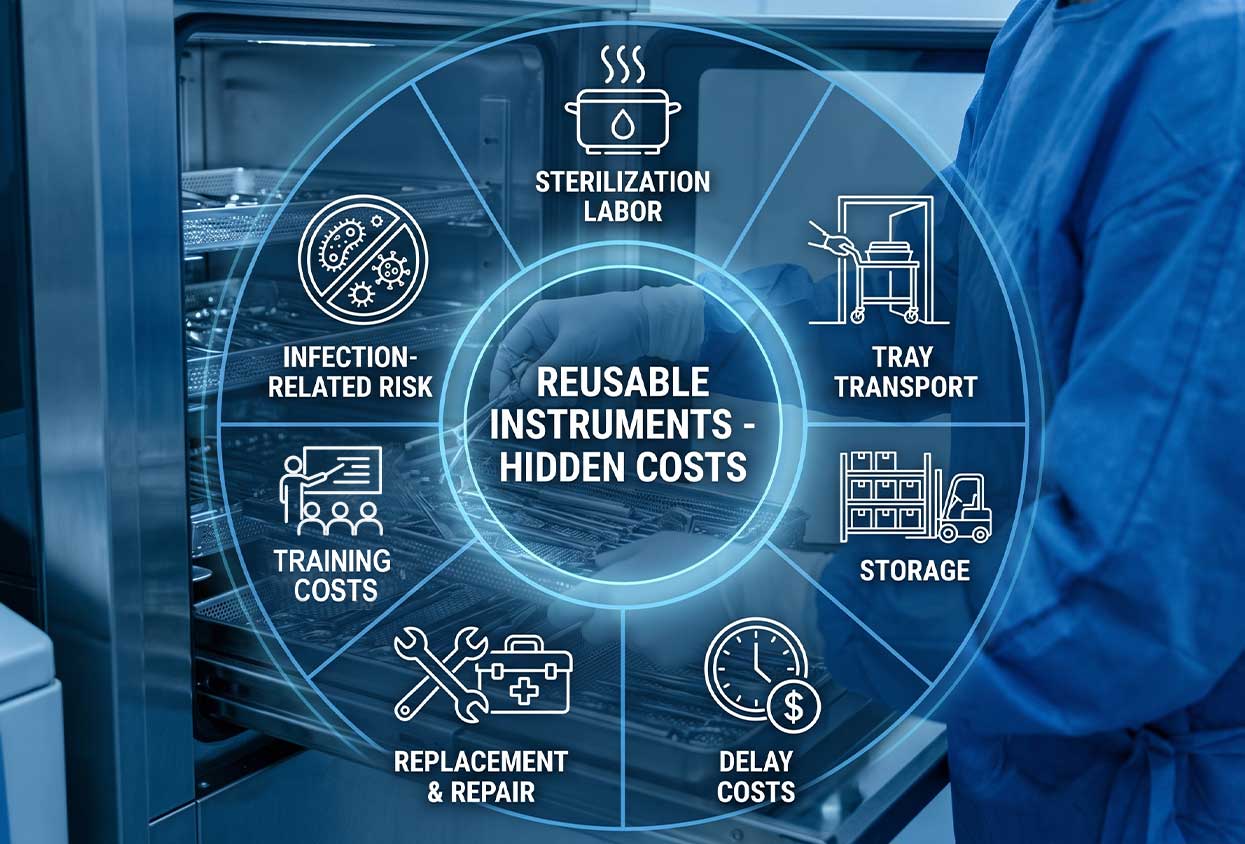
Reusable surgical instrument systems have lots of hidden fixed and variable costs that make them expensive, risky and antiquated for the new delivery model needed by both hospital and the outpatient market. Tray systems overlook the full economic impact for both implant OEMs and the facilities that use them. A reusable trauma kit may carry a capital value of $15,000 to $30,000, while a sterile, single-use procedure kit is fraction of that cost yet depending on indication. The difference, however, extends far beyond acquisition cost. Reusable sets—often managed as loaners or consignment—introduce significant fixed and variable expenses tied to sterilization, transport, storage, staffing, delays, and instrument loss or repair. ECA Medical’s single-use Surgery-Ready™ sterile kits shift these cost centers into a more predictable per-case model, often delivering meaningful savings—frequently exceeding $1,000 per procedure—while creating operational and financial advantages for both the implant company and the provider.
Most cost comparisons in this industry don't get past the first line item. An ASC, hospital or OEM implant partner looks at the use of a reusable tray next to the price of a single-use kit, sees that the reusable option is lower, and stops there. That comparison is incomplete, and leaves out most of what actually drives the total cost of a case.
A more complete comparison has to include everything that happens between purchase and use: sterilization, transport, storage, staffing, and the risk of something going wrong along the way. Once these line items are added back in, facilities that run the full comparison often find the numbers tell a very different story than the purchase order suggests.
Sterilization labor, tray transport, inventory carrying costs and related labor all sit outside the sticker price of a reusable tray, and they add up with every cycle. Then there are the costs that only show up when something goes wrong: OR delays when a tray arrives incomplete, contaminated, or still wet from reprocessing. None of that appears on the purchase order, but all of it shows up in the day's schedule and the monthly cost.
Even the capital side of the equation is easy to underestimate. Reusable trays need to be replaced as they wear out or are damaged, and the sterilization equipment behind them represents its own ongoing capital and maintenance cost, neither of which shows up when comparing reusables vs single-use surgery-ready™
Every one of those costs recurs with every single case, whether or not anyone is tracking it as a line item. A facility that hasn't separated sterilization labor from its general operating costs is, in effect, carrying that expense without ever seeing the true number.
This is part of why the reusable-versus-single-use conversation so often stalls at the wrong time. The instrument price is easy to find on an invoice. Sterilization labor, delay costs, storage, labor, and infection-related expenses are scattered across payroll, facilities, and clinical outcomes data, which makes them easy to overlook even though they are just as real.
Sterile processing bottlenecks and an overreliance on flash sterilization are two of the most common sources of hidden cost, and both tend to get worse as case volume grows. Cancellations and case delays tied to tray availability are common enough to be a real line item, not an anomaly.
A cancelled or delayed case can mean a patient must be rescheduled, a surgeon’s block time goes partially unused, and staff are still scheduled and paid even when the case does not happen on time. These downstream effects are rarely traced back to a tray that was not ready, but that is often where they begin.
Flash sterilization, in particular, deserves attention here. It exists as a legitimate emergency option, but it is frequently used simply because a facility ran short on properly processed trays, not because a true emergency required it. Every time that happens, the facility is trading a few minutes of scheduled relief for a process that carries a higher risk of inadequate sterilization.
None of these costs show up neatly on a single invoice, which is exactly why they are so easy to underestimate. A facility can go years without ever calculating what its delays, cancellations, and flash sterilization use actually cost, simply because that number does not exist anywhere as a single line item.
There is also a liability dimension that is easy to underweight. A multicenter review of spine surgery cases found that preoperative in-room delays beyond one hour occurred in nearly half of all cases studied, and were linked to a statistically significant increase in surgical site infection, 4.9% compared with 2.3% for shorter delays 1. That is not a claim that reusable systems are unsafe. It is evidence that every additional processing step and every extra minute of delay introduce another opportunity for something to go wrong.
A fixed, predictable per-case cost with no reprocessing labor attached is a very different budgeting exercise than one built around variable sterilization costs and occasional delay-driven overruns. Surgery-Ready™ solutions eliminate flash sterilization risk and the possible contamination-related delays that come with it.
The numbers back this up. A 200-site cost-modeling study on total knee arthroplasty found a median total savings of $994 per case with single-use instrumentation, with 48% of sites saving at least $1,000 per case once turnover time and sterilization costs were factored in 2. The same study found that sites with higher staff wages and sterilization costs, exactly the conditions many ASCs operate under, had the greatest probability of realizing the largest savings with the adoption of single-use instruments and kits.
Sterile processing delays add up quietly across a single day of cases, and the totals can be larger than most facilities expect. One hospital-based cost analysis totaled reprocessing-related expenses, including delay time, technician training, and infection-related readmissions, at roughly $174,000 a year for a facility running 500 cases annually with two trays per case 3. None of that figure includes the instruments themselves. It is the operational cost of simply keeping reusable trays in circulation.
Spread across 500 cases, that works out to roughly $350 per case in reprocessing overhead alone, before a single instrument is purchased. Held up against an ECA Medical Surgery-Ready™ kit's all-in cost, the comparison starts to look very different than the one most facilities ran when they first priced out their instrument sets.
These are commutations worth reviewing before signing off on another year of reusable trays. Adding up sterilization labor, delays, training costs, and infection-related risk against a single, known per-case cost tells a very different story than comparing instrument prices side by side.
The real comparison is never tray price versus kit price alone. It is the total operational cost. Once sterile processing bottlenecks, delays, and downstream risk are counted, Surgery-Ready™ solutions tend to come out ahead, not because the instruments are cheaper, but because everything around them is simpler.
This is the shift worth making in how a facility evaluates instrument spend.
ECA Medical built its single-use instrument lineup around exactly this kind of total cost picture, so facilities can see the full number upfront instead of discovering it in pieces across a year of sterile processing invoices and delay reports. Learn more about why ECA approaches single-use this way, or request a cost comparison conversation with ECA Medical.
Are Surgery-Ready™ single-use kits actually cheaper than reusable trays?
It depends on total cost, not sticker price alone. Once sterilization labor, tray transport, delay costs, and infection-related risk are included, single-use kits are frequently cost-competitive or cheaper on a per-case basis.
What hidden costs do reusable trays create in sterile processing?
Labor for cleaning, inspecting, and reassembling trays, transport between the OR and sterile processing, inventory carrying costs, and the cost of delays when a tray is incomplete, contaminated, or still wet.
How does flash sterilization affect surgical costs and safety?
Flash sterilization is often used when a facility runs short on properly processed trays, and it carries a higher risk of inadequate sterilization along with the delay it takes to perform, adding both cost and risk to a case.
Can ASCs calculate their real cost per case with reusable systems?
Yes, by tracking sterilization labor, tray transport, delay minutes, training costs, and infection-related expenses alongside the instrument cost itself, rather than looking at instrument price in isolation.