Every ASC leadership team eventually has the same conversation. How do we grow case volume without growing everything else along with it? More cases usually mean more staff, more inventory, more sterile processing capacity, more cost and more complexity to manage.
It’s natural to assume growth requires more of everything, more hires, more storage, more vendors to manage. But this assumption is worth questioning because a large share of what limits case volume in an ASC is not physical space or surgeon availability; it is the labor and time tied up in reprocessing instruments between cases.
It is easy to see why the assumption persists. Most growth planning in healthcare starts from a staffing model, since staff availability has historically been the hard constraint on almost everything a facility does. But when the actual bottleneck is reprocessing capacity rather than clinical staffing, solving it with more hires addresses the wrong problem, and it does so at real cost.
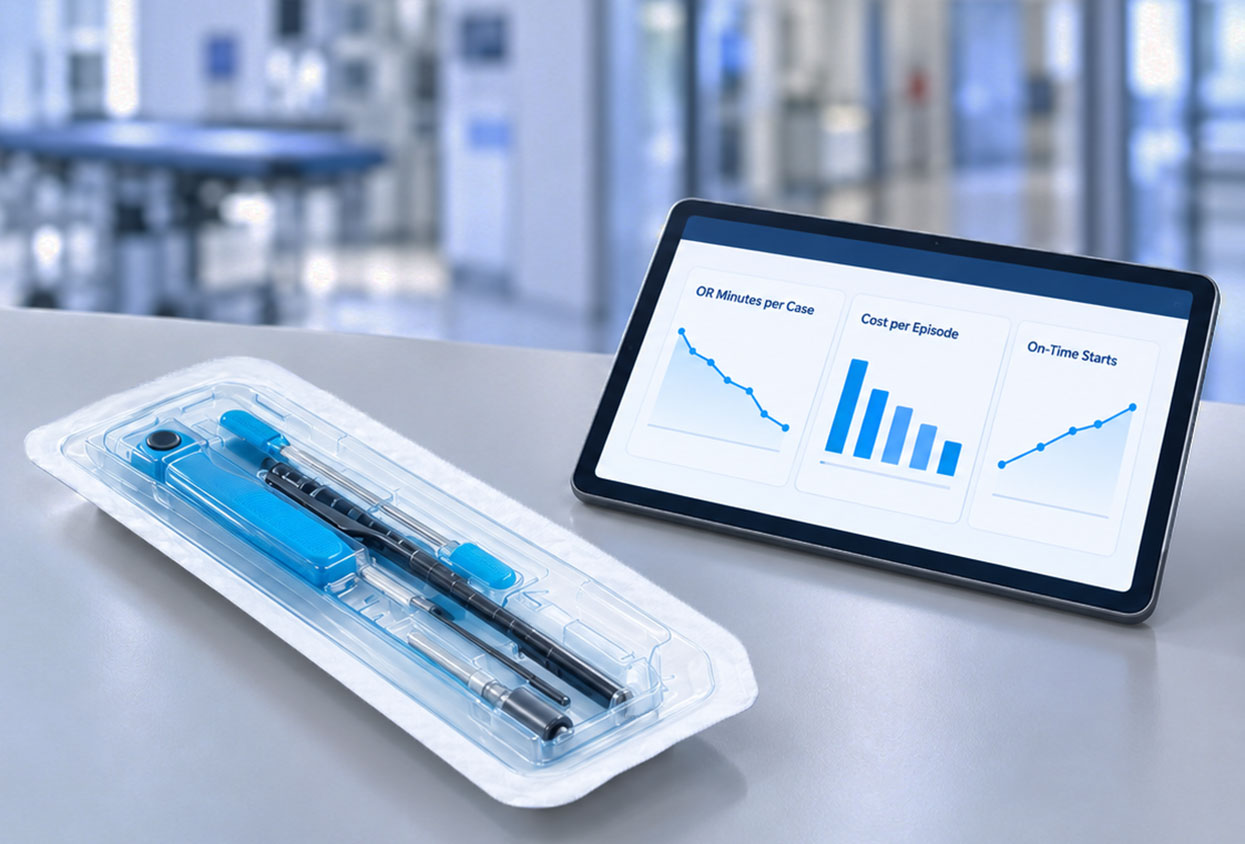
Surgery-Ready™ procedure kits change the equation. By replacing much of the reprocessing workload associated with reusable instruments, they allow ASCs to expand case volume without scaling staffing, sterile processing capacity, or supply chain management in parallel.
Lean staffing models are the norm in outpatient surgery, which leaves little room to absorb more volume without stretching an already tight team. Sterile processing technicians, in particular, are scarce, and training a new one is not a small expense.
One analysis of hospital reprocessing costs put the price of training a single sterile processing employee at around $41,414, a cost that scales with every new hire a growing facility adds just to keep up with reusable tray volume 1. On top of that direct cost, staff turnover in sterile processing introduces ongoing variability in how trays get processed, which is its own source of delay and risk.
This is where the math starts to work against a facility trying to grow the traditional way. Adding one more case block a day might sound simple on a spreadsheet, but if it requires another trained sterile processing technician, the facility is absorbing a five-figure training cost and a hiring timeline before that added volume ever generates a dollar of revenue.
The broader labor market makes this harder still. Sterile processing has struggled with recruitment and retention across the industry for years, and ASCs are often competing for the same limited pool of qualified technicians as larger hospital systems that can offer more resources or higher pay. Growth plans that depend on winning this competition are inherently harder to achieve.
Pre-assembled, sterile, single-use kits require no reprocessing labor at all. There is no cleaning cycle, no inspection step, no reassembly. That single change removes one of the most labor-intensive parts of the surgical workflow, and it is the part that scales worst as case volume grows.
For existing staff, it means less time spent on reprocessing tasks and more time available for the parts of the job that actually require their training and attention. That is a meaningful shift in a facility where every staff hour is already accounted for, and it can also reduce the overtime that reprocessing bottlenecks tend to create at the end of a long case day.
It is worth noting what this does not mean. It does not mean a facility needs fewer skilled people. It means the people already on staff are not spending their time on the labor-intensive process that a Surgery-Ready™ kit removes before it ever arrives at the facility.
Surgery-Ready™ kits reduce the inventory management burden compared to juggling multiple reusable tray sets, each with its own cleaning schedule and storage requirements. Simplified ordering and restocking support predictable case pacing instead of a scramble every time volume ticks up.
Surgery-Ready™ kits enable ASCs to increase case volume without expanding headcount or physical footprint. Instead of investing in additional sterile processing capacity or allocating space for more reusable instrument sets, growth becomes a matter of ordering additional kits—scaling volume in a linear, predictable way without adding operational layers.
By contrast, expanding reusable instrument inventory introduces compounding complexity. Supporting higher volume typically requires capital investment in new sets, additional storage, and increased sterile processing workload, all of which must be tracked, maintained, and cycled alongside existing inventory. A kit-based model avoids this entirely, since scaling simply means ordering more of a standardized solution already integrated into the workflow.
There is also a meaningful planning advantage. Kits follow a straightforward procurement cycle, whereas reusable trays carry independent lifecycles that involve tracking, maintenance, repair, and eventual replacement. Simplifying that system reduces variability and removes a significant operational burden as the facility grows.
Removing just one bottleneck, tray availability, can open up more case slots than might seem possible. One modeling study on total knee arthroplasty found that cutting the number of trays processed per case from eight down to one freed up enough OR time to add a case on up to 51% of operating days, without a single new sterile processing hire 2.
Multiply that across a month, and the picture becomes clearer. A facility running twenty operating days that can now add a case every two day is not looking at a marginal improvement. Its looking at significant improvement.
ECA Medical’s Surgery-Ready™ procedure kits give ASCs a way to increase case volume without adding staff, expanding sterile processing, or introducing new supply chain complexity. The same model also makes it easier to scale across additional locations with a consistent, repeatable approach.
By replacing the operational burden of reusable instrument management with a standardized, procedure-specific solution, Surgery-Ready™ kits simplify growth. Instead of building a larger, more complex operation, ASCs can focus on doing more with the resources they already have.
Learn more about who ECA is and explore kit options for your specialty.
Can an ASC really add more cases per day without hiring more staff?
Yes, when reprocessing is removed or significantly reduced from the equation. Single-use surgical procedure kits eliminate the sterile processing steps that consume staff time between cases, which is often the real ceiling on how many cases a facility can run in a day, not the number of people on staff.
How do surgical procedure kits reduce supply chain complexity?
Consolidated, procedure-specific kits replace a facility's need to order, track, and store multiple reusable instruments and tray sets, simplifying inventory management down to a single, predictable ordering process instead of coordinating cleaning schedules across several sets.
What's the learning curve for staff switching to kit-based workflows?
It is shorter than learning a reprocessing workflow, since there is no cleaning, inspection, or reassembly process to train on. Legacy and new staff can be productive faster with a pre-configured, complete kit, which also shortens the time before a new hire can work independently.
Do surgical procedure kits work for high-volume orthopedic ASCs?
Yes. High-volume specialties like orthopedics tend to see the largest benefit, since they are also the specialties most affected by tray sterilization bottlenecks and turnover delays between cases.
How does kit standardization support multi-surgeon facilities?
Standardized kits give every surgeon and every room the same complete, predictable set, which reduces variability across a facility instead of leaving consistency up to whichever trays happen to be ready that day for whichever surgeon is scheduled next.