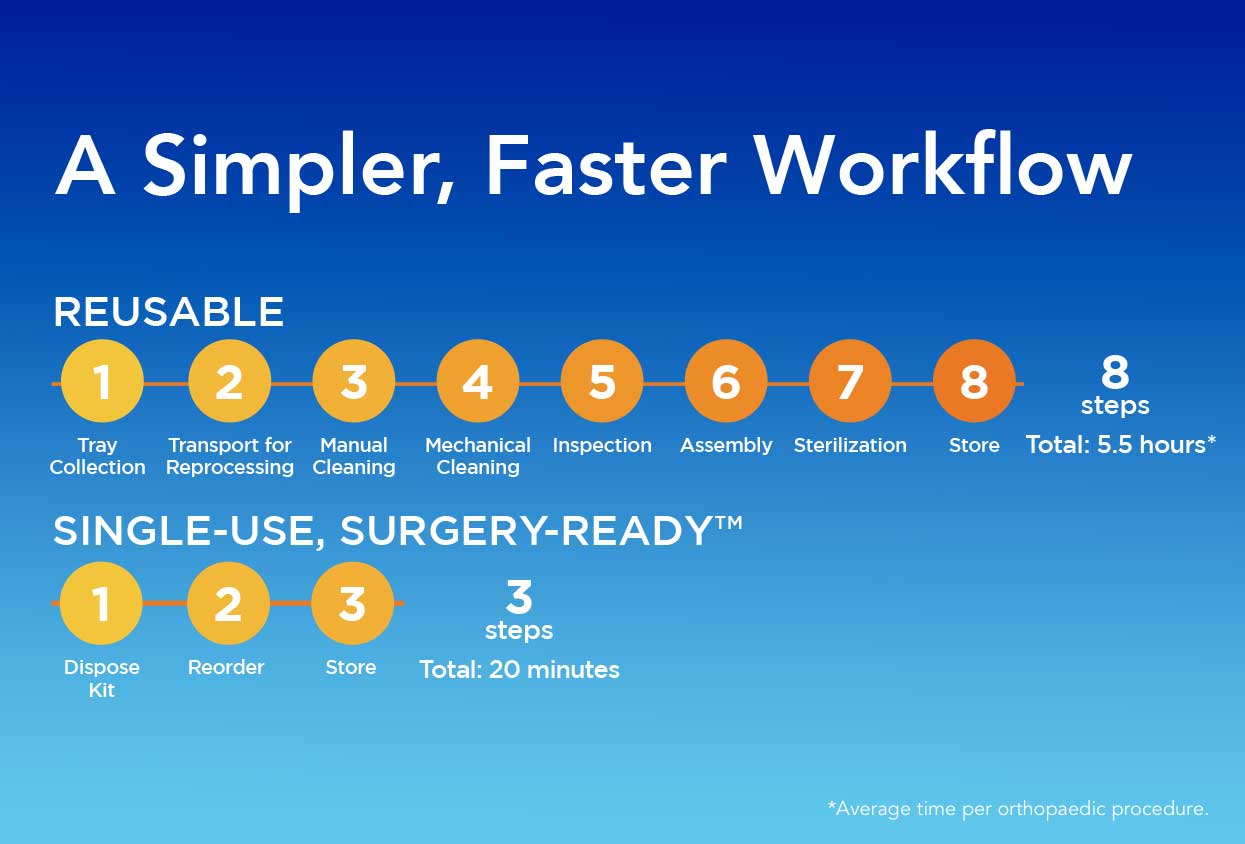
Case prep is not one task; it is a system made up of many small steps, and any one of them can introduce friction or variability into the day. Sterilization, staging, tray assembly, and instrument availability and counts. Each step depends on the one before it going right. ECA Medical Surgery-Ready™ solutions reengineer the entire system.
Most conversations about surgical efficiency focus on what happens inside the OR itself, the surgeon's technique, the anesthesia team's timing, and the way the room is set up. Far less attention goes to everything that happens before the patient ever enters the room, even though that is often where the real variability the possibility of delay originates.
Every step, from sterilization to staging to tray assembly, is a variable that can fail on its own, and none of them fail in isolation. A missed step in sterilization shows up later as a contamination hold. A staging error shows up as a missing instrument mid-case. Small inconsistencies compound across a surgical day, and by the fourth or fifth case, what started as a minor hiccup has become a real delay.
This is why trying to fix one step at a time rarely solves the underlying problem. A facility might tighten up its sterilization process only to find that staging errors are still causing delays, because the two were never actually connected in the first place. The friction moves elsewhere in the chain instead of disappearing.
Treating this as a checklist encourages facilities to try and fix problems one at a time as they appear. Instead, treating case prep it as a system means looking at how each step affects the next, and designing the new whole process so that a failure anywhere along the chain becomes far less likely in the first place.
Reframing changes where a facility looks for improvement. Instead of asking which single step went wrong today, the more useful question becomes why the system allowed that step to go wrong at all, and what would need to change so the same failure could not happen again tomorrow.
Predictable does not mean nothing ever goes wrong. It means reliable starts, reliable turnover, and reliable case pacing, built on reduced dependence on any one person or process performing perfectly every single time. That distinction matters because it shifts the goal from perfection to consistency, which is a far more achievable standard to build a schedule around.
A system built for consistency does not need every person and every step to be flawless. It needs the process itself to make errors less likely and less costly when they do happen, which is a fundamentally different goal than simply asking staff to be more careful or work harder.
This is also where a facility's culture and its systems start to reinforce each other. Staff who trust that a kit will be complete and correct spend less mental energy checking and rechecking, which frees them up to focus on the patient in front of them instead of the process behind the scenes.
Over time, this trust becomes part of how a facility operates. The staff that are not constantly bracing for the next tray problem tend to move through a case day with more focus and less friction, which shows up in everything from staff retention to patient experience.
Friction in an OR rarely announces itself clearly. It shows up as a slightly longer setup, a moment of hesitation while someone checks a tray, a delay that gets absorbed into the schedule without ever being labeled as a problem. Reducing friction means addressing all of those small moments at once, not waiting for one of them to become large enough to notice.
Surgery-Ready™ solutions simplify compliance and chain of custody for every kit, since there is one sterile, complete package instead of baskets of instruments per procedure that have to pass through multiple hands and multiple processing steps. This also reduces cognitive load on surgical staff, who no longer have to double-check tray contents against what should be there. Learn more about how ECA develops these kits.
Chain of custody matters more than it might sound. Every time an instrument moves from the OR to sterile processing and back, there is a record to maintain and a chance for something to go wrong along the way. A single-use kit that goes straight from the package to the field and then to disposal has a far shorter, simpler chain to track or monitor case by case.
The result is that non-value-added operational costs gets removed from the surgical ecosystem instead of being managed around. In a real-world spine surgery time study, switching from reusable to sterile single-use trays cut total perioperative OR handling time from about 26 minutes down to roughly 3 minutes per case, nearly 23 minutes handed back to the schedule with every single case 1. And typically, every minute saved is worth $60-80 to the ASC. 2
Extra Minutes like this also have other effects. They show up as a calmer room, a team that is not rushing to catch up, and a schedule with enough margin to absorb the small surprises that come up on any surgical day without falling behind. This margin is often what separates a facility that runs smoothly from one that is constantly recovering from its own schedule.
Modularity, flexibility, speed, and predictability are becoming baseline expectations for outpatient surgery, not differentiators. ECA Medical’s single-use, Surgery-Ready™ systems are designed for the future of outpatient care, supporting the lean, fast-paced environments in which ASCs operate.
Reusable instrument systems were largely designed around the infrastructure of large inpatient hospitals, with central sterile departments, deep inventory, and staffing levels that most ASCs do not have and are not trying to build. As more procedures continue to move into outpatient settings, the facilities best positioned to take on that volume will be the ones whose case prep does not depend on infrastructure they were never built to carry.
This shift is already underway across orthopedics, spine, and a growing list of other specialties, as procedures once reserved for inpatient hospitals move steadily into ambulatory settings. Facilities that build their case prep around single-use Surgery-Ready™ kits will be in a stronger position to absorb more volume than facilities still trying to scale a hospital-style reprocessing model inside an outpatient footprint.
Efficiency, variability, and operational friction are all symptoms of the same underlying issue: inconsistency in surgical workflows. Surgery-Ready™ solutions address this by replacing fragmented, task-based preparation with a standardized, predictable system. When instruments arrive sterile, assembled, and ready to use, case prep becomes reliable rather than variable. That reliability reduces dependence on sterile processing and makes the day’s schedule easier to plan, manage, and execute.
ECA Medical designs Surgery-Ready™ kits as a full procedural ecosystem, not a single product, covering everything from kit configuration to who ECA is as a manufacturing partner. See how it fits your facility by reaching out to ECA Medical.
What does it mean to treat case prep as a "system"?
It means recognizing that sterilization, staging, tray assembly, and instrument counts are all interdependent steps, where a failure in one creates a delay or risk in the next, rather than treating each step as an isolated task that can be fixed on its own.
How do Surgery-Ready™ solutions reduce variability in surgical outcomes?
By standardizing what is in every kit and removing unneeded instruments as well as manual reprocessing steps, Surgery-Ready™ solutions reduce how much a case's outcome depends on any one person or any one reusable instrument performing perfectly every time.
What kind of operational friction do ASCs face without standardized kits?
Missing instruments, incomplete trays, contamination holds, inconsistent setups between surgeons, and the delays and miscommunication that come with all of it, often compounding across a single surgical day.
How does reducing friction affect surgeon and staff satisfaction?
Smoother, more predictable days mean less last-minute troubleshooting and fewer surprises, which surgeons and staff consistently report as just as important to their day-to-day experience than cost alone.
Is this approach different for high-volume versus low-volume ASCs?
The core benefit, predictability, scales either way. High-volume facilities tend to feel the time savings more in aggregate across the day, while lower-volume facilities benefit most from the reduced staffing and training burden per case.