Picture a new implant that is cleared and ready for market. Surgeons are interested, and the sales team has accounts lined up. Yet adoption waits on something that has little to do with the implant itself: how many instrument sets the OEM can build, ship, and keep in circulation.
Reusable instrumentation is heavy, in every sense. In one life cycle assessment, a reusable lumbar fusion set weighed 45.5 kg across six boxes and eleven trays. The single-use equivalent weighed under 2 kg.¹
For orthopedic and spine implant OEMs, the loaner model ties up capital, freight, and field resources before the first case is booked. Sterile-packed, procedure-specific single-use kits let an OEM scale a launch with surgeon demand instead of with set inventory. This article shows where loaner sets drain capital and time, and how a Surgery-Ready™ kit model changes the launch math.
Every reusable loaner set is a capital asset with ongoing costs. Each one carries a build cost, freight in both directions for every case, instrument replacement, and service and refurbishment over its life.
The life cycle numbers show how those costs compound. The same assessment assumed a reusable set serves about 300 surgeries over five years and loses 10 percent of its instruments each year.¹ In other words, an OEM does not build a set once. It rebuilds part of every set, every year, for as long as the set stays in the field. The model's loaner scenario also routed each set about 3,136 km by truck from the distributor to the hospital, and the same distance back, where the distributor checked and restocked it before the next trip.¹
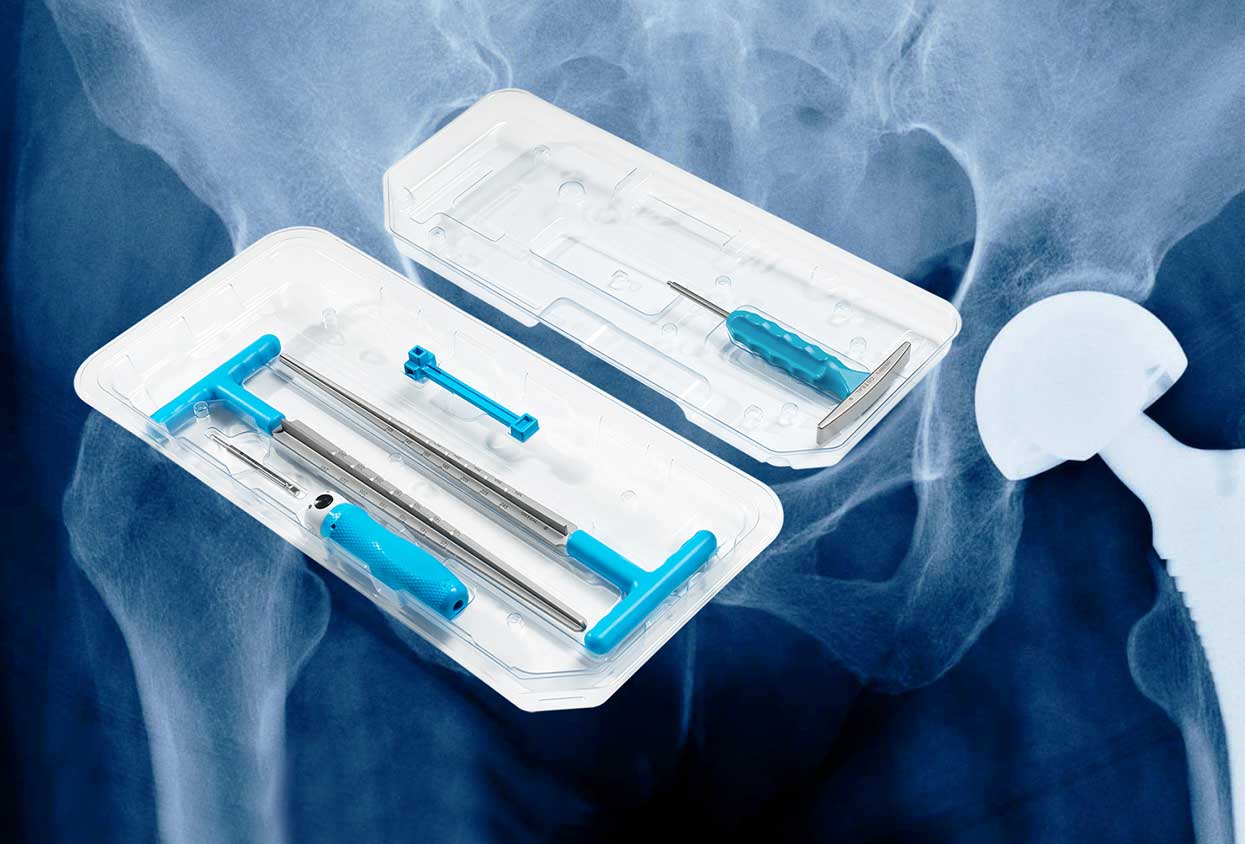
Set contents add to the burden. Conventional pedicle screw systems can ship with up to 7 trays, more than 60 instruments, and more than 200 screws. The single-use system in the same analysis used 1 tray, 5 instruments, and 14 screws, and the average case in that analysis used about five screws.² Every unused screw and instrument in a reusable set still has to be built, shipped, tracked, cleaned, and sterilized.
Loaner sets create work for the facility as well as the OEM. The authors of a Journal of Arthroplasty cost model note that traditional knee instrument sets are typically loaned to the facility by the manufacturer, and that managing their intake, processing, and transport can be a substantial burden.⁴
Timing is another weak point. A review in Clinical Spine Surgery reported that when devices arrive the morning of surgery, or when teams add devices to an existing tray, the procedure is likely to be postponed by at least 5 hours, at an estimated $187.50 per hour of delay.³ In a spinal fusion study cited by Abdalla, the reusable system was unavailable at the time of surgery in 2 of 20 cases, or 10 percent.² Abdalla's own analysis found the single-use system saved an average of 21 minutes of OR time per case.²
For an OEM, these are not just facility problems. Every late or incomplete set erodes surgeon confidence in a new implant. A surgeon who waits on instruments during an early case is less likely to schedule the next one.
Launch math is simple. The number of active sets caps how many surgeons can use a new implant in the same week. If every set is in transit, in sterile processing, or in a case, the next surgeon waits. Adding capacity means building more sets, which ties up more capital before demand is proven.
Single-use kits break that link, because each kit is built for one case and ships ready to open. A health technology assessment of a disposable pedicle screw kit for lumbar arthrodesis found that the manufacturer could supply kits on request faster than the standard sterilization process allows. The smaller kit also made internal transport and storage easier.⁵ The authors added that supply speed depends on the agreement between supplier and hospital, which makes it a launch-planning decision.⁵ With the right supply plan, kits can follow surgeon demand case by case, without waiting for sets to cycle back.
Single-use Surgery-Ready™ kits also let OEMs standardize the instrument experience across every account from the first case. Each surgeon opens the same configuration, in the same condition, at every facility. There is no variation from worn instruments, missing pieces, tray assembly errors, or sterilization delays.
The shift to outpatient orthopedics raises the stakes, and it sped up in 2026. Total knee arthroplasty joined Medicare's ASC Covered Procedures List for 2020, and total hip followed for 2021.⁶ For 2026, CMS began a three-year phase-out of the inpatient-only list, starting with 285 mostly musculoskeletal services.⁷ The 2026 rule also added 168 orthopedic codes to the ASC list, including revision total hip and revision total knee arthroplasty.⁸ The CY 2027 final rule, issued November 4, 2026, removes 637 more services from the inpatient-only list in the phase-out's second year.⁹ Implant OEMs now sell into a growing number of sites that were not built around large sterile processing departments.
ASCs typically have less storage and sterile processing capacity than hospitals, which is where single-use instruments deliver the most benefit.¹⁰ At one center, single-use instrumentation reduced a six-tray knee system to a single tray of metal instruments to sterilize per case.¹⁰ A six-box loaner set is a poor fit for a center that has to turn rooms quickly and has little space to stage instruments.
OEMs that arrive with sterile, procedure-specific kits remove a barrier to ASC adoption. The kit fits the way an ASC operates, which makes the implant easier to say yes to.
Moving from loaner sets to single-use kits is a development project, and it works best with a partner who handles the full path from concept to supply. A typical program covers:
ECA Medical works as a Surgery-Ready™ solutions partner for implant OEMs, supporting each of these stages, with more than 300,000 sterile kits distributed worldwide.¹¹ See how ECA approaches developing your kit, or explore ECA's procedure kits and single-use surgical instruments.
Reusable loaner sets were built for inpatient hospitals with large sterile processing departments. Launch models for the ASC era need instrumentation that ships ready and scales with demand. For implant OEMs, single-use Surgery-Ready™ kits turn instrumentation from a capital constraint into a launch platform.
If a new implant is on your roadmap, now is the time to decide how it will reach the OR: in a reusable loaner set that has to be built, shipped, and reprocessed, or in a single-use kit that arrives ready for the case. Contact ECA to start a kit development conversation ahead of your next launch.
What does a reusable loaner set really cost an implant OEM?
Beyond the build cost, a loaner set carries round-trip freight for each case, instrument replacement, service, and field support. One life cycle model assumed a set loses 10 percent of its instruments each year.¹
How do single-use kits speed up an orthopedic implant launch?
They remove the cap that set inventory places on adoption. Kits can be supplied as surgeons schedule cases, instead of waiting for reusable sets to return and be reprocessed.
Can single-use kits work alongside existing reusable instrument sets?
Yes. An OEM can start with a high-volume procedure or a new implant line and keep reusable sets in place for other systems during the transition.
Why do ASCs prefer sterile-packed instrumentation?
ASCs typically have less storage and sterile processing capacity than hospitals.¹⁰ Sterile-packed kits arrive ready for the case, which supports faster turnover and multi-case days.
How long does it take to develop a procedure-specific single-use kit?
Timelines depend on kit complexity, the number of instruments, and validation requirements. An early conversation with a kit partner helps align development with the launch schedule.
1. Leiden A, Cerdas F, Noriega D, Beyerlein J, Herrmann C. Life cycle assessment of a disposable and a reusable surgery instrument set for spinal fusion surgeries. Resources, Conservation and Recycling. 2020;156:104704.
2. Abdalla Y. Value based healthcare: Maximizing efficacy and managing risk with spinal implant technology. Interdisciplinary Neurosurgery. 2020;22:100810.
3. Agarwal A, MacMillan A, Goel V, Agarwal AK, Karas C. A paradigm shift toward terminally sterilized devices. Clinical Spine Surgery. 2018;31(7):308-311.
4. Goldberg TD, Maltry JA, Ahuja M, Inzana JA. Logistical and economic advantages of sterile-packed, single-use instruments for total knee arthroplasty. The Journal of Arthroplasty. 2019;34(9):1876-1883.e2.
5. Ottardi C, Damonti A, Porazzi E, et al. A comparative analysis of a disposable and a reusable pedicle screw instrument kit for lumbar arthrodesis: integrating HTA and MCDA. Health Economics Review. 2017;7:17.
6. Centers for Medicare & Medicaid Services. CY 2020 OPPS/ASC Final Rule (CMS-1717-FC) fact sheet, November 1, 2019; CY 2021 OPPS/ASC Final Rule (CMS-1736-FC) fact sheet, December 2, 2020
7. Centers for Medicare & Medicaid Services. CY 2026 OPPS/ASC Final Rule with Comment Period. Federal Register. November 25, 2025.
8. Becker's ASC Review. The procedures that shifted to the outpatient model in 2026.
9. Centers for Medicare & Medicaid Services. CY 2027 OPPS/ASC Final Rule (CMS-1850-F) fact sheet, November 4, 2026.
10. Crawford DA, Lombardi AV Jr, Berend KR. Improving operating room efficiency with single-use disposable instruments for total knee arthroplasty. Surgical Technology International. 2022;40.
11. ECA Medical. Developing Your Procedural Kit.