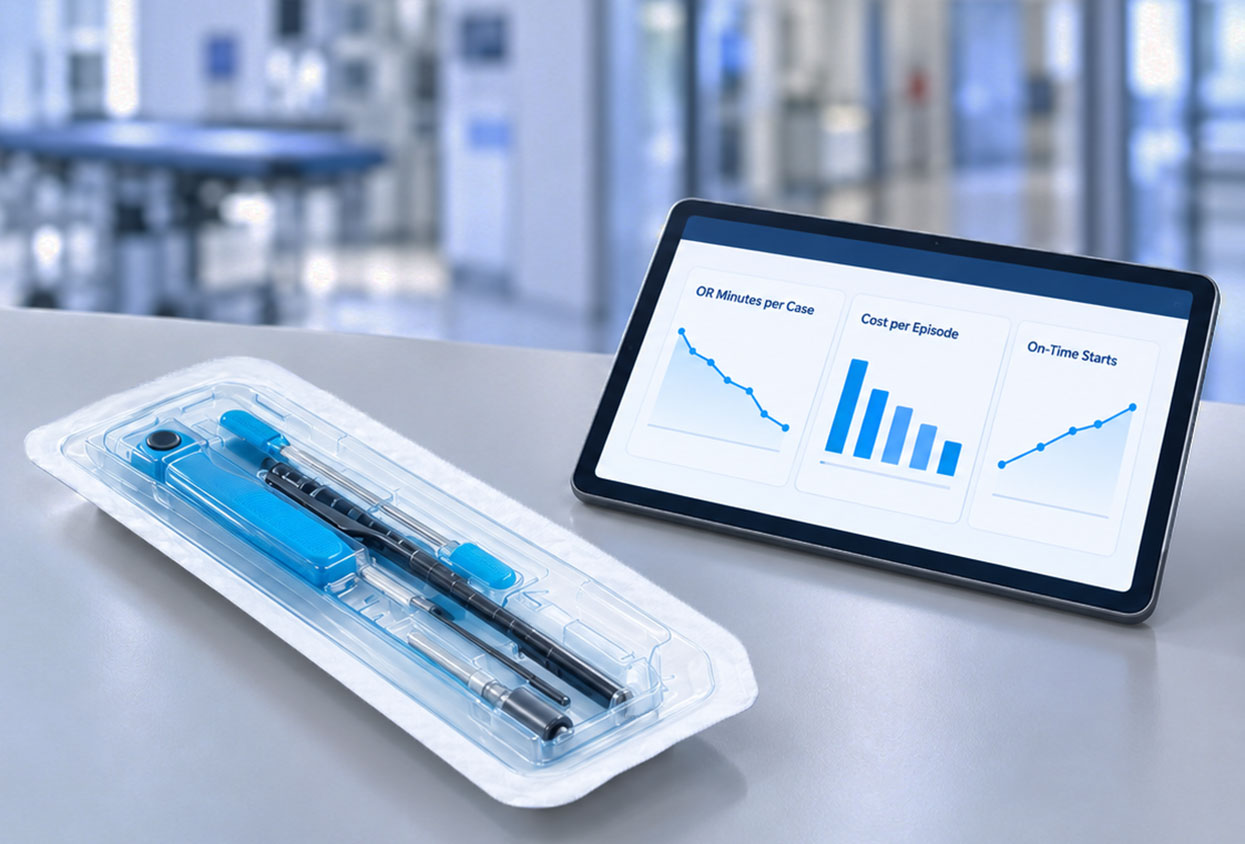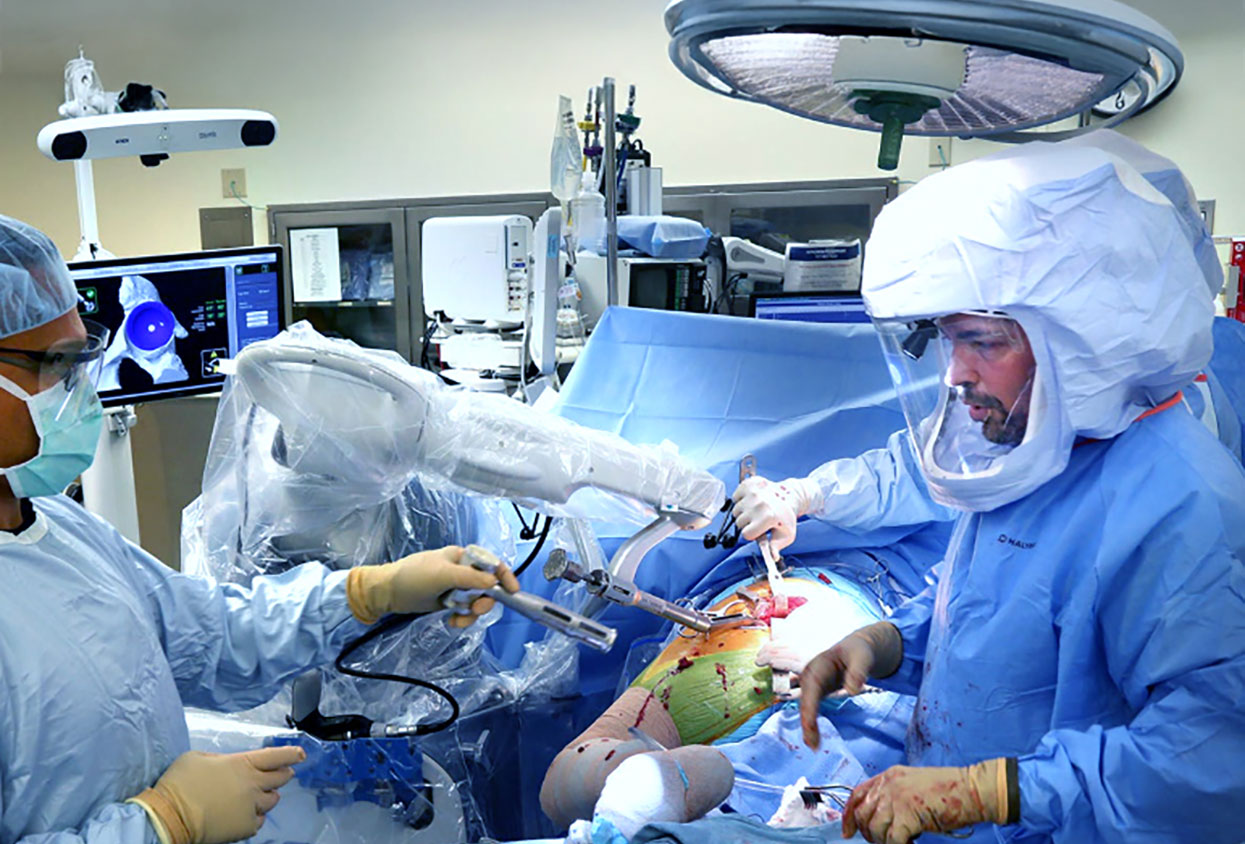
Running an ambulatory surgery center means managing every variable that affects whether cases start on time, run smoothly, and turn over efficiently. Most of those variables are clinical. Some are logistical. And a growing number of ASC administrators are recognizing that instrument management carries one of the largest operational footprints in the building. Sterile single-use, surgery-ready instrument kits offer a path to shrink that footprint significantly and reduce avoidable workflow variability.[1]
This is not just a product trend. It is a structural shift that aligns directly with how ASCs create value: by moving through more procedures safely, efficiently, and predictably, with as few moving parts as possible.[1]
Time is the primary economic driver in an ASC. Not time in the abstract, but time in very specific terms: when the first case starts, how long turnover takes, and whether the third and fourth cases of the day run at the pace the schedule assumed. When those variables behave predictably, the ASC runs more efficiently. When they do not, the financial consequences compound quickly through overtime, delayed discharges, frustrated surgeons, and lost case capacity.
Reusable instrument management introduces complexity into each of these variables. Trays can come back from reprocessing incomplete. Instruments can fail inspection. Sterilization cycles can run long because the previous case finished late. Immediate-use steam sterilization can fill the gap, but a study of adult hip and knee arthroplasty found that only 9.5% of immediate-use steam sterilization events involved an acceptable indication. In that same study, 45.2% of IUSS events occurred because instruments were received unsterile, and 37.5% were tied to operating room turnover pressure rather than a true emergency need.[2]
These are not rare edge cases. They are documented examples of the recurring friction points that busy surgical teams deal with when instrumentation depends on repeated in-house reprocessing.[1][2]
Sterile processing staffing was already a challenge before the healthcare workforce disruptions of recent years. In outpatient surgery, that challenge is even sharper because ASCs typically operate with lean teams and limited redundancy. Training new sterile processing staff to manage complex reusable sets takes time, and inconsistency during that training period can create the kind of process variation that follows the surgeon and patient into the OR.[1]
Single-use surgical instrument kits reduce that dependency. When instruments are used once and disposed of, the sterile processing workload shifts away from decontamination, assembly, packaging, and sterilization and toward inventory control and case readiness. For ASC administrators managing lean teams, that reduction in operational dependence is not just a convenience. It contributes to greater workflow consistency and less exposure to staffing-related variability.[1]
The practical effects of switching to sterile single-use surgical instrument kits become clearest when you follow a typical procedure day. With reusable systems, an ASC’s sterile processing team has to receive trays, decontaminate and reprocess them, inspect and package each set, run sterilization cycles, and have sets confirmed and available before the first case. Between cases, that cycle begins again. Any slip in that chain can produce a delayed start or a compromised setup.[1]
With single-use, surgery-ready kits, that cycle is removed. Sterile kits are stored in the facility, pulled before the case, opened at the sterile field, and disposed of after the procedure. There is no inter-case reprocessing, no instrument transport back through sterile processing, and less dependence on turnover speed to determine case readiness.[1]
Peer-reviewed modeling in total knee arthroplasty found that single-use instrumentation reduced median total costs by $994 per case. The same study found that single-use instrumentation reduced turnover-related time enough that an additional case could potentially be completed on 10.8% of 8-hour operating days, 29.3% of 10-hour operating days, and 51.0% of 12-hour operating days.[2] In an ASC, the exact numbers will vary by procedure mix, but the operational principle is the same: when you remove reprocessing dependency, you recover schedule capacity.
The most common objection to sterile single-use surgical instrument kits in ASC settings is cost. That objection makes sense when the comparison is confined to unit price. It becomes much less convincing when the full cost of reusable systems is properly mapped.
In the Journal of Arthroplasty modeling study, tray sterilization was the single largest cost driver for reusable systems, followed by tray management logistics and OR turnover costs.[2] In a separate health technology assessment of lumbar arthrodesis instrumentation, the total process cost was slightly lower for the disposable kit than for the reusable one (€4,242.6 vs. €4,279.1), and the analysis found meaningful organizational advantages related to storage, purchasing, internal handling, and traceability.[3]
That is the better way to think about the economics. SPD labor, sterilization supplies, packaging materials, equipment maintenance, tray logistics, repair, and delay-related disruption all carry cost. Surgery-ready procedural kits move much of that operational burden out of the facility and into a more transparent per-case model.[1][2][3]
Sterile single-use surgical instrument kits are not simply a clinical preference for ambulatory surgery centers. They are a system design choice that affects OR throughput, staffing efficiency, compliance burden, and financial predictability.[1][2][3]
That is why this conversation should not be framed only as single-use versus reusable. It should be framed as whether the instrumentation model fits the ASC operating model. Reusable systems were built for environments with larger sterile processing departments, deeper tray inventory, and more scheduling buffer. ASCs were not.[1]
ECA Medical approaches this need as a Surgery-Ready solutions partner, not simply as a single-use instrument supplier. Purpose-built, sterile-packed, procedure-specific kits align instrumentation with the operational realities of outpatient surgery: speed, consistency, traceability, and fewer moving parts.[1]
Sterile single-use surgical instrument kits help ASCs reduce operational drag by taking repeated reprocessing steps out of the surgical workflow. Evidence on IUSS misuse, turnover-related sterilization pressure, tray sterilization cost, and procedure-day capacity all points in the same direction: fewer process-dependent steps can support more reliable and efficient surgical operations.[1][2][3]
For facilities trying to improve both workflow predictability and surgical readiness, the strongest advantage of single-use kits is not convenience alone. It is the ability to replace a variable, labor-intensive process with a more controlled and repeatable one.[1][2][3]
How do sterile single-use surgical instrument kits affect OR turnover time in an ASC?
Single-use kits remove the inter-case reprocessing cycle from the workflow. Because used kits are disposed of rather than returned to sterile processing, turnover involves removing used materials and opening the next kit rather than waiting for instruments to clear reprocessing. Research in orthopedic procedure modeling found enough turnover-related time savings to create capacity for additional cases on a meaningful percentage of OR days.[1]
What happens to ASC staffing requirements when facilities move away from reusable instrument systems?
Sterile processing requirements decrease meaningfully. With single-use kits, the workload shifts from managing complex reprocessing cycles to receiving, storing, and documenting kit inventory. That reduces reliance on scarce sterile processing labor and supports more consistent execution.[1]
Are there compliance advantages to using single-use instrument kits over reusables?
Single-use kits simplify sterility assurance because the instruments arrive terminally sterilized and ready for use, rather than depending on repeated in-house reprocessing steps. That can reduce reliance on workaround practices such as IUSS and make case documentation and readiness more straightforward.[1][2]
How do single-use kits affect the overall financial performance of an ambulatory surgery center?
The strongest economic case appears when the full cost of reusable operations is counted, including SPD labor, sterilization supplies, equipment maintenance, tray logistics, and OR delay. Published studies found meaningful cost savings or near-cost parity alongside organizational benefits, rather than a simple price-premium story.[1][3]
Can an ASC transition fully to sterile single-use instrument kits, or do some procedures still require reusables?
That depends on the facility’s procedure mix and how broadly procedure-specific kits are available. Many centers adopt them first in high-volume or high-friction procedures where the operational benefit is easiest to measure.[1]
[1] Goldberg TD, Maltry JA, Ahuja M, Inzana JA. Logistical and Economic Advantages of Sterile-Packed, Single-Use Instruments for Total Knee Arthroplasty. The Journal of Arthroplasty. 2019.
[2] Zuckerman SL, Parikh R, Moore DC, Talbot TR. An Evaluation of Immediate-Use Steam Sterilization Practices in Adult Knee and Hip Arthroplasty Procedures. American Journal of Infection Control. 2012.
[3] Ottardi C, Damonti A, Porazzi E, et al. A comparative analysis of a disposable and a reusable pedicle screw instrument kit for lumbar arthrodesis integrating HTA and MCDA. Health Economics Review. 2017.