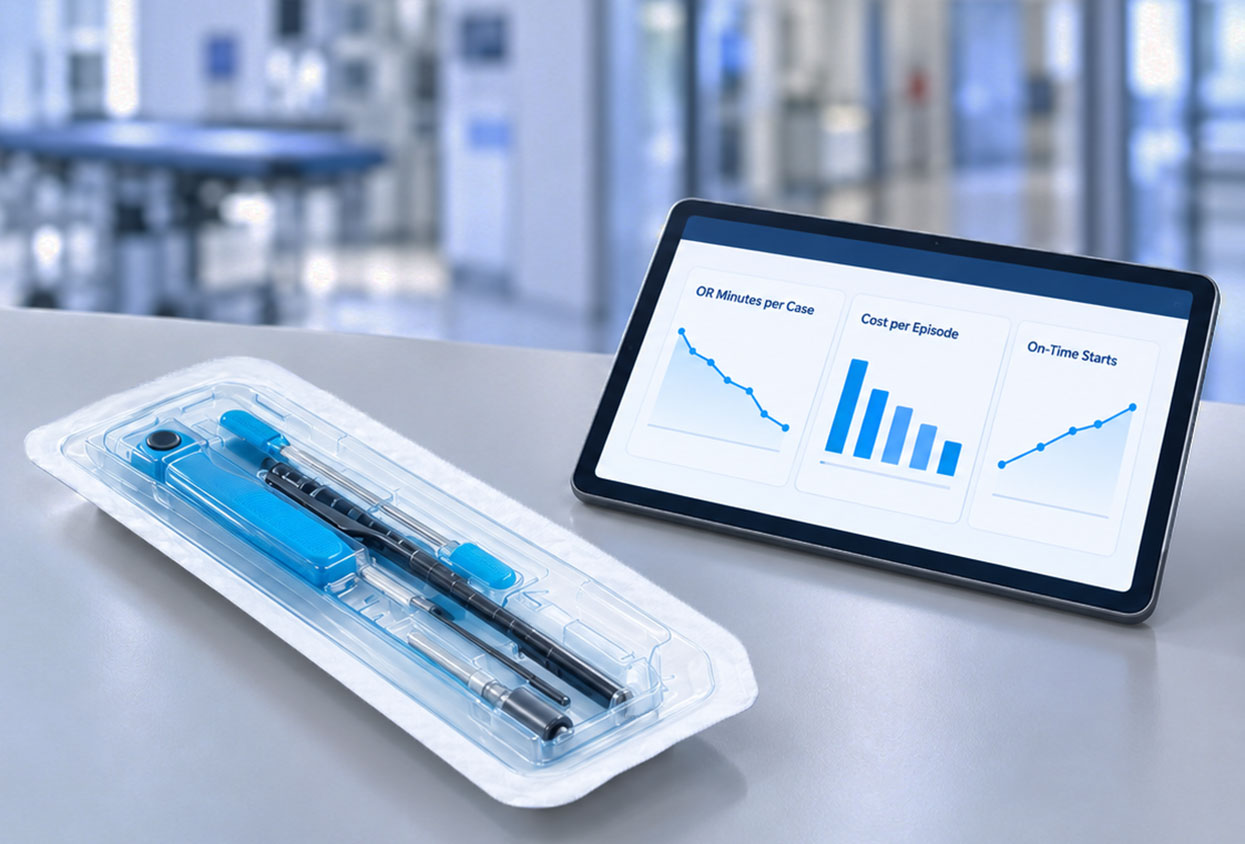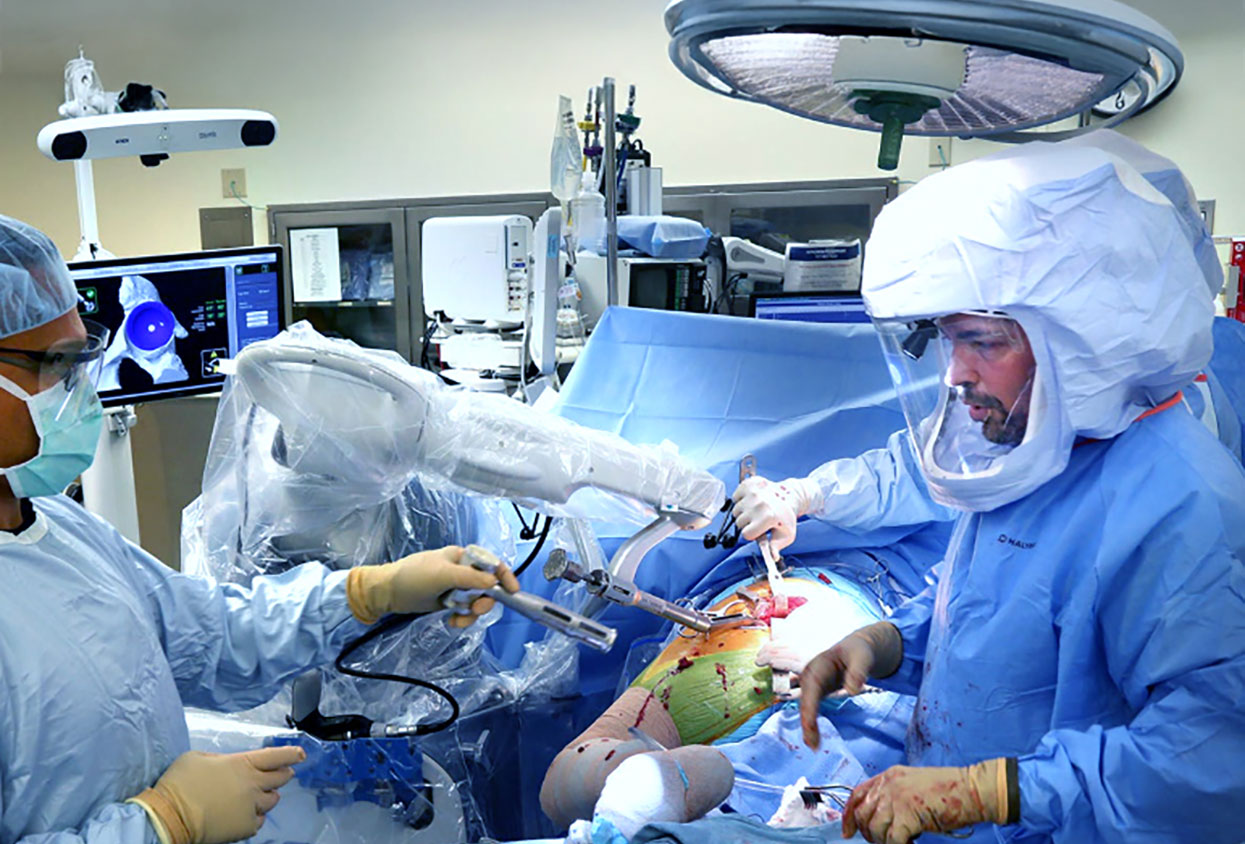
Many ASCs reach a point where adding cases becomes unexpectedly difficult despite strong demand and available OR time. The constraint often isn’t clinical or scheduling—it’s sterile processing. Reusable instrument trays frequently sit at the center of that limitation, and a full lifecycle analysis reveals their true impact on staffing requirements, processing bottlenecks, and overall expansion capacity.
The growth ceiling nobody puts on the schedule.
Sterile processing capacity quietly caps how many cases a site can run. To grow on reusables, you usually have to expand what supports them first: more SPD space, more staff, more sterilization equipment, and more storage. That constraint is structural, not a matter of effort. You can have open OR time and still be unable to use it because instruments cannot be turned around fast enough to support additional cases.
Following a reusable tray through its full lifecycle
A reusable tray's real cost lies includes everything that happens between cases, transport, inspection, cleaning, sterilization, storage, and handling. The instrument's price may be the smallest line on the page once you account for the labor and energy it consumes between every proceedure. A life cycle assessment comparing disposable and reusable spinal fusion instrument sets found that the cleaning and sterilization process was responsible for up to 90 percent of the greenhouse gas emissions, and that this process determined which system was more advantageous environmentally.1 That figure is a vivid proxy for the hidden operational load, too, because the same reprocessing burden that drives emissions also drives labor, time, and bottlenecks. It also complicates the easy assumption that reusable automatically means greener, which is why environmental impact deserves a closer look than it usually gets.
The staffing reality behind every reusable instrument tray
Every reusable tray is a labor commitment. Reusable systems are labor-intensive by design, and that runs straight into one of the hardest realities ASCs face: sterile processing staffing. Shortages, training variability, rising labor costs, and turnover all make reprocessing capacity harder to scale than just floor space. The strain shows up in the data; the same immediate-use steam sterilization study found 37.5 percent of flash events were performed just to support OR turnover, a readiness gap that signals a system stretched thin.2 Single-use, Surgery-Ready™ systems reduce dependence on this scarce, skilled labor, which may become one of the strongest adoption drivers for single-use kits over the next decade.
Supply chain reliability belongs in the same conversation, and it became impossible to ignore after the disruptions of recent years. Loaner logistics, tray shipping, missing instrumentation, and damaged sets are all points where a reusable workflow can fail before a case even reaches the OR. A center that depends on a tray arriving, being complete, and being reprocessed on time is exposed at every one of these functions. A validated, dock-to-stock single-use kit collapses much of that exposure into a single, predictable delivery, which is one less thing standing between a missed schedule and a smooth one.
Expanding capacity without expanding SPD
Here is the strategic payoff. Single-use, surgery-ready kits let an ASC add volume without scaling sterile processing in proportion. Fewer trays to reprocess means fewer bottlenecks, more predictable turnover, and more room to grow. The economics back this up. A health technology assessment of disposable versus reusable pedicle screw kits found comparable total cost alongside advantages in organizational impact, including the elimination of pre- and post-operative sterilization time.3 And a total knee arthroplasty study found single-use instruments could have freed an additional case on up to 51 percent of operating days through time savings alone.4 That is the expansion capacity you unlock without building out more SPD.
Treating the tray as a planning decision, not a purchase
The reason this constraint stays invisible for so long is that reusables are budgeted as a one-time purchase, while their real cost is recurring and operational. Each cycle consumes labor, energy, sterilizer time, and storage, and each of those is a cost you could have applied on a case or even the bottom line instead. When an ASC plans for growth, the instrument tray should be modeled the way you would model any throughput bottleneck, by asking how much volume it can support before it forces you to add staff or equipment behind it.
Reframed that way, the question stops being which instrument is cheaper per unit and becomes which system lets you grow with the least added complexity and overall cost. A reusable tray that looks inexpensive on the invoice can be the most expensive thing in the building if it caps how many cases you can run. A single-use, surgery-ready instrument system carries a visible per-case cost, but it doesn’t change when growth happens, and scalability is exactly what a successful ASC is buying.
There is a sustainability dimension worth weighing here, too, because the easy assumption usually runs the wrong way. The same lifecycle evidence that flags reprocessing as the dominant operational load also shows that single-use does not automatically carry a larger environmental footprint once sterilization is accounted for. For administrators who care about environmental impact alongside capacity, a 2020 lifecycle assessment report on single-use vs. reusable instruments showed single-use instruments to have significantly lower impact on the environment.
• Environmental advantage of the single-use sets indicated a benefit of 45-85% across all impact categories with the single score indicator depicting an overall benefit of 75%.
• Main drivers were the high environmental impact of the steam sterilization and transportation used for reusable instrument sets. 5
Conclusion
So, are reusable instrument trays limiting our ASC growth? For many centers, the answer is yes, and a full lifecycle analysis usually reveals that staffing and sterile processing bottlenecks, not square footage, are the real constraint. The instrument price was not usually the point. Once you account for the labor, energy, and the readiness burden each tray carries, single-use, surgery-ready systems look less like a supply choice and more like a way to grow without rebuilding the back of the house or increasing the ASC physical footprint.
ECA Medical: helping ASCs map the hidden cost of reusables
ECA Medical helps ASCs see the full lifecycle picture and grow with surgery-ready™ solutions that negate the reprocessing and other associated burdens. As the world leader in single-use, sterile-packed kits and instruments, we turn sterile processing constraints into expansion capacity. See why single-use adds up across the lifecycle, or talk with our team about modeling the true cost of your trays.
FAQs
How do reusable trays limit ASC case capacity?
They tie throughput to sterile processing speed. If trays cannot be cleaned, sterilized, and turned around fast enough, open OR time goes unused. Growing on reusables usually means expanding SPD staff, equipment, and space first, which is slow and costly.
What hidden costs show up in a tray lifecycle analysis?
Transport, inspection, cleaning, sterilization, storage, and handling on every single cycle. A life cycle assessment found cleaning and sterilization drove up to 90 percent of the environmental impact for reusable sets,1, a strong signal of how much operational load sits downstream of the purchase price.
Can an ASC grow volume without adding sterile processing staff?
Largely, yes. Single-use, surgery-ready systems remove sets from the reprocessing queue, so added cases do not require a proportional increase in SPD labor. That decoupling of growth from sterile processing capacity is the central advantage.
How do I calculate the true cost of my reusable trays?
Add the per-cycle labor, energy, and reprocessing time to the instrument cost, then weigh it against the throughput you lose to turnover and readiness gaps. Studies comparing disposable and reusable kits often find comparable total cost once the organizational burden is included.3
Sources
1. Leiden A, Cerdas F, Noriega D, Beyerlein J, Herrmann C. Life cycle assessment of a disposable and a reusable surgery instrument set for spinal fusion surgeries. Resources, Conservation & Recycling. 2020;156:104704.
2. Zuckerman SL, Parikh R, Moore DC, Talbot TR. An evaluation of immediate-use steam sterilization practices in adult knee and hip arthroplasty procedures. American Journal of Infection Control. 2012;40(9):866–871.
3. Ottardi C, Damonti A, Porazzi E, et al. A comparative analysis of a disposable and a reusable pedicle screw instrument kit for lumbar arthrodesis: integrating HTA and MCDA. Health Economics Review. 2017;7:17.
4. Goldberg TD, Maltry JA, Ahuja M, Inzana JA. Logistical and Economic Advantages of Sterile-Packed, Single-Use Instruments for Total Knee Arthroplasty. The Journal of Arthroplasty. 2019;34(9):1876–1883.
5. Leidena, Cerdasa , Noriegab , Beyerleinc, Herrmann Life cycle assessment of a disposable and a reusable surgery instrument set for spinal fusion surgeries; Insitute of Machine Tools and Production Technology (IWF), Technische Universität Braunschweig, Germany b Servicio de Cirugía Ortopédica y Traumatología, Hospital Clínico Universitario de Valladolid, Valladolid, Spain c ATOS Klinik Fleetinsel, Hamburg, Germany, January 2020