Every clinical team shares the same goal at the start of a procedure: Instruments should be ready, complete, sterile, and exactly where they are expected to be. Yet many healthcare environments continue to experience hidden friction tied to reusable instrument workflows. Delayed tray availability, reprocessing backlogs, missing components, and last-minute substitutions quietly interrupt otherwise well-coordinated surgical preparation.
Reusable instruments remain essential across healthcare, but growing operational pressure has forced organizations to reexamine where reuse introduces unnecessary variability. Tight schedules, staffing challenges, and increasing procedural volume leave little margin for disruption. When preparation becomes reactive rather than predictable, even experienced teams feel the strain.
This guide offers a calm and practical look at when adopting Single-Use, Surgery Ready™ Instruments in Clinical Settings becomes a smart operational decision long term. This discussion focuses on workflow stability, safety considerations, cost realities, and implementation strategies that support thoughtful adoption without oversimplifying the decision.
Healthcare organizations rarely ask whether reusable or single-use tools are universally better. The more relevant question is where reliability carries the greatest operational weight.
Clinical environments are managing higher procedural throughput alongside constrained resources. Sterile processing departments operate near capacity, staffing fluctuations affect turnaround consistency, and operating room schedules allow minimal recovery time between cases. These pressures expose weaknesses that may have existed quietly for years.
Most facilities are not attempting to eliminate reusable systems. Instead, leaders seek stability at recurring points of failure. Introducing Single-Use Instruments in Clinical Settings often begins with addressing specific disruptions rather than redesigning entire workflows.
Predictable preparation creates a noticeably calmer environment. When instruments arrive sterile, clearly labeled, and organized for immediate use, setup becomes visually intuitive. The sterile field feels orderly and controlled, reducing cognitive strain during high-focus work.
That sense of visual clarity supports smoother handoffs between staff and fewer interruptions during preparation. Small improvements in organization can translate into meaningful reductions in stress and setup variability.
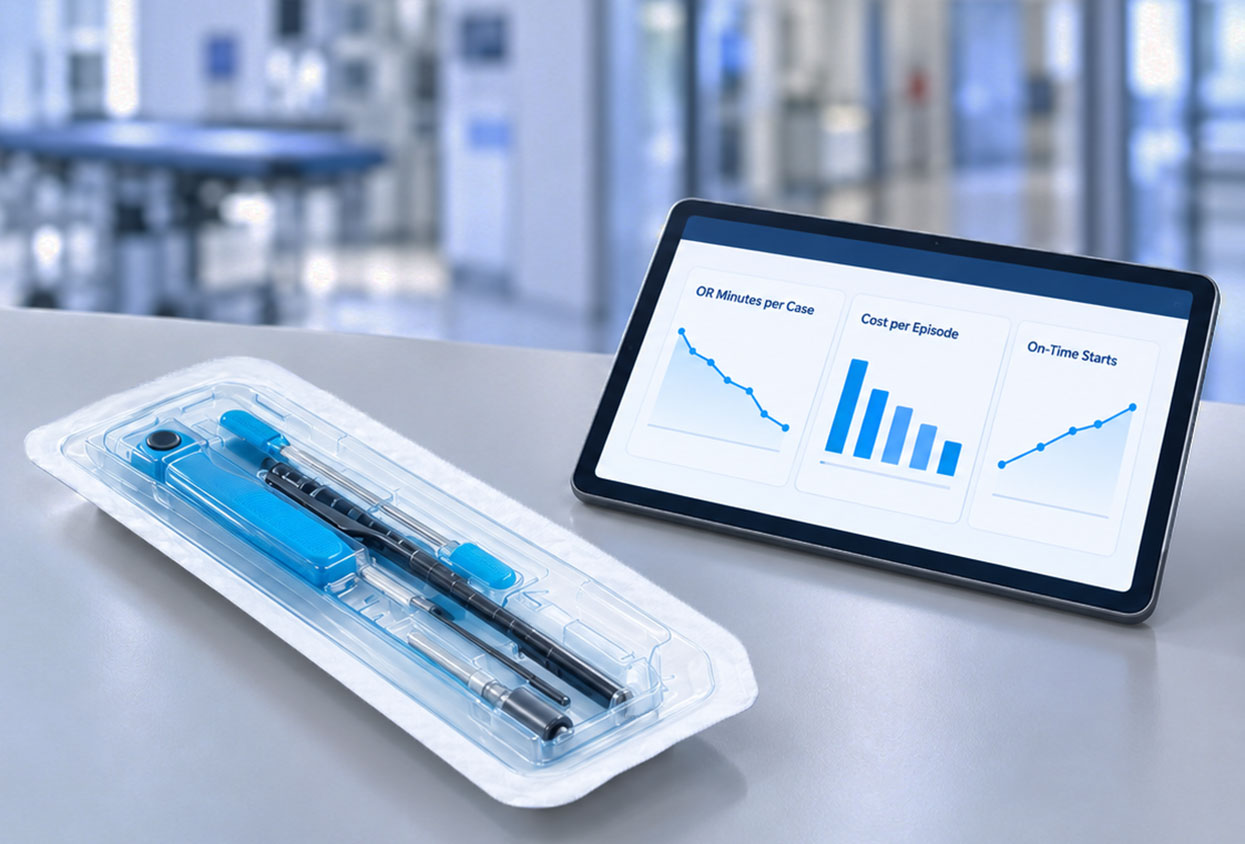
Replacing reusable tools should lead to measurable outcomes. Fewer delays, fewer substitutions, improved availability, and more consistent setup sequences define success. Decisions surrounding Single-Use Instruments in Clinical Settings work best when grounded in operational evidence rather than theoretical advantages.
Reusable workflows function effectively in many environments, yet certain conditions repeatedly introduce inefficiencies.
Instrument turnaround depends on cleaning, inspection, sterilization, drying, and redistribution. Any delay within this chain can ripple into case preparation. Wet packs, incomplete indicators, or limited sterilization capacity often result in postponed starts or rushed adjustments.
These challenges rarely reflect shortcomings within sterile processing teams. Instead, increasing demand stretches systems designed for earlier procedural volumes. Introducing Single-Use Instruments in Clinical Settings can relieve pressure by removing selected components from the reprocessing cycle entirely.
Loaner trays, shared instrument sets, or split inventory frequently create uncertainty. Teams may discover missing items during draping or staging, forcing rapid workarounds. Staff compensates through experience, but variability increases the workload.
Consistency improves when essential tools arrive ready and reliably available. Predictable access through Single-Use Instruments in Clinical Settings reduces reliance on coordination across multiple departments.
Repeated substitution of instruments due to availability issues slows preparation and increases the risk of setup confusion. Variations in design, sizing, or handling characteristics require adaptation in real time.
Consistency supports performance. Standardized instrumentation through Single-Use Surgery-Ready™ Instruments in Clinical Settings allows teams to develop repeatable workflows that reduce hesitation and improve efficiency.
Certain procedural environments naturally benefit from standardization.
Procedures performed daily or multiple times per week rely heavily on predictable preparation. Repetition amplifies the impact of small inefficiencies. Reducing decision points during setup helps teams maintain consistent pacing across cases.
Busy orthopedic service lines, outpatient environments, and ambulatory surgery centers frequently see workflow stabilization after adopting Single-Use Instruments for targeted procedural steps.
Some procedural steps demand consistent performance and traceable documentation. Precision Single-Use Surgery-Ready™ torque-limiting instruments represent one example where repeatability matters greatly. Reliable performance helps teams execute critical fixation steps with confidence.
In these scenarios, Single-Use Instruments support standardization without requiring ongoing calibration or maintenance between cases.
Many delays originate from a single unavailable accessory. Staff may open additional trays, call runners, or pause workflow entirely. Single-use systems reduce dependence on multiple supply sources, lowering the likelihood of disruptive gaps.
By consolidating essential components, Single-Use Instruments in Clinical Settings help maintain procedural momentum.
Discussions around infection prevention should remain balanced and factual.
Single-use tools arrive sterile and ready for immediate use, reducing dependency on internal processing steps for those items. This simplification removes complexity from preparation rather than replacing established sterilization expertise.
Adopting Single-Use Instruments in Clinical Settings is not about replacing sterile processing teams but supporting them by reducing workload where variability carries risk.
Single-use products still require disciplined handling. Packaging integrity, sterility indicators, storage conditions, and inspection protocols remain essential. Single-use does not eliminate responsibility for verification.
Proper implementation ensures Single-Use Instruments in Clinical Settings contribute positively to safety goals.
Fewer handoffs and preparation steps reduce opportunities for oversight. Simplified workflows help teams focus attention on patient care rather than logistical coordination.
Consistency achieved through Single-Use Instruments in Clinical Settings strengthens reliability across shifts and clinical environments.
Financial evaluation often begins with per-unit comparison, but operational reality is more complex.
Reusable systems involve labor time, cleaning supplies, sterilization resources, tray maintenance, transportation, and administrative tracking. Delays resulting from unavailable tools may introduce overtime or schedule compression.
When organizations evaluate Single-Use Instruments in Clinical Settings, many hidden costs become visible through workflow analysis rather than spreadsheets alone.
Single-use adoption introduces disposable materials, yet reusable workflows also consume water, chemicals, energy, and labor. Sustainability discussions benefit from balanced evaluation rather than assumptions.
Selective implementation of Single-Use Instruments in Clinical Settings can reduce unnecessary openings and repeat processing cycles when applied thoughtfully. For more on sustainability visit https://www.ecamedical.com/environmental.
Return on investment assumptions sometimes overlook training needs or adoption variability. Measuring actual workflow improvements provides clearer insight than projected time savings alone.
Realistic evaluation helps organizations deploy Single-Use Instruments in Clinical Settings where operational value is demonstrable.
Successful transitions begin with prioritization rather than replacement.
Organizations often identify procedures experiencing frequent delays, recurring substitutions, or heavy turnover pressure. High reliability needs typically signal strong candidates for conversion. Single-Use Instruments in Clinical Settings perform best where consistency directly influences workflow outcomes.
Procedures suited for standardization, predictable performance requirements, and cross-room consistency tend to benefit most. Conversely, rare procedures or highly customized instrumentation may remain better suited to reusable systems supported by strong reprocessing capacity.
Balanced decision-making ensures Single-Use Surgery- Ready™ Instruments complement rather than compete with reusable infrastructure.
Product design and supply reliability matter as much as clinical performance.
Effective systems open cleanly, support sterile technique, and present instruments in intuitive layouts. Clear labeling prevents wrong item openings, while documentation and traceability support compliance requirements.
Operational reliability depends on consistent manufacturing, fulfillment stability, and transparent change communication. Organizations adopting Single-Use Instruments in Clinical Settings often benefit from partners capable of supporting rollout, training, and ongoing optimization rather than simply supplying products.
Transition challenges usually stem from the implementation approach rather than the technology.
Converting too many workflows simultaneously can overwhelm teams and obscure measurable outcomes. Phased adoption allows adjustment and learning. Including scrub technicians, nurses, sterile processing staff, and materials management professionals ensures operational realities guide decisions.
Tracking setup delays, runner calls, extra openings, and staff feedback helps teams understand how Single-Use Instruments in Clinical Settings influence workflow consistency over time.
Short real-world scenarios often clarify decision-making.
A facility experiencing repeated first case delays traced disruptions to tray availability. Converting select components to single-use stabilized morning starts. Another outpatient center managing high daily case volume improved turnover predictability after standardizing preparation with targeted single-use adoption. In a precision-dependent procedural step, consistent instrument performance supported repeatable execution and simplified documentation.
Checklist: Should We Consider Single Use Here?
Deciding when to introduce Single-Use Instruments in Clinical Settings is about about designing systems that remain predictable under pressure. Reliability, availability, and workflow clarity ultimately shape surgical readiness more than ideology.
A practical next step begins with identifying recurring disruptions tied to reusable processes, then piloting single-use solutions where stability offers the greatest operational benefit. Thoughtful adoption allows organizations to reduce friction while preserving clinical flexibility.
For healthcare teams exploring surgery-ready solutions from concept through scalable fulfillment, ECA Medical provides decades of expertise supporting precision fixation and procedural consistency. With more than 55 million single-use instruments delivered worldwide, ECA continues helping clinical environments standardize preparation while maintaining focus on one procedure and one patient at a time.
ECA Medical is continually developing new kits for additional procedures. If a needed solution is not yet available, organizations can collaborate directly with ECA to develop customized systems aligned with their workflow goals. Explore how a measured transition toward surgery-ready instrumentation can support clarity, consistency, and operational confidence across your clinical setting.
Does switching to single-use mean replacing all reusable tools?
No. Most organizations adopt a hybrid approach, introducing single-use only where reliability gains are clear.
How should packaging integrity and labeling be evaluated?
Teams should confirm visibility, readability, sterility indicators, and ease of opening within sterile workflow conditions.
What should be measured during a pilot?
Setup delays, missing item incidents, runner calls, staff workload, and turnover consistency provide meaningful insight.
How can sustainability concerns be addressed responsibly?
Facilities should evaluate environmental impact alongside reductions in reprocessing demand and unnecessary openings.
How can supply chain gaps be avoided?
Partner selection, forecasting alignment, and clear communication reduce transition risk when adopting single-use solutions.