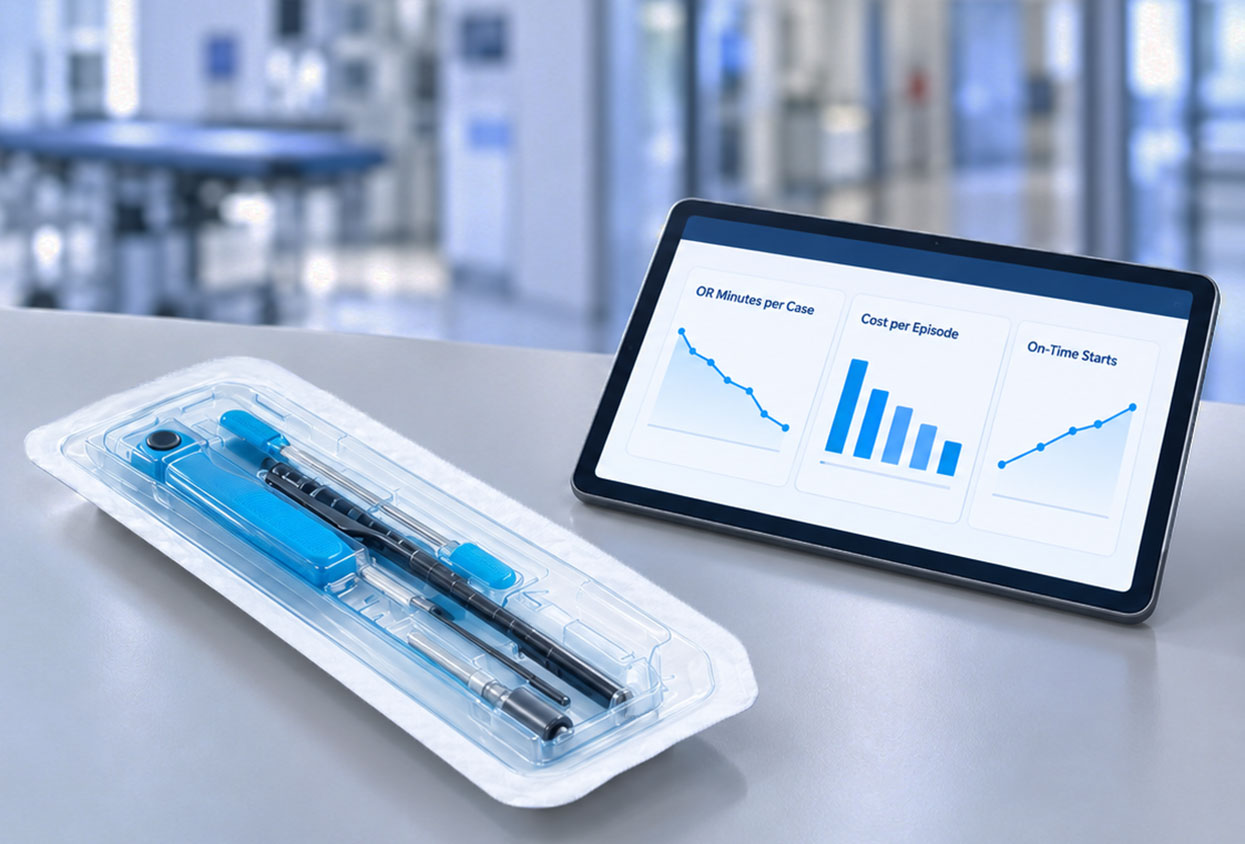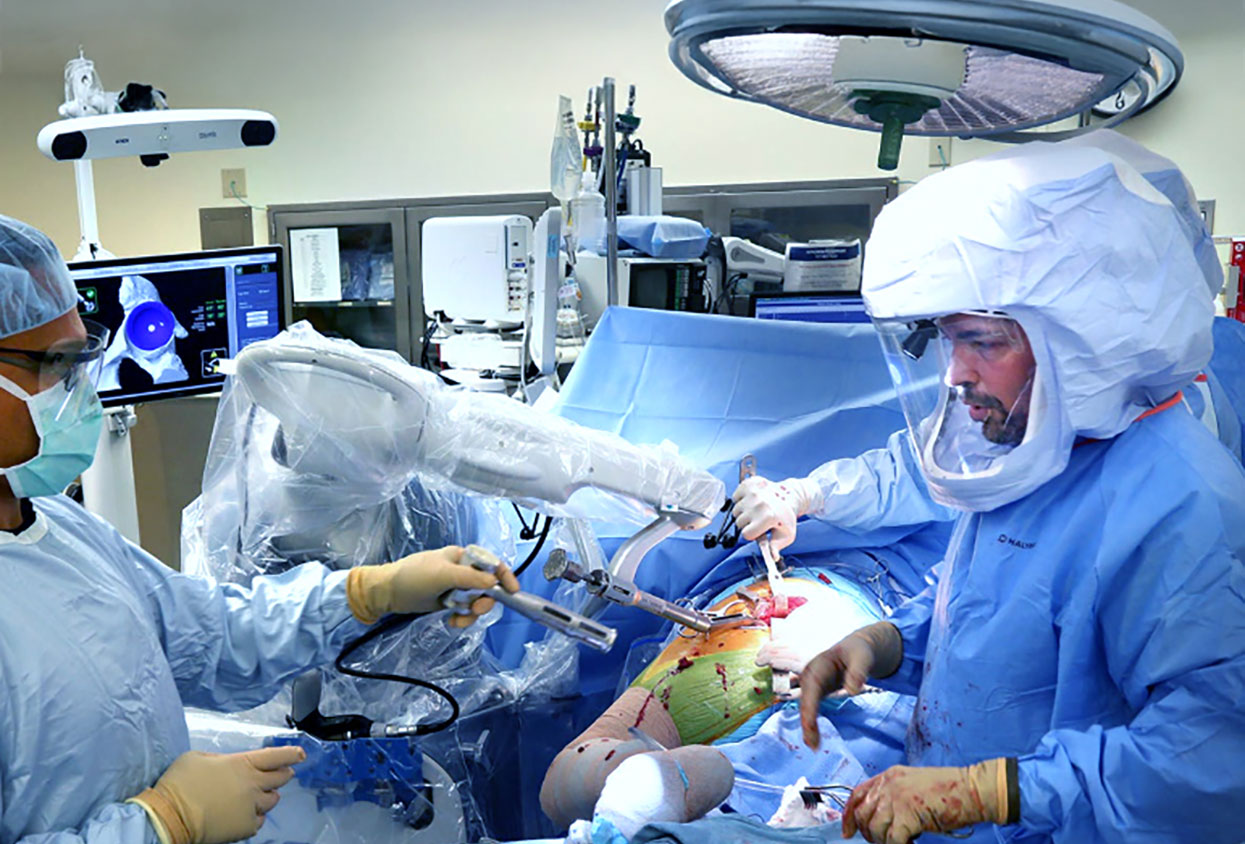
The first question many facilities ask is which system costs less on paper. But purchase price alone rarely tells the full story. A more meaningful comparison considers the total procedural impact of each option—including sterility assurance, workflow efficiency, reprocessing labor, and supply-chain reliability. Viewed through that lens, the choice between single-use and reusable surgical instruments is not simply about which tool is “better,” but which approach best fits the facility, procedure, staffing model, and operational priorities.
Reusable instrumentation depends on a multi-step reprocessing cycle working correctly every time: point-of-use treatment, transport, cleaning, inspection, packaging, and sterilization, each performed by technicians under time pressure. When one step is skipped or run incorrectly, the consequences can be significant. In one documented case, a hospital sterile processing department ran a set of surgical instruments through a gravity sterilization cycle instead of the required pre-vacuum cycle. The deviation exposed 72 patients to a potential risk of infection before it was caught, and the facility had to reconstruct the actual level of risk after the fact.1
Reprocessing pressure also shows up in how often facilities reach for immediate-use steam sterilization, commonly called flash sterilization, to get an instrument turned around quickly between cases. A study of knee and hip arthroplasty procedures found that only 9.5 percent of flash sterilization cases involved a clinically acceptable indication for using it, and documentation of the process was frequently incomplete.2 None of this means reusable instruments are unsafe. It means sterility with reusable instruments depends on a chain of manual steps performed correctly, every time, by people working under real operational pressure.
Single-use Surgery-Ready™ instruments remove that chain. Sterility is built in at manufacturing, verified once, and never depends on a hospital reprocessing step being executed correctly under time pressure.
Reusable trays require assembly before the case, instrument counting, and inspection for damage or missing pieces, and any gap in that process can hold up the room. Surgery-ready kits arrive pre-configured to the procedure, which removes several setup steps and reduces the number of decisions a scrub team has to make before the first incision.
The workflow difference compounds across a full day, not just a single case. A reusable tray asks the same team to repeat the same counting, inspection, and assembly sequence between every procedure, and any variation in how the trays are packed or reprocessed introduces some uncertainty for each new procedure. A Single-use Surgery-Ready™ kit from ECA Medical is consistent by design. The same components appear in the same arrangement every time, which reduces the cognitive load on staff and makes it easier to standardize setup across different rooms, shifts, and even different sites within the same organization.
A closer look at the full cost of a surgical case shows why instrument price alone can be misleading. One economic analysis compared traditional reusable instruments with single-use instruments for total knee arthroplasty, using a Monte Carlo model across 200 simulated sites and 100,000 cases.
Reusable instruments had a median total cost of $1,391 per case. The largest contributors were tray sterilization ($480), tray-management logistics ($372), and operating-room turnover time ($225). Single-use instruments had a median total cost of $406 per case, with OR turnover time as the largest cost contributor at $123.
Across the modeled sites, single-use instruments produced median savings of $994 per case.³
A separate cost analysis of disposable and reusable pedicle screw kits for lumbar arthrodesis found the two systems landed close to cost parity per case, at 4,279 euros for reusable and 4,243 euros for disposable, but noted a meaningful difference in organizational impact between the two models even where the raw cost came out roughly even.4 The lesson from both studies is the same: instrument acquisition cost alone is a poor predictor of total procedural cost.
Operating room time itself carries a cost that rarely appears on an instrument invoice. Independent estimates place OR time at roughly 10 to 30 dollars per minute, and separate research on spinal procedures found that perioperative delays averaged about 187.50 dollars per hour and occurred in delays longer than an hour in 44.4 percent of cases studied.6 Every minute a reusable tray adds to setup or turnover carries that per-minute cost whether or not it shows up as a separate charge, which is exactly why the total cost comparison has to include turnover time and not just the price of the instruments themselves.
Reusable systems that rely on loaner trays introduce a shipping and coordination dependency into every case. Trays travel between hospitals, distributors, and repair vendors on fixed windows, and a shipment that arrives late, damaged, or incomplete becomes the facility's problem on the day of surgery. A study of perioperative delays across more than 1,500 elective procedures found that delays were the most common type of error recorded, occurring in over half of all cases, and that equipment failure was the single most common cause.5 Single-use Surgery-Ready™, dock-to-stock inventory removes the loaner dependency entirely. The Kits are in inventory ready to open when needed, with no shipping window to track and no tray condition to verify before the case.
The literature does not support a blanket claim that reusable instrumentation is unsafe or obsolete. It supports a narrower, more useful claim: reusable systems introduce more process-dependent variability, and that variability carries real operational and financial cost. For a high-volume, well-resourced hospital system with mature sterile processing infrastructure, reusable instrumentation still could be the right economic choice for many procedures. Single-use systems tend to be the better fit specifically in high-turnover, lean-staffed, or outpatient settings, where the operational cost of reprocessing is proportionally larger, and the tolerance for a delayed or incomplete tray is lower.
Outpatient migration to the ASC continues to accelerate. ASCs are built around limited sterile processing capacity, lean staffing, and tight turnover expectations, which are exactly the conditions where reusable systems carry the most hidden cost. As more procedures move to the outpatient setting, the single-use vs reusable surgical instruments decision becomes less about instrument preference and more about which model actually fits the facility doing the buying.
Comparing single-use vs reusable surgical instruments on sterility, workflow, cost, and supply chain impact together, rather than on price alone, points toward a clearer answer. Reusable instrumentation still has a limited place. Single-use systems remove a meaningful amount of process-dependent risk and hidden operational cost, and for outpatient and high-turnover settings in particular, that difference is significant.
ECA Medical designs and manufactures single-use, Surgery-Ready™ instruments and procedure kits built to arrive sterile, complete, and ready to use, removing the reprocessing and loaner logistics variables from this comparison for the procedures where that fit makes sense. Request a workflow or cost assessment to see how the comparison looks for your case mix.
Q: Are single-use surgical instruments actually safer than reusable ones?
A: Single-use instruments remove the reprocessing step where documented sterilization failures and flash sterilization misuse tend to occur. That reduces one category of process-dependent risk, though overall safety also depends on facility protocols and case type.
Q: Do single-use kits cost more than reusable trays over time?
A: Not necessarily. Independent cost modeling has found single-use instrumentation reaching near cost parity or lower total per-case cost once sterilization labor, tray logistics, and turnover time are included, not just the acquisition price.
Q: How does instrument choice affect OR turnover time?
A: Reusable trays require counting, inspection, and reprocessing between cases, while pre-configured single-use kits are ready to open, which independent modeling has linked to meaningfully shorter turnover.
Q: What happens when a reusable instrument tray shipment is delayed or damaged?
A: A delayed, damaged, or incomplete tray typically forces a facility to reschedule, substitute instruments, or delay the case, and equipment-related issues are consistently documented as a leading cause of operating room delays.
Q: Is sterilization failure common with reusable surgical trays?
A: Documented failures do occur, including cases where instruments were run through the wrong sterilization cycle, and studies of flash sterilization use have found frequent gaps between actual practice and appropriate indication.
1. Donskey CJ, Yowler M, Falck-Ytter Y, Kundrapu S, Salata RA, Rutala WA. A Case Study of a Real-Time Evaluation of the Risk of Disease Transmission Associated With a Failure to Follow Recommended Sterilization Procedures. Antimicrobial Resistance and Infection Control. 2014;3:4.
2. Zuckerman SL, Parikh R, Moore DC, Talbot TR. An Evaluation of Immediate-Use Steam Sterilization Practices in Adult Knee and Hip Arthroplasty Procedures. American Journal of Infection Control. 2012;40:866-871.
3. Goldberg TD, Maltry JA, Ahuja M, Inzana JA. Logistical and Economic Advantages of Sterile-Packed, Single-Use Instruments for Total Knee Arthroplasty. The Journal of Arthroplasty. 2019;34:1876-1883.
4. Ottardi C, Damonti A, Porazzi E, et al. A Comparative Analysis of a Disposable and a Reusable Pedicle Screw Instrument Kit for Lumbar Arthrodesis, Integrating HTA and MCDA. Health Economics Review. 2017;7:17.
5. Khu KJ, Kaderali Z, Bernstein M. Delays in the Operating Room, Signs of an Imperfect System. Canadian Journal of Surgery. 2010;53:189-195.
6. Agarwal A, MacMillan A, Goel V, Agarwal AK, Karas C. A Paradigm Shift Toward Terminally Sterilized Devices. Clinical Spine Surgery. 2018;31:308-311.