Every operating room carries two parallel realities. One is clinical, measured, and technical. The other is human, shaped by habit, pressure, anticipation, and trust. Where these realities meet, variability can be a real factor or a subtle inconsistency. A tray that feels unfamiliar. A setup that takes longer than expected. A moment of hesitation where certainty normally lives.
Variability remains one of the most persistent challenges in modern surgical environments because it is rarely intentional. It emerges from strained systems, manual processes, and inherited workflows that were never designed to scale. Even in high-performing facilities, case-to-case inconsistency continues to erode efficiency long before anyone names it as a problem.
Surgery-ready procedure kits enter this landscape not as a convenience, and not as a shortcut, but as a systems-based response to variability itself. They represent a shift in thinking. Instead of asking skilled teams to compensate for inconsistency, we redesign the environment so consistency is built in.
In this article, we examine how surgery-ready procedure kits reduce variability and improve surgical efficiency by stabilizing preparation, supporting intraoperative flow, enhancing safety, and restoring predictability to operations. We speak to surgeons, OR managers, supply chain leaders, and healthcare administrators who understand that efficiency is not about speed. It is about reliability. Throughout, we return to the idea of the surgical artist, because surgery, at its best, is not mechanical. It is practiced. It is rhythmic. It depends on trust in both hands and systems.
Modern surgery is increasingly complex, yet the environment in which it occurs often relies on fragmented preparation methods. Instruments are gathered from multiple locations. Preferences live in memory rather than in systems. Setup depends on who is scheduled, how familiar they are, and how much time remains before the patient enters the room.
This variability introduces friction into spaces designed for precision. While surgical teams adapt remarkably well, adaptation itself carries a cost. Cognitive energy is spent managing logistics instead of maintaining focus. Over time, this erosion becomes normalized.
Surgery-Ready™ procedure kits shift the conversation from individual performance to system behavior. They are not designed to make people work faster. They are designed to make the environment behave the same way every time. This distinction matters. For the surgical artist, consistency is not restrictive. It is liberating.
In a surgical setting, variability refers to differences that occur from one case to the next, even when the procedure is identical. These differences can involve instrumentation, tray composition, setup sequence, room layout, or workflow timing. Each variation introduces uncertainty.
When setup differs between cases, surgical teams cannot rely on expectation alone. Scrub technicians must visually confirm rather than instinctively reach. Surgeons must request rather than assume. Circulators must adjust rather than flow. These micro-adjustments increase cognitive load and slow results.
Operational consequences follow quickly. Delays occur when instruments are missing or incompatible. Interruptions arise when workflows break. Turnover times stretch unpredictably. Efficiency suffers not because teams are inefficient, but because systems demand constant attention and adaptation.
Variability can also affects patient safety. Each deviation introduces an opportunity for error, stress, or fatigue. For the surgical artist, whose craft depends on continuity and focus, variability disrupts rhythm at precisely the wrong moment.
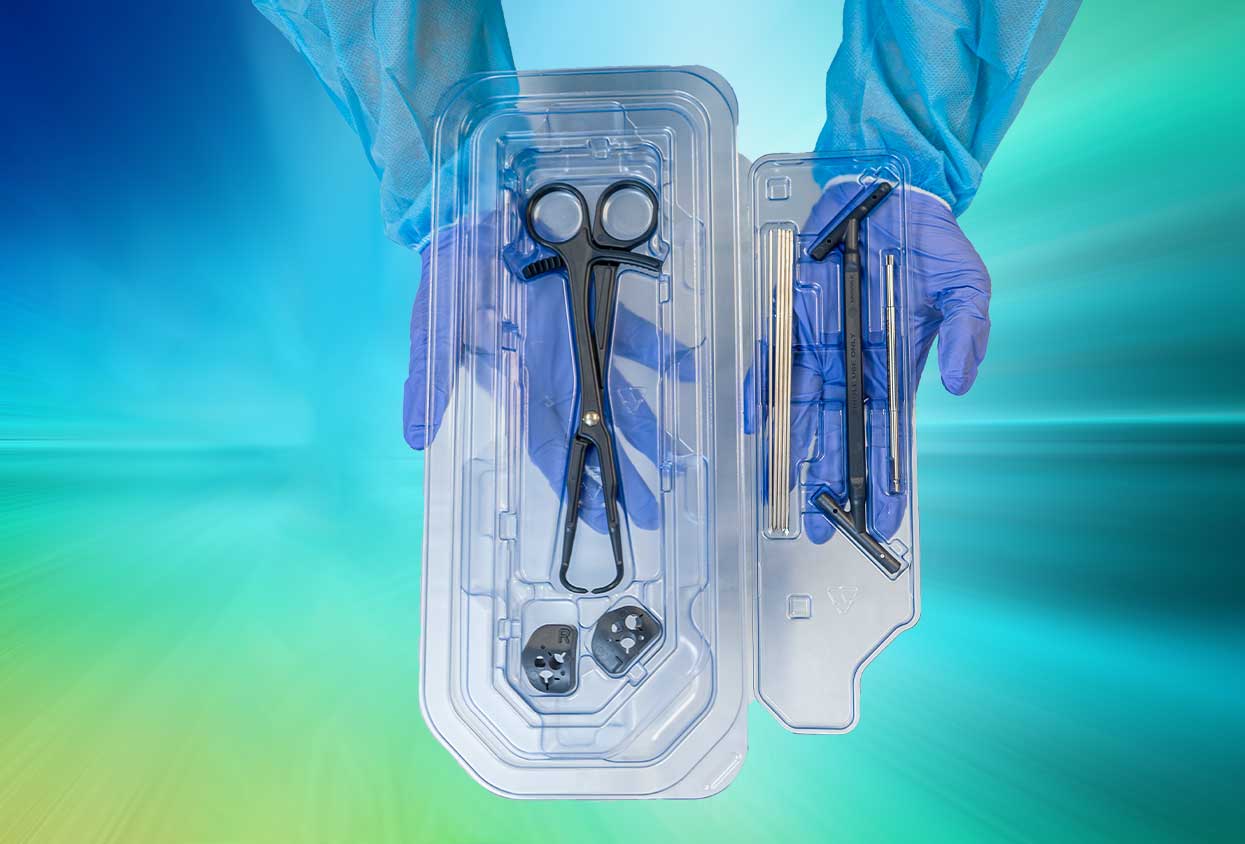
ECA Medical’s Surgery-Ready™ procedure kits are preconfigured, single-use, procedure-specific systems that arrive ready for immediate use. They are designed not as collections of items, but as integrated workflows packaged into a sterile environment.
Each kit is built around standardized surgical protocols and physician preferences. Instrument selection is deliberate. Sequencing is intentional. Packaging layout is engineered to support natural progression through the procedure. Sterility is maintained from assembly through the point of use.
Designing these kits requires a deep understanding of how procedures unfold in real environments. The goal is not minimalism. It is completeness without excess. Consistency without rigidity.
When kit configuration remains consistent across facilities and teams, the surgical environment becomes predictable. This predictability allows the surgical artist to step into the procedure without recalibration. The system fades into the background, where it belongs.
Preoperative preparation is one of the most variable phases of surgery. Manual tray assembly introduces differences driven by time pressure, experience level, and interpretation of preference cards. Even small omissions can cascade into larger disruptions.
Surgery-Ready™ procedure kits eliminate this variability by removing manual assembly from the equation. Each kit arrives fully configured, validated, and ready. There is no need to interpret instructions or substitute items.
Because setup no longer depends on individual experience, accuracy and completeness become repeatable. The same kit behaves the same way, regardless of who is working or where the procedure occurs.
This consistency improves predictability in OR scheduling. Turnover times stabilize. The case starts to become more reliable. The surgical artist benefits from this calm because artistry requires mental space.
Inside the procedure, efficiency emerges from familiarity. When the instrumentation layout is consistent, muscle memory takes over. Movements become economical. Decisions become intuitive.
Surgery-Ready™ procedure kits support this efficiency by ensuring that instruments appear where expected, in the order they are needed. There is no pause to locate alternatives. No interruption to resolve compatibility questions.
Standardization also supports smoother handoffs between scrub technicians and surgeons. Shared expectations reduce verbal clarification. Momentum builds naturally.
Predictable workflows allow surgical teams to maintain focus. Attention remains on tissue, alignment, and outcome rather than logistics. The surgical artist operates within a rhythm that is practiced rather than improvised.
Errors often arise not from lack of skill, but from moments of disruption. Standardized kits reduce the risk of omitted, incorrect, or incompatible instruments by design. What enters the sterile field has already been curated.
Single-use configurations further support safety by reducing handling and reprocessing exposure. Sterility risks decline as complexity decreases. Cross-contamination concerns are mitigated through simplification.
Predictable workflows reduce stress and fatigue-related errors. When teams are not constantly adjusting, cognitive load decreases. Decision-making becomes clearer.
For patients, reduced variability translates into safer environments and more consistent outcomes. For the surgical artist, safety is not separate from artistry. It is foundational.
Time in the operating room is shaped as much by preparation and interruptions as by the procedure itself. When setup is faster and disruptions are fewer, total procedure time contracts naturally.
Surgery-ready procedure kits support consistent on-time case starts by removing preoperative uncertainty. Teams can trust the schedule because the environment behaves predictably.
Improved turnover efficiency allows facilities to schedule more cases per day without compressing care. Patient wait times shorten. Utilization improves.
Some surgeons report that these optimized, sterile instrument packs have the potential to double their daily case flow under ideal conditions—an outcome driven not by speed, but by consistency and readiness.
These gains accumulate quietly. Efficiency emerges not through urgency, but through alignment. The surgical artist feels this as steadiness rather than pressure.
Variability complicates supply chain planning. When usage patterns fluctuate, forecasting becomes difficult. Excess inventory accumulates. Redundant processing increases.
Standardized kits simplify inventory management by creating predictable consumption patterns. Forecasting improves. Excess stock declines. Tray processing is reduced.
Lean supply chain strategies depend on consistency. Surgery-ready procedure kits create clear signals that materials management and OR staff can coordinate around. Communication improves. Waste recedes.
While the surgeon may never see these systems directly, their impact is felt in the absence of friction and delay.
Cost control in surgery is often framed as a tradeoff between efficiency and quality. Surgery-Ready™ procedure kits challenge this assumption by demonstrating that predictability improves both.
Reduced setup time lowers labor costs without asking teams to work faster. Single-use kits reduce reprocessing, sterilization, and maintenance expenses. Fewer delays and errors translate into measurable savings.
Importantly, these efficiencies come from system design, not staff overextension. Teams are supported rather than strained.
For the surgeon, this matters deeply. Artistry cannot flourish under constant pressure. It requires systems that hold steady.
Surgery-ready procedure kits align with evidence-based standardization initiatives and value-based care models. Consistency supports training, onboarding, and cross-coverage.
As surgical services expand across facilities, standardized systems provide a common language. Teams can scale without sacrificing quality.
The surgeon benefits from this alignment, moving between environments without losing rhythm or confidence.
High-volume procedures benefit most from reduced variability because inefficiencies multiply quickly. Ambulatory surgery centers see significant gains due to tight schedules and limited staffing.
Facilities facing staffing shortages or high turnover rely on standardized systems to maintain quality. Complex procedures benefit from predictable setups that support sequencing and precision.
In these environments, the surgical artist depends on the system to remain consistent while skill takes center stage.
Surgery-ready procedure kits reduce variability at every stage of the surgical process, from preparation through execution and recovery. They replace improvisation with intention. They connect standardization with efficiency, safety, and cost control in ways that feel natural rather than forced.
Improved surgical efficiency is not the result of moving faster. It is the result of designing systems that behave reliably, allowing people to work at their best. The surgical artist thrives when tools, timing, and flow align.
As a trusted single-source partner, ECA Medical Instruments supports organizations transitioning toward surgery-ready procedure kits and standardized surgical systems. When consistency is designed into the environment, surgery becomes not only efficient, but quietly excellent, one procedure, one patient, one successful result at a time.