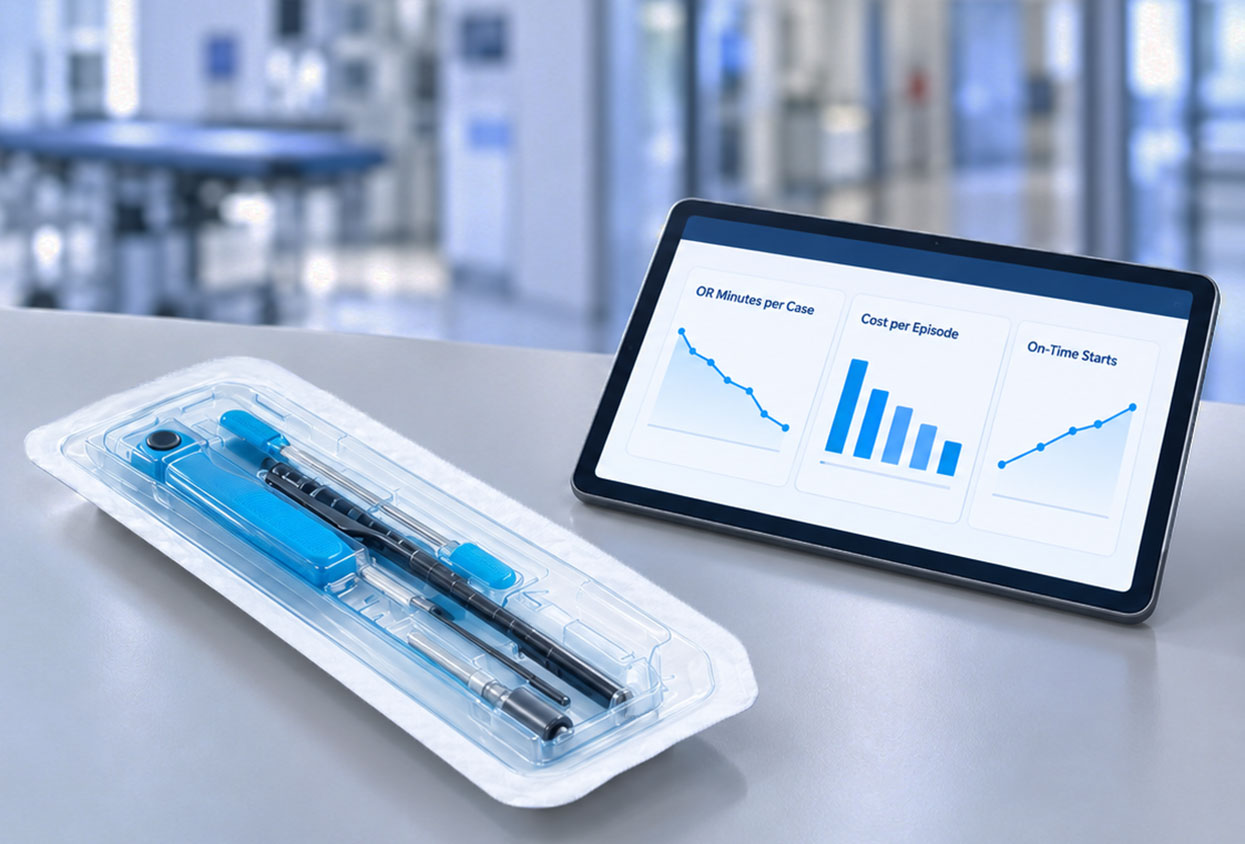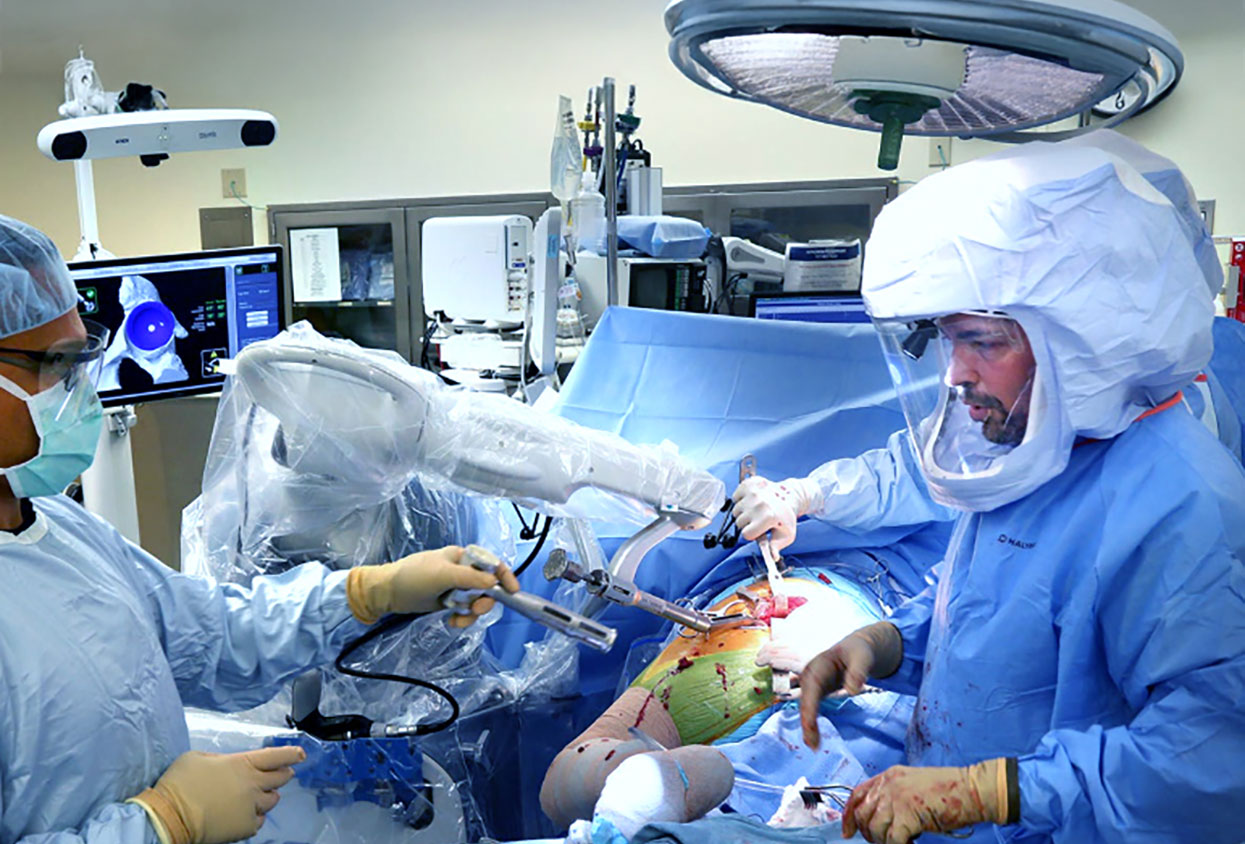
Every surgical procedure depends the surgeon the implant and a host of other factors. For example it also depends on whether the correct instruments are complete, sterile, available, and organized when the case begins. Surgical teams are asked to maintain readiness, support predictable schedules, and control operating costs, often with limited staff and rising procedural volume. Custom sterile surgery=ready™ procedure kits exist because a generic, one-size-fits-all tray forces a team to adapt its workflow to the tray, instead of the other way around.
Single-use Custom kits are especially useful when workflow consistency, rapid turnover, focused procedures, or sterile processing capacity are priorities, and less useful in settings where a large, mature reusable tray infrastructure is already working well.
A reusable instrument set's workload does not end when the case does. The full cycle includes point-of-use treatment, transport, manual and mechanical cleaning, inspection for cleanliness and function, reassembly, packaging, sterilization, sterility-assurance monitoring, storage, and eventually repair or replacement of worn or lost components. Reusable devices have to be processed according to manufacturer instructions, and instruments that contact sterile tissue, bone, or the vascular system require thorough cleaning and sterilization every time, backed by written policies, staff training, and competency validation.
This workload on a reusable set is harder to execute than it may sound. Independent testing of washer-disinfector cleaning cycles has found that organic residue can survive standard cleaning processes and go on to impair the sterilization step that follows.1 And when a reprocessing step is skipped or run incorrectly, the consequences can be significant. In one documented case, a hospital ran a container of surgical instruments through the wrong sterilization cycle, and the facility had to retroactively assess a potential infection risk for 72 patients who had already undergone surgery with those instruments.2
The operational impact shows up well before it reaches that level of severity though. It shows up in slower turnover between cases, added staffing and training requirements, strain on sterile processing capacity, last-minute substitutions when a tray is incomplete, and reduced scheduling flexibility on high-volume days. None of this means reusable sets are inherently the wrong choice. Reusable instrumentation remains appropriate for many procedures and facilities. The relevant question is where can a sterile, ready-to-open, single-use Surgery-Ready™ model remove many of these operational steps.
A custom sterile procedure kit is a procedure-specific configuration of the instruments and supporting components a surgical case requires, designed around the intended workflow, packaged in a sterile barrier system, and delivered ready for use. Depending on the procedure, a kit can include single-use surgical instruments, procedure-specific implant instruments, delivery or preparation instruments, supporting disposable components, sterile packaging and labeling, and instructions for use with traceability elements, all organized around the anticipated sequence of the procedure.
The contents single-use Surgery-Ready kit are selected for the specific procedure, the instruments are organized around the surgical workflow rather than a standard components list, and the format is built to support predictable setup rather than requiring the team to sort through trays of unnecessary components on the sterile field.
An appropriately configured kit reduces the need to gather, inspect, assemble, and count multiple loose components before each procedure. A scrub team can open a single-use Surgery-Ready™ sterile kit rather than build a case setup from separate sources. Standardized contents can reduce variability across rooms, shifts, and sites, which becomes especially valuable when an ASC is turning rooms quickly or running repeatable, high-volume procedures.
A single-use sterile kit removes the need to reprocess its disposable instruments after the case, which relieves pressure on decontamination and sterile processing workflows, reduce the number of tray-related cleaning and sterilization cycles a department has to run, and lower dependence on sterilizer availability and turnaround timing. For a facility managing staffing constraints or limited sterile processing capacity, that relief can be meaningful, though the degree varies by case volume and existing infrastructure.
Delays also happen when a tray has not finished reprocessing, a required instrument is missing or in repair, or sterile processing is managing an unexpectedly heavy workload. A ready-to-open kit reduces the dependencies that hold up room preparation, and after the case, disposable components can be handled according to facility disposal policy rather than routed through a reprocessing cycle. That will support a more predictable room reset and schedule flow, particularly for repeatable procedures.
Standardized kit contents help ensure a team begins each case with the expected instrument configuration, and arranged to align with the procedural sequence. This consistency especially useful for facilities with multiple surgical teams, rotating staff, or standardized service lines, and a carefully designed kit can reduce the number of unnecessary instruments and trays occupying the sterile field.
Fewer reusable trays to track among operating rooms, central sterile processing, storage, repair vendors, and distributors simplifies planning for procedure-specific inventory, and a defined kit configuration supports more standardized purchasing and replenishment. Facilities should still evaluate the complete cost of ownership, including instrument acquisition, reprocessing labor, utilities, repairs, sterilization, tray inventory, storage, and procedure volume, rather than assuming a kit model automatically reduces total cost in every case.
ASCs typically operate with streamlined teams, compressed schedules, constrained storage, and a strong emphasis on efficient room turnover. In that environment, a custom single-use Surgery-Ready™ sterile kit is a practical option for procedures that benefit from a focused, repeatable instrument configuration. That can mean supporting a repeatable workflow for high-volume, standardized procedures, reducing the need to maintain duplicate reusable sets, helping facilities with limited on-site sterile processing resources, simplifying readiness for early-morning first cases, and reducing the operational disruption caused by unavailable, incomplete, or damaged reusable instruments.
The single-use kit model changes the workflow. It does not eliminate the need for disciplined perioperative practice. The more useful question is not whether reusable or single-use instrumentation is universally better, but which model best supports the procedure, facility workflow, staffing model, clinical requirements, and total operational economics at hand.
Effective custom procedure kits are developed around the actual procedure, not around a generic list of instruments. That starts with the required steps, surgical approach, implant system, and surgeon workflow, then works through which components are essential versus optional, which instruments are suited to a single-use format, how the kit will be opened and presented in the OR, and what sterile-barrier packaging, labeling, traceability, and storage needs apply. Getting this right requires close alignment among clinical, perioperative, supply-chain, quality, and regulatory stakeholders early in the process, not after a configuration has already been finalized.
Custom sterile procedure kits help ASCs and hospitals reduce some of the operational complexity associated with reusable instrumentation. By providing a procedure-specific, sterile, ready-to-open configuration, they support more predictable preparation, reduce dependence on reprocessing cycles, and simplify post-case instrument handling, without asking every facility to treat one instrumentation model as the only right answer.
ECA Medical co-develops procedure-specific, single-use Surgery-Ready™ kits tailored to how facilities and surgical team actually work, from initial configuration through sterile packaging and delivery. Contact ECA Medical to evaluate kit configuration, sterile packaging, and manufacturing requirements for your procedure.
Q: What makes a procedure kit custom instead of off-the-shelf?
A: A custom kit is configured around the specific steps, instruments, and sequence of a defined procedure, rather than assembled from a standard, generic components list.
Q: How do custom sterile kits reduce setup time in the OR?
A: By arriving pre-configured and ready to open, custom kits reduce the need to gather, inspect, count, and assemble loose components before each case.
Q: Can custom procedure kits be used in both hospitals and ASCs?
A: Yes. The configuration principles apply in both settings, though ASCs with lean staffing and compressed schedules often see the workflow benefit most directly.
Q: Do custom kits help offset staffing shortages in sterile processing?
A: They reduce the number of trays that require reprocessing, which lowers demand on sterile processing labor and training, of course the effect depends on overall case mix and existing capacity.
Q: How long does it take to develop a custom procedure kit?
A: Development timelines vary with procedure complexity and instrument count, and generally shorten when clinical, quality, and supply-chain stakeholders are involved from the start rather than brought in after the configuration is set.
1. Ransjö U, Engström L, Håkansson P, et al. A Test for Cleaning and Disinfection Processes in a Washer-Disinfector. APMIS. 2001;109:299-304.
2. Donskey CJ, Yowler M, Falck-Ytter Y, Kundrapu S, Salata RA, Rutala WA. A Case Study of a Real-Time Evaluation of the Risk of Disease Transmission Associated With a Failure to Follow Recommended Sterilization Procedures. Antimicrobial Resistance and Infection Control. 2014;3:4.