Single-use procedure kits are reshaping how hospitals and ambulatory surgery centers (ASCs) think about efficiency, cost, and safety in the operating room (OR). As surgical volumes rise and reimbursement pressures tighten, clinical teams are being asked to do more with the same—or fewer—resources. Reusable trays that once felt like the default option are now being scrutinized for the hidden costs, variability, and delays they introduce into the workflow.
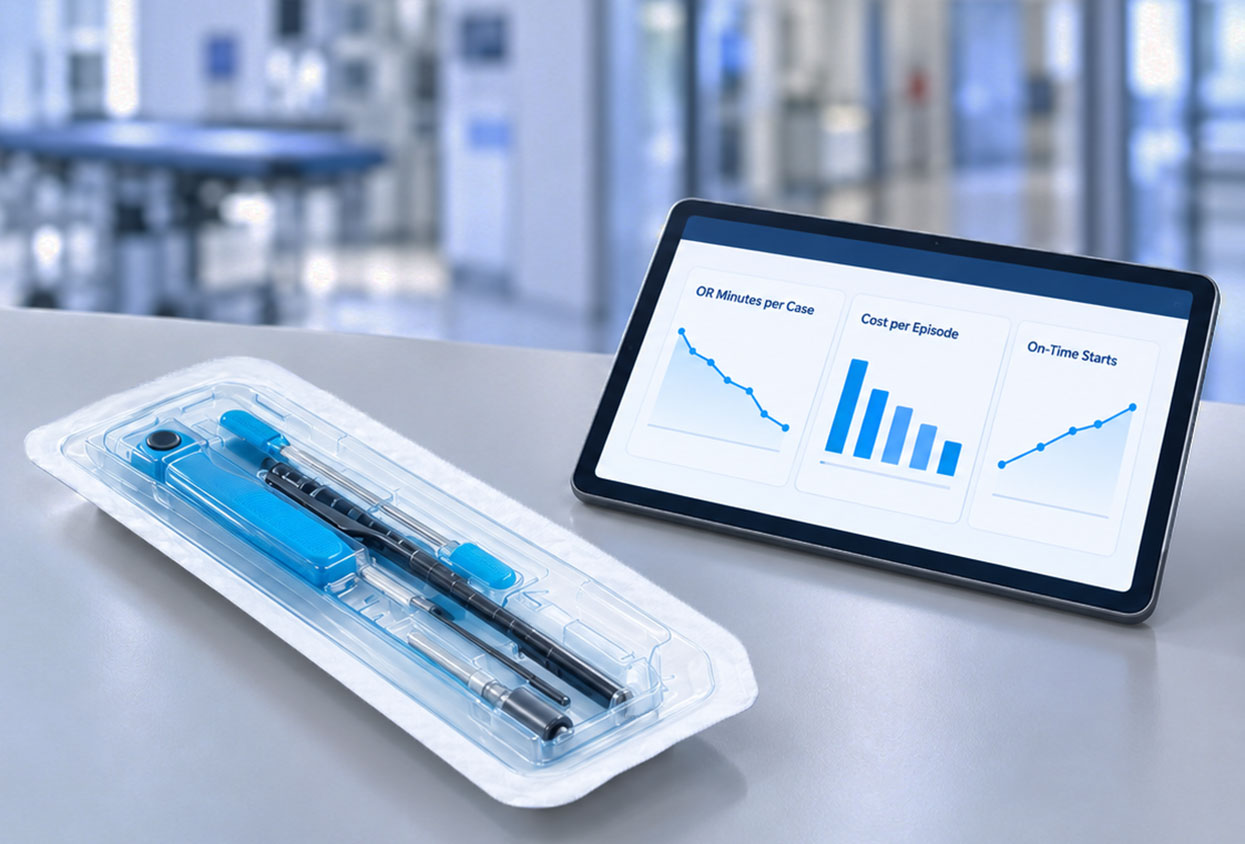
In this environment, surgery-ready™ single-use procedure kits offer a different model: predictable performance, simplified logistics, and a per-case cost structure that is easier to manage. By combining sterile, pre-assembled instruments and implants in one package, these solutions help ASCs and hospitals improve OR throughput, reduce reprocessing workload, and gain clearer visibility into true procedural costs.
Traditional reusable instrument sets come with a complex ecosystem of sterilization, maintenance, transport, and inventory management. Each cycle introduces opportunities for delay—missing instruments, worn components, incomplete trays, or sterilizer backlogs—which can stall cases and disrupt tightly packed OR schedules.
Single-use procedure kits replace that variability with a standardized, ready-to-open solution. Each kit is configured for a specific procedure, pre-sterilized, and validated for use straight from the box. That means the scrub opens the kit, the surgeon operates with a calibrated set of tools, and at the end of the case the entire kit is discarded—no reprocessing loops or repair queues to manage.
Efficient ORs depend on predictable workflows. Every delay—waiting on a washer cycle, locating a missing instrument, or exchanging damaged tools—multiplies downstream: case start times slip, turnovers slow, and staff fatigue increases. Single-use procedure kits help remove those friction points at several key steps.
For OR leaders, the result is a more predictable daily schedule, fewer bottlenecks between cases, and better alignment between staffing, room availability, and case demand.
Every OR director knows that infection control has both clinical and financial implications. Reusable systems rely on multiple handoffs, from pre-cleaning to washing, inspection, packaging, and sterilization. Each step must be executed perfectly to maintain sterility, and each step adds labor, time, and risk.
Sterile single-use instrument kits arrive pre-validated and sealed, eliminating reprocessing as a source of variability. There is no risk of bio-burden left in lumens, no uncertainty about sterilizer performance for that cycle, and no concerns about instruments that have degraded after repeated use. By providing a new, pristine set of instruments for every procedure, single-use kits help reduce the risk of surgical site infection, shorten recovery times, and limit costly readmissions.
For ASCs in particular, where reputation and throughput are tightly linked to quality metrics, this reliable approach to sterility supports both clinical outcomes and operational performance.
On the surface, single-use procedure kits may appear more expensive than reusable trays on a per-unit basis. However, a closer look at the total cost of ownership tells a different story. Reusable systems carry indirect expenses that are often spread across budgets and rarely captured at the case level.
Facilities that move to single-use, surgery-ready™ procedure kits frequently realize savings and financial benefits in several areas:
When all of these factors are included—labor, sterilization, SSI risk, OR time, and inventory—many providers find that single-use kits deliver a more predictable, and often lower, cost per procedure than their reusable counterparts.
A high-performance single-use procedure kit is not just a generic pack of instruments; it is carefully engineered around the way surgeons operate and the way OR teams work. For spine, trauma, extremity, and other orthopedic procedures, kits can be configured to match the exact sequence of steps, torque requirements, and implant systems used in that service line.
For hospitals, this level of customization supports consistent technique across multiple surgeons and locations, while reducing the training burden on new staff. For ASCs, it enables lean staffing models by simplifying setup, counting, and turnover—even when case volumes are high and room utilization targets are aggressive.
By aligning instrument design, layout, and packaging with real-world workflow, surgery-ready™ single-use kits help healthcare providers unlock both operational and clinical performance gains.
Despite being designed for one-time use, single-use instruments must meet the same high standards of precision, strength, and ergonomics as reusable systems. ECA’s single-use torque limiters, drivers, and ancillary tools are built with high-grade materials and tight manufacturing tolerances to deliver the consistent performance surgeons expect in demanding procedures.
At the same time, sustainability remains an important consideration. Lifecycle assessments have shown that when reprocessing, transportation, and energy use are factored in, well-designed single-use instrument kits can have a lower overall environmental impact than reusable trays in many scenarios. Ongoing advances in materials, packaging, and waste management are further improving the balance between clinical performance, efficiency, and environmental stewardship.
Regulatory compliance and traceability are fundamental to any device used in the OR. With single-use procedure kits, manufacturers such as ECA Medical assume responsibility for validation, documentation, and lot-level tracking. Each kit is produced under rigorous quality systems and can be traced from manufacturing through to use.
For hospitals and ASCs, this simplifies documentation, supports audits, and helps ensure that every kit deployed in the field meets the same high standard of safety and performance. Consistency at this level is critical for organizations striving to standardize care and reduce variability across sites.
Partnering With an Experienced Single-Use Innovator
Designing a high-performance single-use procedure kit that genuinely improves OR efficiency and reduces cost requires deep understanding of surgical workflows, sterilization science, and device engineering. For more than four decades, ECA Medical has focused on single-use, surgery-ready™ instrument and procedure kit solutions that support predictable, efficient, and cost-effective surgery in both hospital and ASC environments.
By collaborating closely with OEMs, surgeons, and OR leaders, ECA develops kits that align with specific procedures, service lines, and business objectives. Whether the goal is to accelerate ASC growth, optimize implant distribution, or standardize care across a health system, single-use procedure kits from ECA are designed to help providers move faster, reduce risk, and control costs—without compromising on performance.
If you are looking to improve OR efficiency, strengthen infection control, and gain better visibility into per-case costs, now is the time to explore how ECA Medical’s single-use, surgery-ready™ procedure kits can fit into your strategy.
1. How do single-use procedure kits improve operating room efficiency?
Single-use procedure kits arrive pre-assembled, sterile, and surgery-ready, so OR teams no longer need to pull, assemble, and count multiple trays before each case. This reduces setup and turnover time, minimizes delays caused by missing or damaged instruments, and helps keep cases on schedule. For high-volume service lines, standardized procedure kits make workflows more predictable, which supports better room utilization and higher case throughput.
2. How can single-use procedure kits reduce ASC and hospital costs?
Although the per-unit cost of a single-use kit may appear higher than a reusable tray, the total cost per case is often lower once reprocessing, labor, utilities, repairs, and lost OR time are factored in. Single-use kits eliminate the need for sterilization cycles, reduce cancellations and delays, and limit the financial impact of surgical site infections. For many ASCs and hospitals, this leads to more predictable—and frequently lower—costs per procedure.
3. Are single-use procedure kits more cost-effective for ASCs than for hospitals?
Both ASCs and hospitals can benefit, but ASCs often see outsized gains because their business models depend on tight schedules, lean staffing, and high room utilization. By shortening setup and turnover, reducing variability, and simplifying logistics, single-use procedure kits help ASCs increase daily case volume without adding reprocessing capacity or additional staff. Hospitals, in turn, can use the same kits to offload central sterile bottlenecks and support growth in outpatient and short-stay procedures.
4. Do single-use procedure kits help reduce the risk of surgical site infections (SSIs)?
Yes. Because single-use kits are sterilized, validated, and used once, they eliminate reprocessing as a source of contamination risk. There is no concern about residual bio-burden, incomplete cleaning, or instrument degradation over multiple cycles. Providing a fresh, sterile set of instruments for every procedure supports stronger infection prevention strategies, which can translate into fewer SSIs, shorter patient stays, and lower readmission-related costs.
5. How do single-use procedure kits support staff efficiency and satisfaction?
When OR and central sterile teams no longer need to assemble, track, and turn around complex reusable trays, they can focus more time on direct patient care and high-value clinical tasks. Standardized, easy-to-use procedure kits reduce cognitive load, minimize last-minute troubleshooting, and help new staff get up to speed faster. Over time, this can improve staff satisfaction and reduce burnout associated with constant “fire drills” around missing or delayed instruments.
6. Can single-use procedure kits be customized for specific procedures or surgeon preferences?
Yes. High-performance single-use procedure kits are typically configured for specific procedures, implant systems, and surgeon workflows. Kits can be tailored to instrument layout, sequence, and torque requirements so that each case follows a familiar, predictable pattern. This level of customization reinforces consistency across surgeons and locations while maintaining the efficiency and cost advantages of a surgery-ready, single-use solution.
7. How do single-use procedure kits fit into a health system’s long-term cost and growth strategy?
Single-use, surgery-ready kits give organizations a clearer view of per-case costs and make it easier to scale service lines without investing heavily in new sterilization capacity, additional staff, or complex inventory systems. As more procedures shift to outpatient settings, these kits help hospitals and ASCs expand capacity, support satellite locations, and standardize care across the network—all while maintaining control over quality, efficiency, and cost.