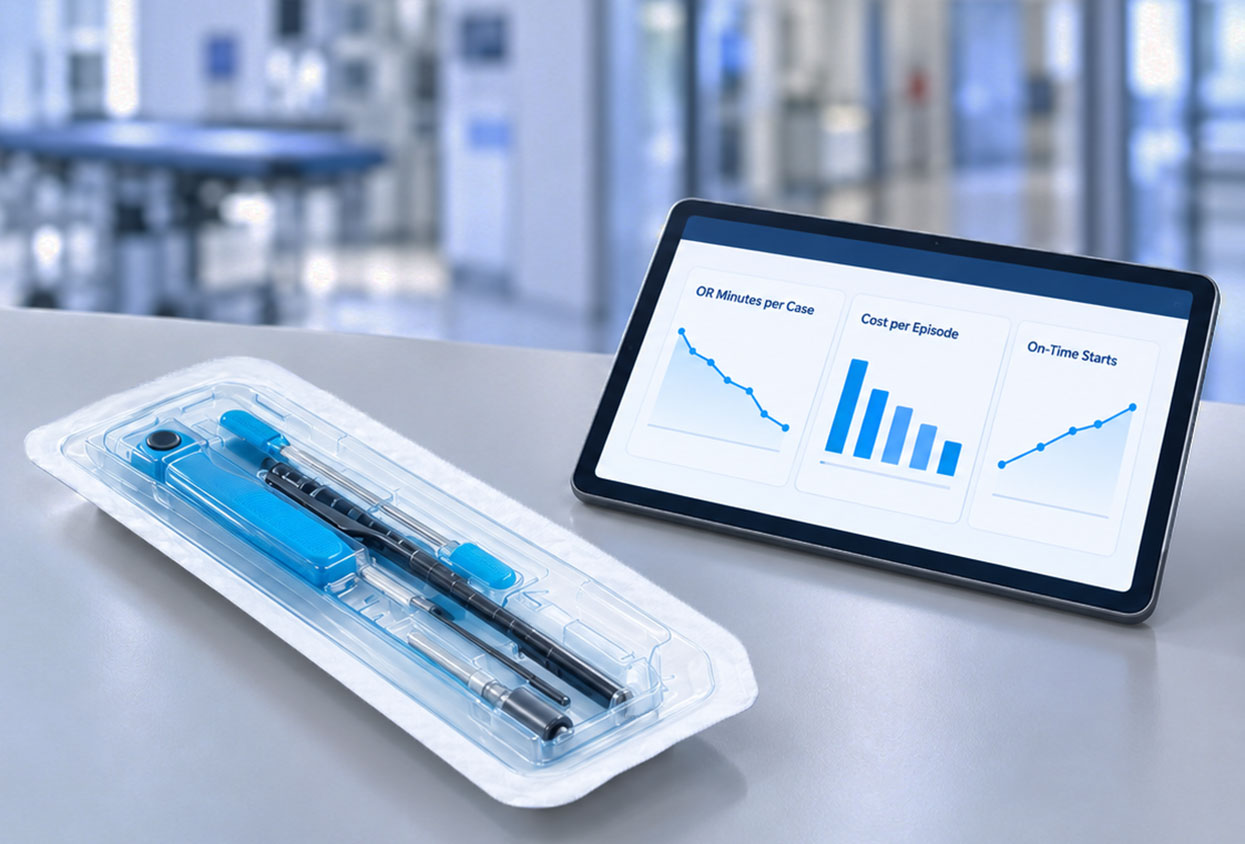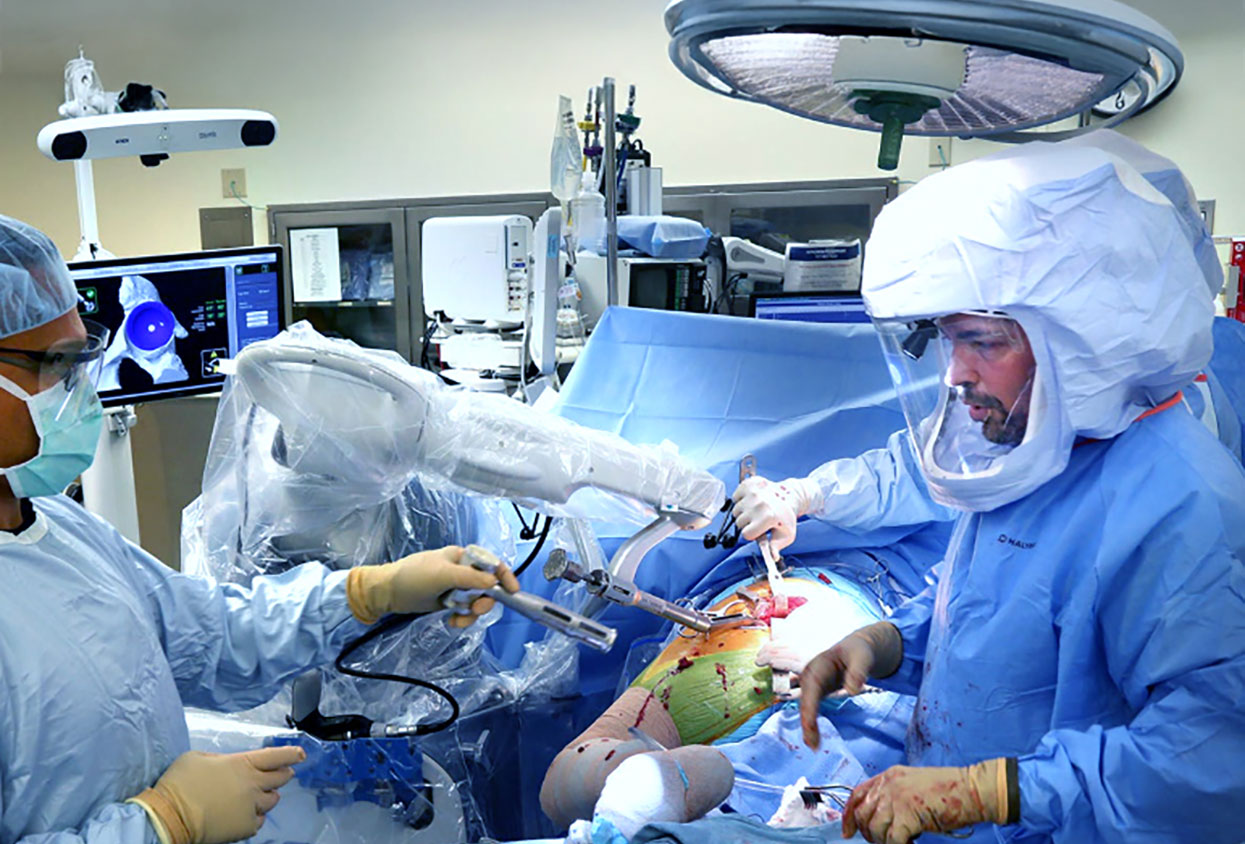
Sterile instrument kits are single-use, procedure-ready sets designed to arrive in the OR fully packaged, inspected, sterilized, and standardized. Each kit is assembled in controlled manufacturing conditions, so the instrument lineup is consistent, sterility is validated, and the workflow from storage to table is nearly frictionless.
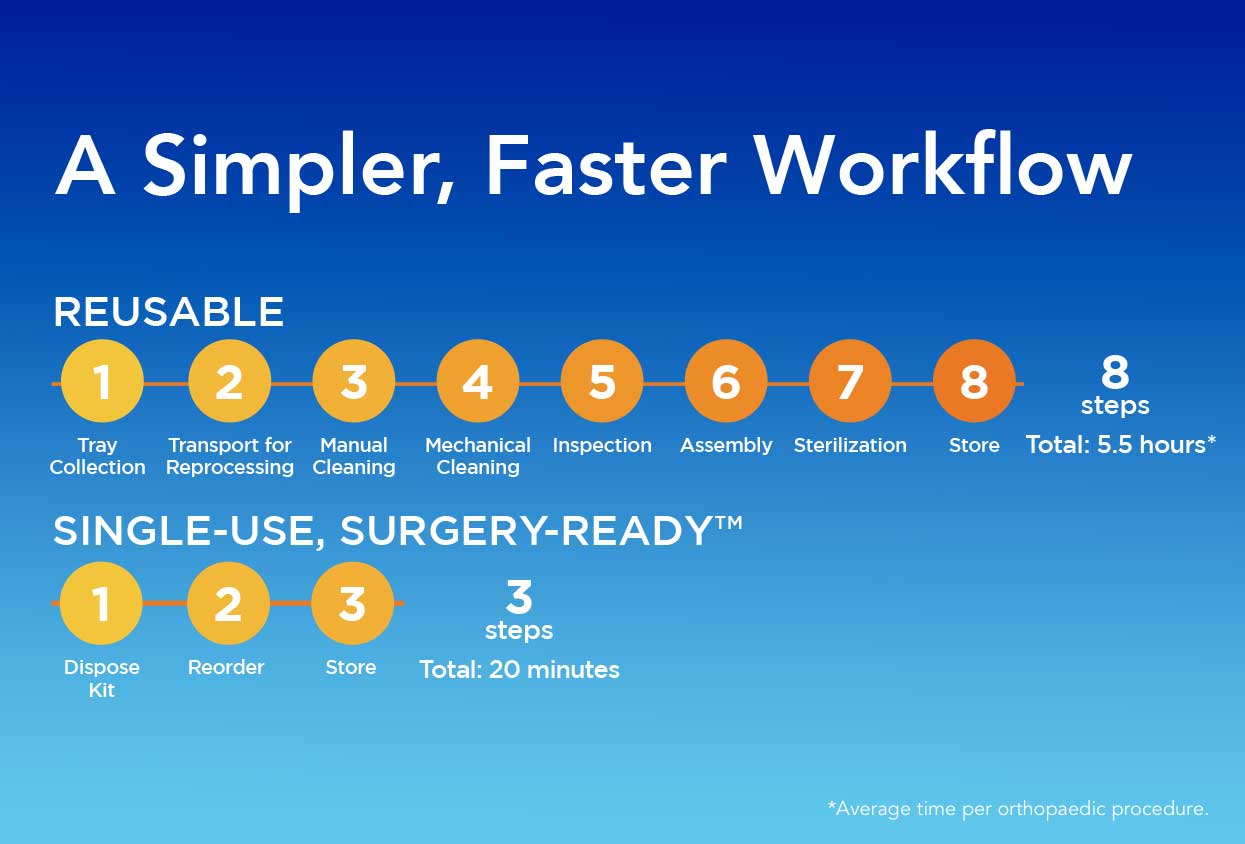
Because sterile instrument kits are ready to open and use, they minimize the number of human touches required. There is no cleaning, repacking, assembling, or checking of tray completeness. For OR teams used to variability in reusable tray content, this sets up a predictable cadence: the same tools, in the same order, with the same sterility assurance every time. The reduced handling alone eliminates several opportunities for errors while improving time-to-table readiness.
This predictability is a cherished benefit. When each kit mirrors the last, surgeons enjoy a consistent degree of performance. The OR avoids delays caused by missing instruments or late-arriving trays. And Sterile Processing Department (SPD) teams are relieved from the unpredictable ups and downs of reprocessing volume.
Reusable trays follow a far more complex life cycle: a tray must be moved out of the OR after each use, decontaminated to detailed standards, inspected for wear or damage, reassembled instrument by instrument, sterilized, cooled, wrapped or containerized, stored, and redistributed. In any of these steps, breakdowns may happen that cause delays, increase costs, or introduce clinical risk.
Even in optimal circumstances, reusable trays can differ in their completeness: instruments are moved, borrowed, misplaced, or taken out to be repaired without any assurances that the missing piece is identified before the next case. Setup times also vary with the accuracy of trays, staff expertise, and the complexity of reprocessing steps.
And because the entire workflow depends on the SPD, performance depends on staffing levels, training, equipment reliability, documentation accuracy, and coordination between OR and SPD schedules. Misalignment in any of these elements will send ripples through the surgical schedule, right down to case readiness.
Why this comparison matters more than ever.
In addition, rising surgical volumes and expanding service lines are increasingly straining reusable tray systems. Meanwhile, chronic staffing shortages limit throughput and increase overtime costs in Sterile Processing Departments across the country. Delays at any point of the reprocessing cycle place immediate pressure on OR leaders to find alternatives that can stabilize workflow.
Surgeons are also expecting more. With cases becoming increasingly specialized and precision-based, the need for consistent, predictable, procedure-ready instruments continues to rise. Variability and delays once tolerated are no longer.
Financial pressures magnify the need for transparency in true cost structures. OR leaders must assess not only the price related to instruments but also the hidden costs related to training, repairs, inefficiencies, compliance exposure, and the operational consequences of delays. In this environment, sterile instrument kits vs. reusable trays is not a theoretical conversation-it is a front-line operational decision with calculable results.
The financial equation around reusable trays becomes far more complex when all associated costs are fully examined. Many of the most influential cost drivers are not visible on budgets labeled "instruments," but rather absorbed across labor, equipment, compliance, and operating room workflow disruptions.
Every reusable tray consumes labor costs in each reprocessing cycle. The processes of decontamination, inspection, assembly, documentation, packaging, and sterilization require skilled personnel. When case volumes increase, the number of trays moving through SPD also increases in proportion, driving the department to overtime staffing and emergency sterilization cycles.
Training new technicians is expensive, and turnover creates a rift in quality. Mistakes like missing instruments, partial decontamination, or improperly assembled trays will be more common when employees are stretched thin. One delayed tray holds up the entire surgical schedule, which in turn prolongs anesthesia time, increases downstream labor costs, and creates surgeon dissatisfaction-none of which are reflected in the cost of the tray at face value.
SPD equipment-washers, ultrasonic cleaners, and sterilizers require continuous maintenance and periodic replacement. Repairs are costly and unpredictable. The ripple effects of that precious downtime pile up: trays waiting for reprocessing pile up; emergency sterilization cycles rise; cases risk delay or rescheduling. OR leaders often underestimate how much capital and operating costs are tied to keeping reusable workflows functional.
Reusable trays require ongoing quality audits. Instruments should be checked for wear, lubrication requirements, sharpness, and breakage. The leaders in the Sterile Processing Department SPD must record and keep a record of all the repairs, replacements, and cycle counts. Each time an error is found, a worn rongeur, for example, a missing driver, or an improperly assembled device, the tray should be removed from circulation and reprocessed.
These tasks are time-consuming, necessitate close supervision, and require administrative input. They also impact on OR performance. A single incorrectly assembled tray can bring a surgical case to a standstill.
Perhaps the most visible financial risk involves trays arriving in the OR incomplete or incorrectly assembled. Even a small or seemingly insignificant instrument that is missing may disrupt the surgeon's workflow. The result can be a pause in the procedure, a turnover delay, or a request for additional supplies. Each of these scenarios adds time and cost while increasing patient risk.
Reusable systems require significant physical space in many locations: dirty holding, clean storage, staging, and backup inventories. These assets take labor to manage and incur costs. Greater case volumes or added service lines increase storage pressures and contribute to operational friction.
When all these hidden costs are viewed together, the economics of reusable trays shift dramatically. What seems inexpensive on a capital budget becomes a line of ongoing labor, equipment, compliance, and operational costs. In contrast, sterile instrument kits eliminate many of these costs by removing the reprocessing cycle entirely.
Sterile instrument kits vs. reusable trays cannot be decided based on just financial analysis. Clinical quality, safety, and reliability of workflow carry as much weight as direct costs themselves.
Reusable trays introduce variability at many points because sterility depends on human handling, performance of equipment, and strict adherence to protocols. Sterilization effectiveness can be compromised by worn instruments or residual bioburden.
The sterile instrument kits provide factory-level sterility validation, sealed packaging, and quality controls intact until the point of use. The integrity is designed to withstand transport, storage, and handling, removing many variables inherent to reusables.
Surgical site infections are related to sterility failures, incomplete decontamination, or instrument contamination. Reusable trays have naturally higher exposure risk since each instrument may undergo numerous touches and cycles.
Single-use Surgery-Ready™ sterile kits eliminate any bioburden carryover, reducing the pathways of contamination. This difference is of high importance in high-risk procedures for patient outcomes and regulatory compliance.
Reusable trays are often the cause of delays-everything from missing instruments to SPD backlogs to emergency sterilization cycles triggered by unexpected shortages. Each delay eats into OR throughput and increases staffing costs.
Single-use sterilized instrument kits eliminate these variables. Their predictability enables OR teams to start cases on time, with fewer delays, which directly enhances utilization rates and diminishes schedule volatility.
Each reprocessing cycle can stress reusable instruments. Over time, surfaces degrade, joints stiffen, and cutting edges dull. Surgical precision is degraded incrementally, and unexpected breakage may interrupt a case or compromise a patient.
Sterilized instrument kits are uniform and predictable; therefore, there can be no variability in the performance of instruments, while the experience of surgeons will be consistent.
Every step of the reprocessing cycle must be documented. Insufficient or incomplete documentation or processes skipped to save time invites citations or adverse event investigations. Achieving and sustaining compliance requires resources and perfect performance.
Sterile instrument kits help simplify the compliance landscape since they arrive with validated sterility, eliminating reprocessing documentation concerns.
Comparison of strong ROIs requires looking beyond upfront cost to long-term financial and operational value.
Reusable trays seem very cost-effective in the short term, as they are reusable. However, over several years, the costs begin to add up through labor, repairs, capital equipment, and inefficiencies. Sterile kits will introduce a recurring supply cost but remove the long-term financial liabilities tied to reprocessing infrastructure.
Predictable case readiness increases OR throughput, reducing the cost-per-case and maximizing the value of each OR minute. Elimination of reprocessing bottlenecks also reduces overtime and increases staff morale.
Reusable systems struggle when volumes spike. SPD teams cannot always scale at the same pace as scheduled or add-on cases. Sterilized single-use Surgery-Ready™ instrument kits enable quick expansion without adding processing burdens.
Prevention of infections, delays, and intraoperative interruptions safeguards patient outcomes and organizational reputation. Consistent instruments reduce risk at every stage of care.
Standardizing preference sets with sterile instrument kits results in tighter procedure times, predictable workflows, and fewer errors from instrument variability.
Reusable trays incur costs for labor, equipment maintenance, storage, compliance, training, repairs, and operational delays. Sterile instrument kits consolidate these expenses into a single predictable cost structure, while avoiding the risks and volatility associated with reprocessing cycles.
Identify Which Procedures Benefit First: Sterile instrument kits often bring about immediate improvements in high-volume procedures, cases susceptible to tray errors, and those with increased infection prevention needs.
Operational Steps to Start Integration: This usually involves auditing current tray workflows to determine which bottlenecks are most expensive. Once the goals have been set, OR, Sterile Processing Department SPD, and supply chain teams align on readiness and efficiency targets. A pilot implementation typically uncovers measurable gains in accuracy, efficiency, and case predictability.
Surgeons listen to data-driven rationales: fewer errors, fast room turnovers, and standardized instrument sets to support them. Showing consistency in sterile kits will build trust and ease adoption.
Measuring success once implemented: These can be measured by various means: through the reductions in case delays, Sterile Processing Department SPD overtime, tray assembly errors, repair frequency, infection-related expenses, and overall improvement in OR throughput.
The decision of sterile instrument kits vs. reusable trays is no longer solely a budget consideration but reflects a broader analysis of clinical reliability, operational efficiency, risk mitigation, and long-term financial sustainability. Assessment by OR leaders often uncovers that hidden costs and workflow consequences provide more stability, predictability, and readiness with single-use solutions than traditional reusable systems. ECA Medical provides solutions designed to support OR leaders seeking more efficient, Surgery-Ready™ pathways.